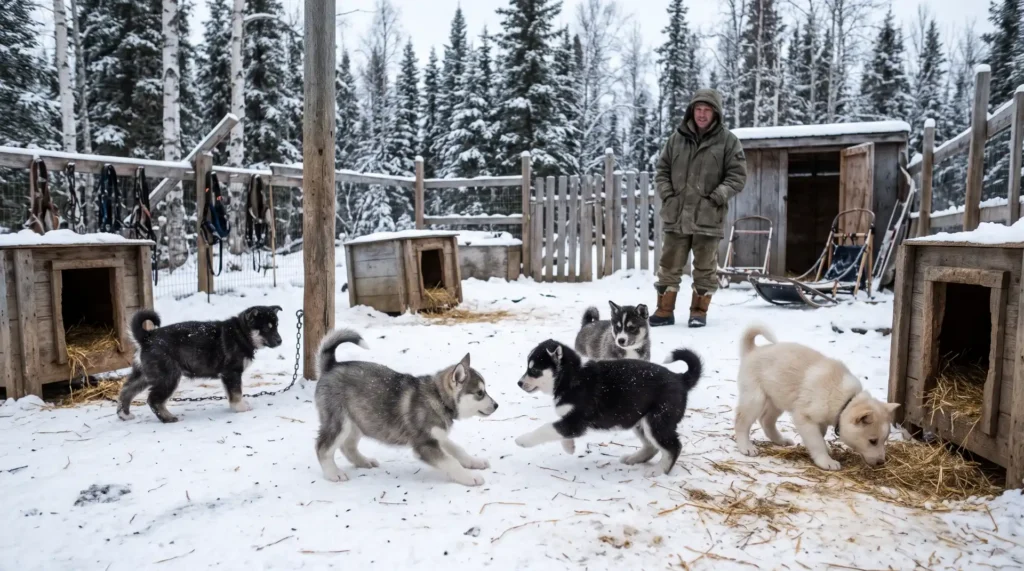
Raising sled dog puppies involves much more than providing food, shelter, and opportunities to play. These young dogs represent the future of a mushing team, and their early experiences can influence how they respond to unfamiliar environments, interact with other dogs, communicate with people, and eventually handle the physical and mental demands of working on a trail. A successful sled dog does not become dependable simply because it belongs to a working breed or comes from a kennel with experienced racing dogs. Good development requires patience, thoughtful handling, appropriate socialization, consistent training, and an understanding of each puppy’s individual personality.
Across the United States, sled dog kennels range from small recreational operations to established racing programs and professional adventure businesses. Although their goals may differ, responsible mushers share an important responsibility: giving puppies the opportunity to develop into healthy, confident, well-adjusted dogs before introducing demanding working activities. This process begins during the earliest stages of life and continues through adolescence and adulthood.
Alaskan Huskies, Siberian Huskies, and other dogs selected for mushing may demonstrate strong athletic abilities, enthusiasm for movement, and interest in working alongside other dogs. However, physical potential is only one part of a successful working animal. A puppy must also learn to trust its handler, recover from unfamiliar experiences, respond to basic cues, and remain comfortable around the sounds, equipment, people, and environmental conditions associated with a sled dog kennel.
Early development should never become a race to produce the strongest or fastest young dog. Instead, the objective is to build a solid foundation that protects physical health while encouraging curiosity, cooperation, and emotional stability. Understanding how to raise sled dog puppies properly helps mushers develop stronger relationships with their animals and creates better conditions for future training.
Understanding the Early Development of Sled Dog Puppies
The first several months of a puppy’s life are especially important because young dogs are learning how to interpret their surroundings. Their experiences with people, littermates, unfamiliar sounds, handling, and different environments gradually influence how they respond to the world as adults.
During this period, puppies develop physical coordination, communication skills, curiosity, and social awareness. They begin recognizing familiar people, exploring objects, testing their abilities, and learning how interactions with other dogs work. These experiences establish important foundations for later training.
For sled dog breeders and mushers, understanding these developmental stages makes it easier to introduce appropriate activities without overwhelming young animals.
The Importance of the First Few Weeks
Newborn puppies depend heavily on their mother for warmth, nutrition, protection, and early development. During the first weeks, their eyes and ears gradually become functional, their movements improve, and their awareness of their surroundings increases.
At this stage, the priority should be maintaining a clean, comfortable, and secure environment. Puppies need appropriate nursing opportunities, regular monitoring, and enough space to develop without unnecessary disturbance.
Responsible breeders also begin gentle handling when appropriate. Carefully touching a puppy’s paws, examining its body, and becoming familiar with its natural reactions can help prepare it for future veterinary examinations and routine care.
Handling must remain gentle and brief. Young puppies should never be treated as toys or passed continuously between visitors. Their mother must have opportunities to rest, and the litter needs a predictable environment.
As puppies become more mobile, their surroundings can gradually become more interesting. Soft surfaces, safe objects, and gentle environmental changes encourage exploration while allowing them to remain close to familiar companions.
Development Between Three and Eight Weeks
As puppies become more active, their interactions with littermates become increasingly valuable. They begin learning important social behaviors through play, including how to approach another dog, recognize boundaries, and respond when play becomes too rough.
These early interactions help puppies develop communication skills that will matter later when they live and work around larger groups of dogs.
Mushers should observe how individual puppies behave during these interactions. One puppy may regularly initiate play, while another prefers to observe before participating. Some puppies are naturally more adventurous, whereas others approach unfamiliar objects cautiously.
These differences do not automatically indicate which dog will become the best sled dog.
A quieter puppy may eventually become a dependable team member, while an energetic puppy may need additional work learning self-control. Individual temperament should be considered alongside health, physical development, and willingness to participate.
This is also an appropriate period for introducing safe household and kennel experiences. Puppies can gradually become familiar with ordinary human voices, gentle movement, different floor textures, and familiar outdoor sounds.
The objective is not to expose them to everything immediately. It is to help them discover that unfamiliar experiences can be safe and rewarding.
Early Socialization: Building Comfortable and Adaptable Dogs
Socialization is one of the most important parts of raising sled dog puppies. It involves helping young dogs become comfortable with different people, animals, environments, sounds, surfaces, and everyday situations.
For future working dogs, this process is particularly important because mushing environments can be busy and unpredictable. Puppies may eventually encounter barking teams, moving equipment, unfamiliar handlers, visitors, vehicles, changing weather, and crowded starting areas.
A dog that has experienced gradual, positive introductions to different situations may be better prepared to handle these experiences as an adult.
According to the American Veterinary Society of Animal Behavior, the first three months are a particularly important period for puppy socialization. The organization recommends safe, positive exposure during this developmental window rather than waiting until puppies have completed every vaccination.
Introducing Puppies to Different People
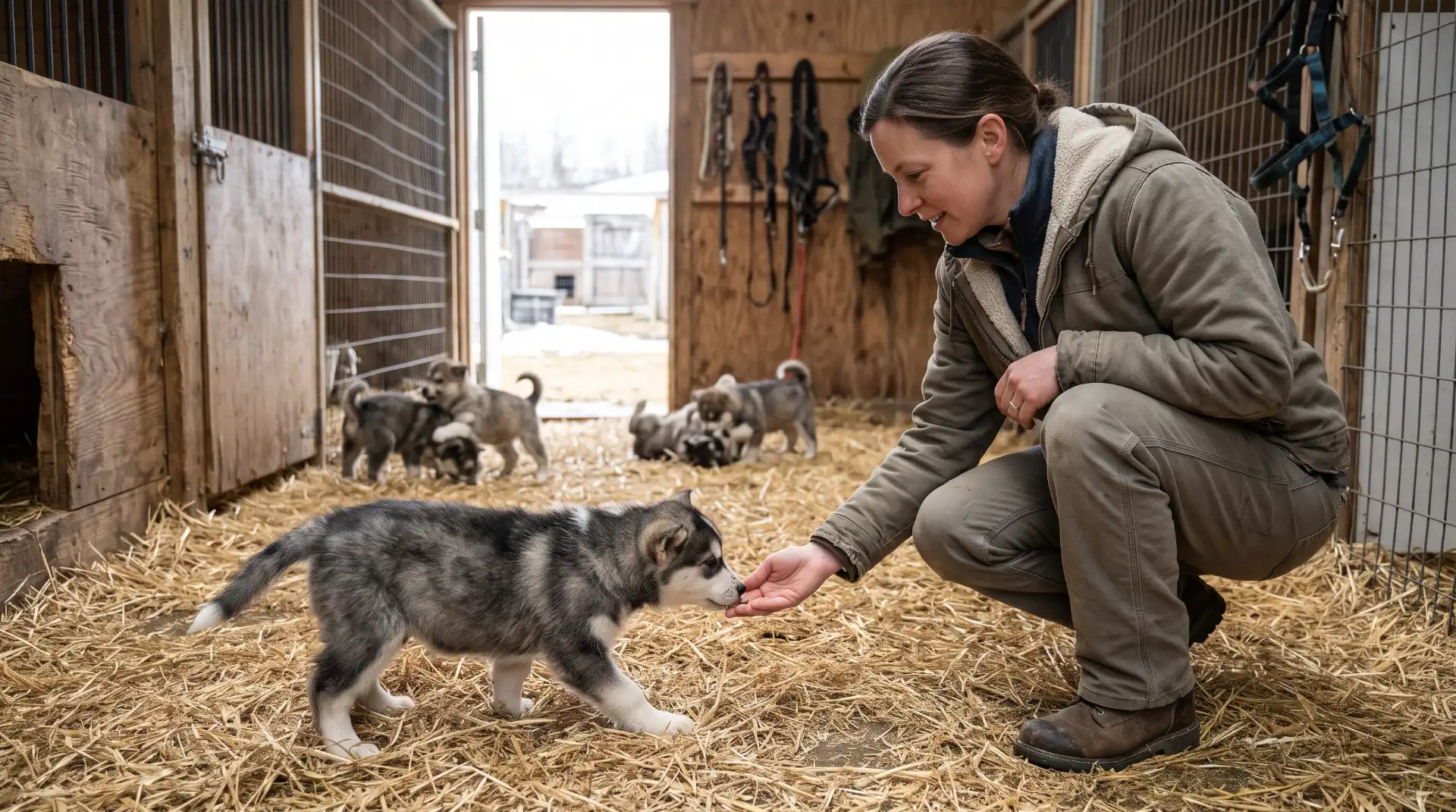
Sled dog puppies should become comfortable interacting with different types of people. This can include kennel employees, family members, experienced mushers, veterinary professionals, and responsible visitors.
However, introductions should be controlled. A puppy should not be surrounded by several strangers at once or forced to accept physical contact when it is uncomfortable.
Begin with one calm person approaching at a comfortable distance. Allow the puppy to investigate naturally. If it approaches, the person can offer a small treat or gentle interaction.
Over time, puppies can meet people wearing different clothing, hats, gloves, boots, and winter jackets. These details matter because working environments often involve heavy clothing that changes a person’s appearance.
For example, a puppy accustomed only to seeing handlers in ordinary indoor clothing might initially hesitate when approached by someone wearing a large insulated parka and snow goggles.
Gradual introductions help reduce the possibility of unfamiliar clothing becoming frightening.
Children should also be taught how to interact appropriately with puppies. They should avoid chasing, grabbing, shouting at, or disturbing sleeping dogs. Adult supervision is essential during every interaction.
Introducing Puppies to Other Dogs
Sled dogs usually spend considerable time around other canines, making healthy dog-to-dog communication an important developmental skill.
Puppies begin learning through interactions with their mother and littermates. Later, carefully selected adult dogs can provide additional opportunities to observe appropriate canine behavior.
Experienced dogs can demonstrate how to approach another animal, respond to social signals, and remain comfortable in a kennel environment.
However, not every adult dog is a suitable companion for a young puppy. Large, overly energetic, poorly socialized, or aggressive dogs can create frightening experiences.
Introductions should therefore involve calm, healthy, appropriately vaccinated dogs with suitable temperaments.
Supervised play sessions should remain relatively short, particularly when puppies are young. Mushers should watch for signs of discomfort, including repeated attempts to hide, tucked tails, trembling, excessive avoidance, or persistent attempts to escape an interaction.
A puppy that chooses not to play should be allowed to take a break.
The American Kennel Club provides additional guidance in its resource on supervising puppy play sessions, including the importance of watching canine body language and preventing overwhelming interactions.
Introducing New Sounds and Environmental Experiences
Sled dog kennels can be noisy places. Adult dogs may bark when visitors arrive, feeding containers may produce unfamiliar sounds, and equipment can create rattling or mechanical noises.
Young puppies benefit from gradually becoming familiar with these ordinary environmental experiences.
Mushers can introduce sounds such as distant barking, gentle equipment movement, vehicles passing nearby, and normal household activity.
The volume and distance should be adjusted according to the puppy’s reaction. There is no advantage to playing loud recordings or deliberately frightening a young dog.
For example, a puppy might first hear the sound of a vehicle from inside a comfortable kennel. Later, it may observe the vehicle from a safe distance before eventually becoming accustomed to riding in one.
The same approach can be used for harnesses, sled components, wheeled training equipment, and other objects associated with mushing.
Positive exposure teaches puppies that unfamiliar sounds and objects do not automatically represent danger.
Creating Positive Experiences With Different Surfaces
Future sled dogs may travel over packed snow, loose snow, ice, dirt, grass, gravel, and other outdoor surfaces.
Puppies can begin exploring safe surface variations during normal play and supervised movement.
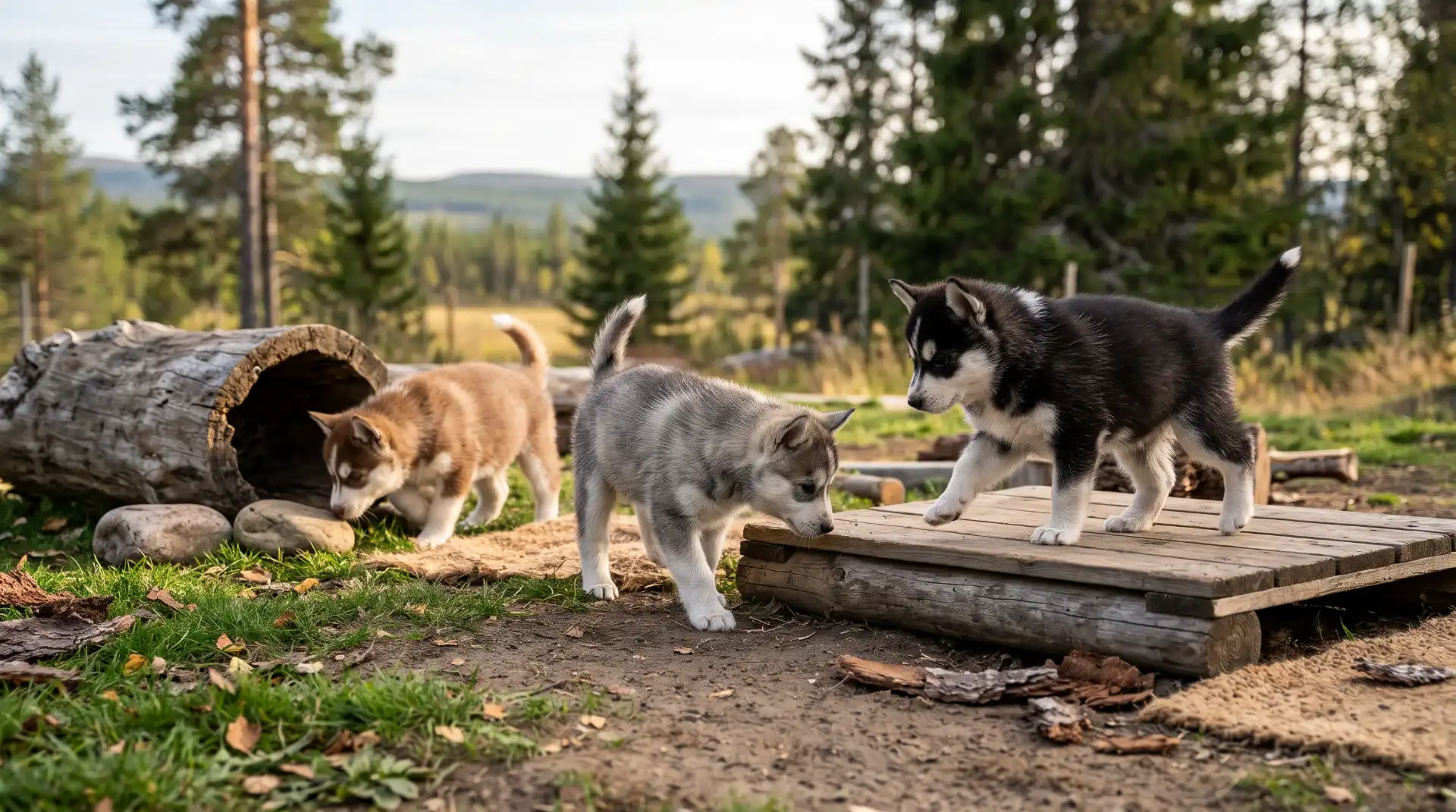
A young dog might investigate a rubber mat, walk across a wooden platform, explore short grass, or move over a clean section of packed dirt.
These activities encourage coordination and curiosity without requiring strenuous exercise.
Avoid slippery surfaces, sharp materials, unstable structures, and objects that could injure small paws.
The purpose is to build familiarity rather than test physical endurance.
Confidence Building: Helping Puppies Become Resilient
Confidence is an important quality in working dogs because mushing environments can involve unfamiliar situations, changing conditions, and unexpected distractions.
A confident dog is not necessarily fearless. Instead, it can investigate unfamiliar experiences, recover after mild uncertainty, and respond to familiar guidance.
Some puppies naturally approach new objects immediately. Others prefer to observe before moving closer. Both responses can be normal.
The musher’s responsibility is to create opportunities for gradual learning without forcing the puppy beyond its comfort level.
Encouraging Natural Curiosity
One effective way to build confidence is through supervised exploration.
Puppies can investigate safe objects, walk through simple play areas, discover new scents, and interact with different textures.
For example, a musher might place a few familiar toys near a new object, such as a small cardboard tunnel or low wooden platform. The puppy can approach and investigate at its own pace.
Food rewards and praise can encourage exploration, but the puppy should never be pushed onto an object it clearly wants to avoid.
Small successes gradually help young dogs become more comfortable with unfamiliar situations.
Teaching Puppies to Recover From Mild Surprises
Working dogs occasionally encounter unexpected experiences. A branch may move in the wind, a door may close, or another dog may bark suddenly.
Puppies should learn that these ordinary events do not require prolonged fear.
When a puppy becomes uncertain, the handler should remain calm and give it room to recover. If the puppy chooses to investigate again, gentle praise can reinforce that decision.
Repeatedly exposing a frightened puppy to the same experience at an overwhelming intensity can make the fear worse.
A better approach is to reduce the difficulty. Increase the distance, lower the noise, or return to a familiar activity before trying again.
This gradual method encourages emotional recovery rather than avoidance.
Developing Independence Without Creating Anxiety
Sled dog puppies need to develop confidence around people while also learning to spend short periods independently.
A puppy that becomes distressed whenever its handler moves away may struggle with ordinary kennel routines, veterinary visits, or future working arrangements.
Independence should be introduced gradually.
Start with brief moments in a familiar, comfortable enclosure while the handler remains nearby. Reward calm behavior and gradually increase the duration when the puppy is comfortable.
Provide safe toys, comfortable bedding, and appropriate opportunities for rest.
Puppies should not be left to cry for extended periods as a training strategy. Persistent distress may indicate that the experience is too difficult or that the puppy needs additional reassurance.
The goal is to teach that temporary separation is manageable, not to make the puppy feel abandoned.
Building Confidence Through Small Challenges
Simple enrichment activities can help young dogs develop problem-solving abilities.
A puppy might search for a few pieces of food scattered across a clean mat, investigate a shallow cardboard box, or follow a familiar handler through a simple obstacle-free route.
These activities encourage exploration and independent decision-making.
Challenges should match the puppy’s age and physical abilities. Avoid high jumps, unstable climbing equipment, steep obstacles, and activities that place unnecessary stress on developing joints.
Confidence grows through repeated successful experiences, not through physical difficulty.
Basic Training for Sled Dog Puppies
Although serious sled training should wait until a dog is physically mature enough for the activity, basic education can begin during puppyhood. Young dogs are capable of learning simple behaviors through repetition, positive reinforcement, and consistent communication.
Early training helps establish a relationship between the puppy and its handler. It also creates useful habits that will eventually make kennel management, veterinary care, transportation, and team training easier.
The most effective approach is to keep lessons short, enjoyable, and appropriate for the puppy’s developmental stage.
Teaching a Reliable Name Response
One of the first things a puppy should learn is to recognize its name.
A reliable name response helps handlers gain the puppy’s attention during feeding, play, grooming, and everyday kennel activities.
Begin in a quiet environment with minimal distractions. Say the puppy’s name once in a friendly voice. When it looks toward you, immediately reward the response with praise, a small treat, or a brief play session.
Repeat the exercise during different parts of the day.
As the puppy becomes more familiar with the name, gradually practice in slightly more distracting environments. For example, a musher can call the puppy while it is exploring a familiar outdoor area.
Avoid repeatedly shouting the name when the puppy is distracted. Instead, make the exercise easier by reducing competing distractions and rewarding successful responses.
A puppy should associate its name with positive attention rather than punishment.
Teaching Come When Called
Recall is among the most useful behaviors a sled dog can learn.
Even dogs that will eventually work in harness need to respond when their handlers call them. Recall can make everyday management safer, particularly when puppies are moving around kennels or participating in supervised outdoor activities.
Start indoors or within a secure enclosure.
Move a short distance away, crouch slightly, and use a consistent recall word such as “come.” When the puppy approaches, reward it immediately.
The reward should be meaningful. Some puppies prefer food, while others respond more enthusiastically to toys or praise.
As the puppy improves, practice from different distances and locations.
Do not use recall exclusively when an enjoyable activity is about to end. If the puppy learns that coming to its handler always means being taken away from play, its willingness to respond may decrease.
Instead, occasionally call the puppy, reward it, and then allow it to return to its activity.
For future working dogs, a reliable recall provides an additional layer of control and helps reinforce communication between the animal and handler.
Teaching Sit, Down, and Wait
Basic obedience creates useful communication patterns that can be applied throughout a dog’s life.
Sit is a convenient behavior for feeding routines, greeting visitors, and preparing for handling.
Down can encourage a puppy to settle in a comfortable location.
Wait helps teach patience before entering a gate, receiving food, or moving through a doorway.
These behaviors should be introduced gradually.
To teach sit, hold a small treat near the puppy’s nose and slowly move it upward and slightly backward. Many puppies naturally lower their hindquarters while following the movement. When the puppy sits, provide the reward.
Once the behavior becomes familiar, introduce the verbal cue.
For wait, begin with very short pauses. Reward the puppy for remaining in position before gradually increasing the duration.
Avoid demanding prolonged obedience from young puppies. Their attention spans are limited, and frequent breaks help prevent frustration.
Introducing Leash Walking
Leash training is useful even for dogs that will eventually spend much of their working lives in harness.
Sled dogs may need to travel between kennel areas, visit veterinary facilities, participate in public events, or walk safely around vehicles.
Begin by allowing the puppy to investigate a properly fitted, lightweight collar or harness.
The equipment should not restrict movement or create discomfort. Once the puppy appears comfortable, attach a lightweight leash and allow it to move around a familiar, safe area under supervision.
Reward the puppy for walking near the handler and responding to gentle guidance.
Avoid pulling continuously on the leash. If the puppy becomes distracted, encourage it to return through praise or a food reward.
Short sessions are usually sufficient at first.
Over time, the puppy can become familiar with walking on different safe surfaces and responding to gentle changes in direction.
Learning Kennel Manners and Handling
A future sled dog must become comfortable with routine care.
Handlers may need to examine paws, inspect ears, check teeth, brush coats, apply veterinary treatments, and prepare dogs for transportation.
These activities should be introduced through gentle handling exercises.
For example, a musher can briefly touch a puppy’s paw, reward calm behavior, and then allow the puppy to return to play.
Later, the handler can gradually become comfortable examining individual toes and nails.
The same approach applies to ears, shoulders, legs, and other body areas.
Short handling exercises are more effective than holding a struggling puppy in place for an extended period.
It is also useful to teach puppies to stand comfortably on a nonslip surface while being examined.
Positive handling experiences can make routine veterinary care less stressful as the dog grows older.
Introducing Sled Dog Equipment Without Rushing Training
One of the most exciting moments for a musher is introducing a young dog to equipment associated with mushing.
Harnesses, ganglines, sleds, carts, and other training tools eventually become familiar parts of a working dog’s environment.
However, puppies should not be expected to pull equipment simply because they show enthusiasm for running or playing.
Early exposure should focus on familiarity rather than physical performance.
Introducing the Harness
A properly fitted harness should be comfortable and appropriate for the individual dog’s body shape.
During early introductions, allow the puppy to investigate the harness while it is lying on the ground.
Place a few treats nearby and let the puppy approach naturally.
Once the equipment becomes familiar, the musher can briefly place it on the puppy without attaching any pulling equipment.
Reward relaxed behavior and remove the harness before the puppy becomes uncomfortable.
Gradually increase the time spent wearing it as the dog matures and demonstrates acceptance.
A harness that rubs against the shoulders, restricts movement, or places pressure in the wrong areas should never be used.
Becoming Familiar With Sleds and Carts
Sled dogs encounter equipment that can move, rattle, scrape, and produce unfamiliar sounds.
Puppies can gradually become accustomed to these objects without being connected to them.
A stationary sled or cart can be placed at a safe distance from the puppy’s play area. Allow the young dog to observe and investigate it.
The musher can later move the equipment gently while the puppy watches from a comfortable distance.
The purpose is to create familiarity with the sight and sound of mushing equipment.
There is no need to make a puppy run alongside a moving sled or pull a cart during its early developmental period.
Learning the Sounds and Commands of Mushing
Traditional mushing uses recognizable verbal commands to communicate with working dogs.
Some commonly used commands include:
-
Hike: A cue to begin moving forward.
-
Whoa: A cue to stop.
-
Gee: A directional cue for turning right.
-
Haw: A directional cue for turning left.
-
On by: A cue to continue past a distraction or another team.
Puppies can gradually become familiar with these words through simple, low-pressure activities.
For example, a handler might use a consistent forward cue during a short walk or introduce directional words while guiding a puppy around a familiar open area.
At this stage, the objective is to establish consistent associations rather than demand complicated trail responses.
The musher should use the same words consistently. Changing the meaning of a command or using several different expressions for the same behavior can create confusion later.
As the dog matures, these cues can become part of more structured training.
For additional information about the commands, equipment, and progression involved in mushing, see Outlaw Ridge’s Dog Sledding 101: Dog Sledding Basics, Gear, Training and Safety.
Understanding the Physical Development of Future Working Dogs
A puppy’s enthusiasm for running does not mean its body is ready for demanding exercise.
Young dogs are still developing muscles, bones, joints, coordination, and cardiovascular capacity. Their exercise requirements change as they grow.
This is particularly important for sled dogs because adult mushing can involve sustained movement, pulling forces, uneven terrain, and challenging environmental conditions.
A responsible training program must recognize the difference between developing coordination and building working endurance.
Why Growing Puppies Need Appropriate Exercise
Puppies benefit from regular movement, but their activity should be suited to their age and individual development.
Natural play, short exploratory walks, gentle movement, and supervised interactions provide opportunities to develop coordination and confidence.
Avoid repetitive high-impact activities, forced running, heavy pulling, and long-distance conditioning.
A puppy that enthusiastically follows an older dog should not automatically be allowed to match the adult animal’s workload.
The older dog may have substantially greater endurance and physical maturity.
Mushers should also avoid using a single age as a universal starting point for pulling work. Physical readiness varies according to the dog’s size, development, health, and individual circumstances.
A veterinarian familiar with working dogs can help determine when more demanding exercise is appropriate.
Developing Strength Through Natural Movement
Before beginning structured conditioning, puppies need opportunities to move naturally.
Walking over safe ground, exploring gentle slopes, playing with littermates, and changing direction during supervised activity all contribute to physical development.
These activities help puppies learn how to control their bodies.
They also provide opportunities for handlers to observe coordination and movement.
A puppy that consistently limps, avoids using a leg, or appears uncomfortable after ordinary activity should be examined by a veterinarian.
Training should never continue through signs of pain.
Managing Exercise During Different Seasons
In many parts of the United States, sled dog kennels must adapt their routines to changing seasonal conditions.
Alaska and other northern regions may provide long winter training opportunities, while warmer areas require careful scheduling around temperature and humidity.
Puppies should not be taken into extreme cold or excessive heat simply to become accustomed to difficult conditions.
Their bodies are still developing, and their ability to regulate temperature may differ from that of healthy adult working dogs.
During warmer months, supervised outdoor activity should take place during cooler periods, with access to shade and fresh water.
During winter, puppies need comfortable shelter, appropriate bedding, and protection from prolonged exposure to severe weather.
The important principle is to make environmental experiences gradual and safe.
Nutrition and Feeding: Supporting Healthy Puppy Development
Proper nutrition is essential when raising sled dog puppies.
Young dogs require balanced diets that support growth, immune function, muscle development, and normal physical activity.
Although adult sled dogs may require substantial energy intake during demanding work, puppies should not automatically receive the same feeding program.
Their nutritional needs are different.
Choosing Appropriate Puppy Food
A complete and balanced commercial puppy food formulated for the dog’s expected adult size is a practical starting point for many owners.
The food should provide appropriate levels of protein, fat, vitamins, minerals, and other nutrients required for development.
For puppies expected to become medium or large working dogs, selecting an appropriate growth formula is particularly important.
Rapid growth is not necessarily desirable. Feeding excessive calories or adding unnecessary supplements can contribute to nutritional imbalances.
Owners should work with their veterinarian to choose an appropriate diet based on age, body condition, expected adult size, and health.
Establishing a Consistent Feeding Schedule
Young puppies generally benefit from several appropriately sized meals throughout the day.
As they grow, feeding frequency can gradually change according to veterinary recommendations and individual needs.
Consistent meal times help establish predictable routines.
They also allow handlers to monitor appetite and notice changes in eating behavior.
Food should be stored properly to prevent contamination and spoilage. Clean bowls and fresh drinking water should always be available.
A puppy that suddenly stops eating, develops persistent digestive problems, or shows unusual changes in weight should receive veterinary attention.
Avoiding Unnecessary Supplements
Some mushers are familiar with high-energy feeding programs used for adult endurance dogs.
However, supplements designed for heavily conditioned racing animals should not automatically be given to puppies.
Calcium, vitamins, oils, and other supplements can cause problems when provided in inappropriate amounts.
A balanced growth diet should generally supply the nutrients needed by a healthy puppy.
Any additional supplementation should be discussed with a veterinarian.
Monitoring Body Condition
Weight alone does not provide a complete picture of puppy health.
Handlers should observe body condition, energy, coat quality, appetite, and general development.
A puppy should develop steadily without becoming excessively thin or overweight.
Maintaining a healthy body condition also helps protect developing joints.
Regular veterinary examinations provide an opportunity to review growth and adjust feeding recommendations.
Veterinary Care, Vaccination, and Preventive Health
A successful sled dog development program begins with good preventive veterinary care.
Puppies need appropriate vaccinations, parasite control, health examinations, and monitoring as they grow.
Because they will eventually live and train around other dogs, maintaining a healthy kennel environment is particularly important.
Establishing a Veterinary Schedule
A veterinarian should examine puppies during their early development and establish an appropriate preventive-care schedule.
The schedule may include physical examinations, vaccinations, deworming, parasite prevention, and discussions about nutrition.
Vaccination recommendations vary depending on the puppy’s age, health, location, lifestyle, and exposure risks.
Common core vaccinations for dogs include protection against canine distemper, adenovirus, parvovirus, and rabies, with timing determined by veterinary guidance and applicable state requirements.
Working kennels may also need to discuss additional vaccines based on local disease risks and the number of dogs housed together.
Mushers should maintain accurate health records for every puppy.
These records make it easier to track vaccination dates, treatments, growth, and medical concerns.
Protecting Puppies From Infectious Diseases
Kennel environments require careful hygiene because puppies may be exposed to pathogens through contaminated surfaces, feces, shared equipment, or contact with infected animals.
Canine parvovirus is a particularly serious concern for young dogs.
Handlers should maintain clean living spaces, promptly remove waste, disinfect appropriate surfaces, and avoid unnecessary contact with unknown or unvaccinated dogs.
At the same time, protecting puppies from disease does not mean eliminating every opportunity for socialization.
The American Veterinary Society of Animal Behavior supports safe, controlled socialization during early development, including before completion of the vaccination series. The appropriate balance should be discussed with a veterinarian who understands local disease conditions.
avsab.org+1
The American Kennel Club’s puppy socialization guide also provides practical suggestions for introducing puppies to people, environments, sounds, and supervised training experiences.
Monitoring Common Puppy Health Concerns
Mushers should become familiar with changes that may indicate a health problem.
These include persistent diarrhea, vomiting, coughing, nasal discharge, unusual tiredness, poor appetite, limping, and changes in behavior.
Puppies can become dehydrated more quickly than healthy adult dogs, making prompt attention important when digestive problems develop.
Parasites are another concern in kennel environments. Regular fecal examinations and veterinarian-directed parasite prevention help protect individual dogs and the wider group.
A puppy should never be pushed through a training session when it appears unwell.
Early veterinary attention can prevent minor concerns from developing into more serious problems.
Developing Social Skills Within a Sled Dog Team
Living around other dogs is a normal part of life for many sled dogs.
However, being surrounded by a group does not automatically make a puppy socially confident.
Young dogs still need to learn how to interact appropriately, recognize boundaries, and remain comfortable in a shared environment.
A structured approach can help establish positive relationships within the kennel.
Learning From Experienced Adult Dogs
Calm, well-socialized adult dogs can provide useful examples for younger animals.
Puppies may observe how experienced dogs respond to handlers, move through kennel areas, settle after activity, and react to familiar routines.
This kind of learning can be especially useful when introducing young dogs to the general rhythm of mushing life.
However, adult dogs should be selected carefully.
A puppy should not be placed beside an unfamiliar dog simply because the adult has experience in a working team.
The temperament of both animals matters.
Introductions should be supervised, and the puppy should always have the opportunity to withdraw.
Understanding Individual Temperaments
Not every puppy develops the same social preferences.
Some enjoy frequent interaction, while others prefer quieter surroundings.
One puppy might enthusiastically approach unfamiliar people, while another needs additional time before becoming comfortable.
These differences should influence how the musher manages introductions and training.
Forcing every puppy to behave identically can create unnecessary stress.
A well-adjusted working dog does not need to be the most outgoing animal in the kennel. It needs to be comfortable, healthy, responsive, and able to participate appropriately in its environment.
Preventing Bullying and Resource Competition
Feeding, toys, sleeping areas, and access to attention can sometimes create competition between puppies.
Mushers should supervise group activities and provide enough resources to reduce unnecessary conflict.
Food should be offered in a way that allows puppies to eat comfortably without being repeatedly disturbed by littermates.
Toys should be suitable for the size and chewing habits of the animals.
If a puppy repeatedly intimidates another dog or guards resources aggressively, the situation should be managed rather than ignored.
Persistent behavior concerns may require guidance from a qualified trainer or veterinary behavior professional.
Preparing Puppies for Their Future Roles in Mushing
As sled dog puppies mature, their development gradually shifts from general socialization and basic education toward more specialized preparation.
This does not mean every puppy should immediately begin pulling equipment or learning advanced trail commands. Instead, the musher should begin observing individual abilities and introducing age-appropriate experiences that may eventually support working activities.
A successful mushing team depends on several different types of dogs, and not every animal needs to perform the same role.
Understanding the Different Positions in a Sled Dog Team
Traditional sled dog teams generally include lead dogs, swing dogs, team dogs, and wheel dogs.
Each position has different responsibilities.
Lead dogs run at the front and respond to directional commands. They need confidence, communication skills, and the ability to maintain focus when encountering unfamiliar trail conditions.
Swing dogs run directly behind the leaders. They help guide the team through turns and maintain organized movement.
Team dogs provide much of the pulling power and contribute to maintaining a consistent pace.
Wheel dogs run closest to the sled. They often need strength, composure, and the ability to work comfortably near the equipment.
Young dogs can gradually become familiar with these different positions as they mature. However, assigning a puppy a future role too early can create unrealistic expectations.
A puppy that appears independent and curious might eventually become a suitable lead dog, but those qualities need to be evaluated over time.
Likewise, a quieter dog may become an excellent team member without ever needing to lead.
Observing Natural Strengths and Preferences
Mushers should observe how puppies respond to different situations.
Some dogs demonstrate strong interest in exploring new environments. Others show enthusiasm for physical play or naturally maintain close contact with familiar companions.
A puppy might display excellent focus during simple training exercises but become distracted when several dogs are moving nearby.
Another might be physically energetic but need more time to develop confidence around unfamiliar equipment.
These observations can help guide future training decisions.
It is useful to maintain individual development notes for every puppy. Records can include health information, temperament observations, training progress, social experiences, and responses to new situations.
Over time, these notes provide a more complete picture of each dog’s strengths.
Introducing Young Dogs to Experienced Team Members
As dogs mature, controlled exposure to experienced working dogs can help them understand the routines of an established team.
For example, a developing dog may observe older dogs preparing for training, responding to familiar commands, and settling after a session.
Eventually, when the individual dog is physically ready, a musher may introduce it to carefully supervised team activities.
Pairing a suitable young dog with an experienced, calm partner can provide useful opportunities for learning.
The older dog may demonstrate appropriate movement, attention, and responses to the handler.
Nevertheless, the musher must remain responsible for managing the exercise. An experienced partner cannot replace proper supervision, physical conditioning, or individual training.
For more information about how this progression works, read Outlaw Ridge’s article on Training Beside an Experienced Leader in a Sled Dog Team.
Understanding When a Dog Is Ready for Structured Training
There is no single age that guarantees a puppy is ready for demanding sled work.
Readiness depends on several factors, including skeletal development, body condition, general health, behavior, and the physical requirements of the intended activity.
A musher should consult a veterinarian before introducing structured pulling or sustained conditioning.
Even when a young dog appears physically strong, its developing body may not be ready for repetitive workload.
The transition should be gradual and individualized.
Early preparation can include short walks, familiarization with equipment, basic commands, controlled social experiences, and appropriate enrichment.
More demanding activities should be introduced only when the dog is ready.
Mental Stimulation and Enrichment for Growing Sled Dogs
Physical development is only one part of preparing future working dogs.
Mental stimulation helps puppies explore their environment, develop problem-solving abilities, and remain engaged with their handlers.
Sled dogs are often intelligent, active animals that benefit from structured activities. Without suitable enrichment, puppies may become bored or develop undesirable behaviors.
Mental activities do not need to be complicated or expensive.
Simple games can provide meaningful opportunities for learning.
Using Scent Games to Encourage Exploration
Dogs rely heavily on their sense of smell.
Scent games allow puppies to investigate their surroundings while using their natural abilities.
One simple exercise involves placing a few small pieces of puppy-safe food in easy-to-find locations around a clean, familiar area.
Allow the puppy to search for the rewards.
As the dog becomes more experienced, the activity can become slightly more challenging by using additional hiding locations or introducing different safe surfaces.
The objective is to encourage curiosity rather than create frustration.
Food Puzzles and Problem-Solving Activities
Food puzzles can provide another form of mental enrichment.
A puppy might investigate a suitable puzzle feeder, move a simple toy to release a treat, or explore a supervised cardboard box containing a familiar toy.
These activities encourage problem-solving and independent exploration.
All objects should be appropriate for the puppy’s size and chewing behavior.
Avoid toys with small detachable components or materials that could be swallowed.
Food enrichment should also be considered as part of the puppy’s normal daily nutrition rather than an unlimited additional source of calories.
Learning Through Play
Play is an important part of puppy development.
It helps young dogs practice movement, communication, coordination, and appropriate social behavior.
Interactive games with handlers can also strengthen the relationship between people and puppies.
For example, a short game involving a soft toy can teach the puppy to approach, release an object, and return attention to the handler.
These activities can later support useful working behaviors such as attention, recall, and cooperation.
However, play should remain controlled and age-appropriate.
Avoid repetitive jumping, sudden high-impact movements, and overly rough games that could cause injury.
Providing Appropriate Rest Between Activities
Enrichment should never become a continuous training schedule.
Growing puppies require substantial rest.
A young dog that participates in several short activities throughout the day should also have opportunities to sleep and relax without interruption.
Overstimulation can lead to excessive excitement, difficulty settling, and reduced attention during training.
Mushers should recognize when a puppy has had enough activity.
A quiet resting area is just as important as an interesting play environment.
Preparing Sled Dog Puppies for Different Weather Conditions
Weather plays an important role in mushing, particularly in northern states where winter conditions can change quickly.
Future working dogs may eventually encounter freezing temperatures, snowfall, wind, wet conditions, and changing trail surfaces.
However, puppies should not be deliberately exposed to severe weather as a test of toughness.
Their ability to tolerate environmental conditions develops with age, health, physical condition, and appropriate acclimation.
Introducing Puppies to Cold Weather Safely
Sled dogs are commonly associated with winter, but puppies still need protection from excessive cold.
Young animals can lose body heat more quickly than healthy adult working dogs, particularly when they are small, wet, tired, or unable to reach suitable shelter.
During outdoor activities, handlers should monitor the puppy’s comfort and limit exposure according to the weather.
A puppy that shivers, becomes unusually inactive, repeatedly seeks warmth, or appears uncomfortable should be moved to a suitable protected environment.
Shelter should remain dry, clean, and protected from wind.
Bedding must be appropriate for the puppy’s age and behavior.
Understanding the Risks of Warm Weather
Warm weather can also create serious challenges for sled dogs.
Thick-coated dogs may be particularly vulnerable to overheating during physical activity.
Puppies should never be exercised intensely in hot or humid conditions.
Outdoor activities should take place during cooler periods, with access to shade and fresh drinking water.
Handlers should watch for excessive panting, weakness, drooling, disorientation, and unusual behavior.
Suspected heatstroke is an emergency requiring immediate veterinary attention.
Building Familiarity With Seasonal Changes
Rather than forcing puppies to tolerate extreme conditions, mushers can gradually introduce normal seasonal changes.
A puppy might experience gentle snowfall during a short supervised outdoor activity or explore a shaded grassy area during warmer weather.
These experiences provide environmental familiarity without unnecessary physical stress.
The priority should always be comfort, health, and safety.
Common Mistakes to Avoid When Raising Sled Dog Puppies
Even experienced mushers can make mistakes when developing young dogs.
The excitement of preparing a future team member sometimes encourages people to introduce activities too early or expect every puppy to progress at the same pace.
Recognizing common problems helps prevent unnecessary setbacks.
Starting Pulling Training Too Early
One of the most important mistakes to avoid is expecting puppies to perform physically demanding work before their bodies are ready.
A young dog may enthusiastically run beside an adult team, but enthusiasm does not demonstrate skeletal maturity or conditioning.
Premature pulling can place unnecessary stress on developing muscles and joints.
Early education should focus on socialization, confidence, coordination, basic obedience, and equipment familiarity.
Structured physical work should come later, with veterinary guidance.
Comparing Every Puppy to Its Littermates
Puppies develop at different rates.
One may respond quickly to commands, while another needs more repetition. One may enjoy meeting strangers, while another prefers familiar people.
These differences should not automatically be treated as problems.
Constant comparisons can lead handlers to push certain puppies unnecessarily.
Instead, progress should be measured against each puppy’s own development.
A dog that becomes more confident, responds more consistently, and recovers more quickly from unfamiliar experiences is making meaningful progress even if it develops differently from its littermates.
Using Punishment Instead of Positive Reinforcement
Harsh correction can damage trust and make puppies less willing to explore unfamiliar experiences.
Young dogs learn more effectively when desired behaviors are rewarded and training remains predictable.
Positive reinforcement involves rewarding behaviors the handler wants to encourage.
For example, when a puppy calmly approaches a harness, the handler can reward the interaction. When it responds to recall, it receives praise or a treat.
Unwanted behavior can often be managed through redirection, environmental changes, and prevention rather than intimidation.
Overloading Puppies With Social Experiences
Socialization is not about introducing as many experiences as possible in the shortest amount of time.
A puppy that is taken to crowded events, exposed to loud machinery, and introduced to unfamiliar dogs all in one afternoon may become overwhelmed.
Quality matters more than quantity.
Short, positive experiences allow puppies to process new information and recover before another challenge is introduced.
If a puppy becomes hesitant, reduce the intensity and return to a more comfortable activity.
Ignoring Signs of Fatigue or Stress
A puppy may initially participate enthusiastically but gradually become tired or overwhelmed.
Handlers should watch for changes in body language.
Repeated yawning, lip licking, turning away, hiding, trembling, and difficulty settling can indicate discomfort depending on the context.
Physical concerns such as limping, unusual breathing, and reduced activity also deserve attention.
Training should end when the puppy needs rest.
Neglecting Individual Attention
Living in a group kennel does not eliminate the need for individual interaction.
Every puppy benefits from spending some time with a handler without its littermates or other dogs.
Individual sessions make it easier to observe behavior, introduce basic training, and develop a strong relationship.
They also help identify concerns that might be overlooked during group activities.
Creating a Practical Puppy Development Routine
A consistent daily routine helps young sled dogs become familiar with the expectations of kennel life.
The schedule should be flexible enough to accommodate different developmental stages, weather conditions, health needs, and individual personalities.
A puppy’s daily routine should balance nutrition, sleep, social interaction, enrichment, gentle exercise, and appropriate training.
Morning Activities
The morning can begin with a health and behavior check.
Handlers should observe whether puppies appear alert, comfortable, and interested in food.
Food and fresh water should be provided according to the established feeding schedule.
Afterward, puppies can participate in a short supervised play period.
This may include exploring a familiar outdoor area, interacting with littermates, or practicing a simple response to their names.
Midday Learning and Enrichment
A midday session can introduce a new but manageable experience.
For example, the puppy might investigate a harness, practice walking on a leash, or participate in a short scent game.
Only one or two new challenges should be introduced at a time.
Afterward, the puppy should have access to a comfortable resting area.
Afternoon Socialization
The afternoon can provide opportunities for carefully supervised interaction with people or suitable adult dogs.
Handlers might practice gentle paw handling, introduce a new surface, or allow the puppy to observe ordinary kennel activities.
The objective is to reinforce confidence without creating unnecessary excitement.
Evening Rest and Monitoring
The evening routine should include feeding as appropriate, a final opportunity for supervised movement, and a general health check.
Handlers can review the puppy’s behavior and record any changes.
If a puppy has shown unusual hesitation, digestive problems, or reduced activity, these observations should be documented and discussed with a veterinarian when appropriate.
Consistency is valuable, but routines should never become rigid at the expense of the puppy’s needs.
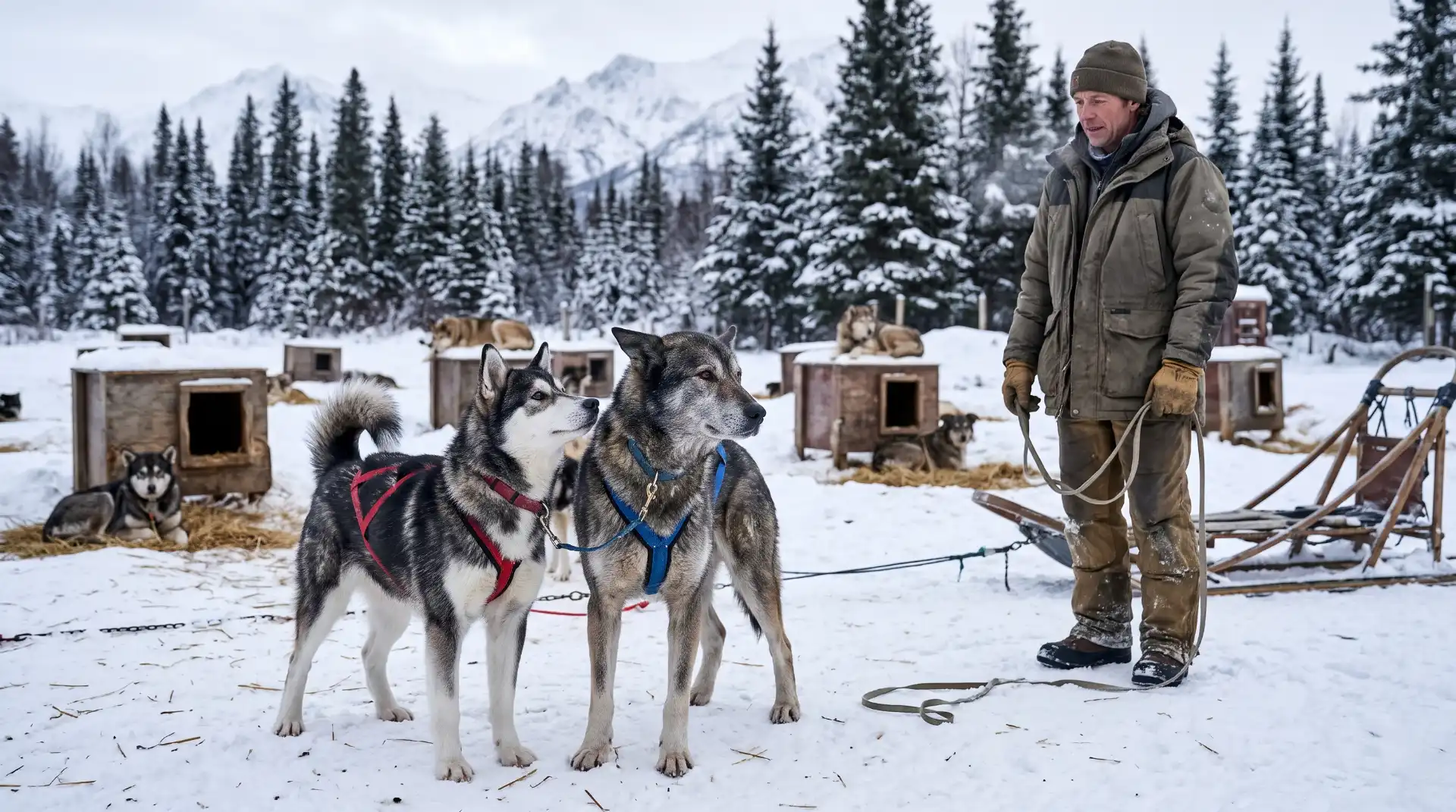
The Role of Responsible Breeders in Raising Future Sled Dogs
The development of a future sled dog begins before the puppy enters its new home or working kennel.
Responsible breeding programs consider temperament, health, physical characteristics, and the suitability of parent dogs for their intended roles.
Although genetics influence certain behavioral and physical traits, early care and training also play important roles in determining how a puppy develops.
Selecting Healthy Parent Dogs
Breeding decisions should consider the health and temperament of both parents.
Mushers should look beyond physical appearance and racing performance when evaluating potential breeding animals.
Important considerations include:
-
General physical health and veterinary history.
-
Appropriate temperament around people and other dogs.
-
Sound movement and physical structure.
-
Family history of inherited conditions.
-
Working ability and suitability for the intended activity.
Health screening recommendations depend on the dogs’ breed background and individual risks. Responsible breeders should discuss appropriate genetic and orthopedic testing with veterinary professionals.
A successful breeding program should prioritize healthy dogs rather than producing puppies simply to increase kennel numbers.
Supporting the Mother During Pregnancy and Nursing
The mother dog’s health directly affects the early environment in which puppies develop.
Pregnant and nursing dogs need appropriate nutrition, veterinary monitoring, clean living conditions, and a comfortable place to rest.
The mother should have access to a quiet whelping area where she can care for her puppies without unnecessary interruptions.
Handlers should monitor nursing behavior, maternal condition, and puppy development.
If a puppy struggles to nurse, fails to gain weight appropriately, or appears unusually weak, veterinary attention is important.
Choosing the Right Homes for Puppies
Not every puppy needs to become a competitive sled dog.
Some may eventually become recreational mushing companions, while others may be better suited to active household environments.
Responsible breeders and mushers should evaluate the individual dog’s temperament, health, and preferences before deciding its future.
Potential working-dog owners should understand the responsibilities involved in maintaining an active northern breed.
These dogs may require considerable exercise, mental stimulation, appropriate shelter, veterinary care, and ongoing social interaction.
Finding a suitable environment is more important than placing every puppy into a working program.
The Importance of Continuing Education as Puppies Mature
Puppy development does not end when a dog learns basic obedience or becomes comfortable wearing a harness.
Training continues throughout adolescence and adulthood.
As dogs mature, their physical abilities, confidence, attention, and working preferences become clearer.
Mushers should continue introducing appropriate new experiences while maintaining the behaviors established during puppyhood.
Moving From Basic Obedience to Working Skills
Once a dog is physically and mentally ready, basic obedience can become part of more structured mushing education.
A developing dog may begin practicing familiar commands in controlled environments before progressing to more complex situations.
The musher can gradually introduce:
-
Reliable responses to directional cues.
-
Calm behavior around other working dogs.
-
Comfortable movement in appropriate equipment.
-
Consistent attention to the handler.
-
Appropriate behavior during starts and stops.
-
Focus when encountering ordinary distractions.
These skills should be introduced gradually.
A dog that performs well in a quiet training area may need additional experience before responding reliably in a busy working environment.
Maintaining Socialization Throughout Adulthood
Socialization should continue after puppyhood.
Adult dogs still benefit from positive experiences with different people, environments, sounds, and situations.
For working dogs, ongoing exposure can help maintain adaptability when kennel routines change or new dogs join the team.
Mushers should continue observing individual reactions rather than assuming that an experienced sled dog will automatically feel comfortable in every situation.
A confident dog still needs appropriate management, rest, and reassurance.
Recognizing When a Dog Is Better Suited to Another Role
Not every dog will become a competitive athlete or enjoy the same type of work.
Some dogs may prefer recreational activity, while others may be more comfortable as companions.
A dog that dislikes harness work should not automatically be treated as a training failure.
Its health, temperament, motivation, and comfort should be considered before deciding whether to continue working toward a particular role.
Responsible mushing means recognizing individual differences and respecting what each dog can comfortably contribute.
Building a Strong Relationship Between Mushers and Young Dogs
One of the most valuable results of raising sled dog puppies properly is the relationship that develops between the animals and their handlers.
Mushing depends on communication, trust, and cooperation.
A dog that feels comfortable around its musher is more likely to engage willingly in training and respond positively to familiar routines.
That relationship is built through ordinary daily interactions rather than occasional training sessions alone.
Feeding, grooming, supervised play, veterinary care, and time spent exploring together all contribute to familiarity.
Handlers should learn to recognize individual body language and behavioral changes.
For example, a puppy that usually approaches a familiar person but suddenly begins avoiding contact may be experiencing discomfort, fear, or a health problem.
Recognizing these changes allows the musher to respond appropriately.
Consistency is equally important.
Using familiar commands, maintaining predictable routines, and rewarding desired behavior help young dogs understand what is expected.
For additional insight into the responsibilities and daily routines involved in caring for a working team, see Outlaw Ridge’s article, Behind the Scenes: A Day in the Life of a Musher.
The strongest relationships develop when handlers understand that working dogs are individual animals with their own personalities, preferences, and limitations.
Frequently Asked Questions About Raising Sled Dog Puppies
What Is the Best Age to Start Socializing Sled Dog Puppies?
Socialization begins during the earliest stages of puppy development. The first three months are particularly important for introducing young dogs to people, sounds, surfaces, animals, and different environments.
These experiences should be positive, controlled, and appropriate for the puppy’s health and developmental stage.
Socialization should continue throughout adolescence and adulthood.
When Can Sled Dog Puppies Start Training?
Basic training can begin during puppyhood through simple activities such as name recognition, recall, leash familiarization, handling exercises, and basic obedience.
However, demanding physical training and pulling activities should wait until the dog is physically mature enough.
The appropriate starting point depends on individual development, health, and veterinary guidance.
How Do You Build Confidence in a Sled Dog Puppy?
Confidence develops through repeated positive experiences.
Allow puppies to investigate unfamiliar objects, explore safe environments, meet suitable people and dogs, and participate in simple problem-solving activities.
Never force a frightened puppy into an unfamiliar situation.
Gradual exposure, encouragement, and appropriate rewards help build confidence over time.
Should Sled Dog Puppies Be Raised Around Adult Dogs?
Yes, carefully supervised interactions with suitable adult dogs can provide valuable social experiences.
Calm, healthy, well-socialized adults may demonstrate appropriate behavior and help puppies become comfortable in a kennel environment.
However, introductions should always consider temperament, health, size, and individual comfort.
What Commands Should Future Sled Dogs Learn First?
Useful early behaviors include responding to their names, coming when called, sitting, waiting, walking comfortably on a leash, and cooperating during handling.
As dogs mature, they can gradually learn traditional mushing commands such as Hike, Whoa, Gee, and Haw.
Consistency is important because dogs need to associate each command with a recognizable behavior.
Do All Sled Dog Puppies Become Working Dogs?
No. Not every puppy will become a competitive or recreational sled dog.
Individual temperament, physical health, motivation, and personal preferences influence suitability for working activities.
Some dogs may become excellent household companions instead.
Responsible breeders and mushers should recognize these differences and provide appropriate opportunities for every animal.
How Much Exercise Do Growing Sled Dog Puppies Need?
Puppies need regular opportunities for natural movement, play, and exploration, but they should not be subjected to demanding endurance training.
Exercise should be appropriate for age, health, and development.
Forced running, heavy pulling, repetitive jumping, and long-distance conditioning should be avoided until the dog is physically ready.
A veterinarian familiar with canine growth and working dogs can provide individualized guidance.
What Should Sled Dog Puppies Eat?
Puppies should receive a complete and balanced diet formulated for growth and appropriate for their expected adult size.
Their nutritional requirements differ from those of adult racing dogs.
Feeding amounts and frequency should be adjusted according to growth, body condition, activity, and veterinary recommendations.
Can Sled Dog Puppies Live in Warm States?
Yes, sled dog breeds can live in different parts of the United States, provided their owners understand their environmental needs.
Warm climates require additional attention to exercise timing, shade, hydration, ventilation, and overheating prevention.
These dogs should never be forced to perform strenuous activities during hot or humid conditions.
What Is the Most Important Part of Raising a Future Sled Dog?
The most important foundation is a combination of good health, positive socialization, confidence, appropriate training, and a trusting relationship with the handler.
Physical ability alone does not create a successful working dog.
A dependable sled dog must also be comfortable in its environment, responsive to communication, and capable of participating without unnecessary stress.
Final Thoughts on Raising Sled Dog Puppies
Raising sled dog puppies is a long-term responsibility that begins with careful early care and continues throughout the animal’s development.
The first months provide valuable opportunities to establish positive relationships with people, develop healthy interactions with other dogs, and introduce unfamiliar experiences in a safe and controlled manner.
These early experiences can influence how young dogs respond to the world as they mature.
Confidence building, basic obedience, gentle handling, appropriate nutrition, veterinary care, and mental enrichment all contribute to developing well-adjusted future working dogs.
However, preparing a puppy for mushing should never become a competition to see which animal can begin pulling first or cover the greatest distance at the youngest age.
Growing dogs need time to develop physically and mentally. Their individual abilities and limitations should guide every stage of preparation.
Some puppies may eventually become talented lead dogs, while others may contribute through strength, teamwork, or different working positions. Some may discover that they prefer life as companions rather than working animals.
All of these outcomes deserve respect.
For American mushers, responsible puppy development also means preparing for changing seasonal conditions, maintaining appropriate kennel standards, and ensuring that young dogs receive the veterinary attention and protection they need.
The best sled dog teams are not built through physical conditioning alone. They develop through years of consistent care, communication, and trust between dogs and the people who work with them.
Every experienced sled dog was once a curious puppy learning how to navigate its surroundings. By giving the next generation enough time, encouragement, and appropriate guidance, mushers can help young dogs develop the confidence and skills needed for a healthy and rewarding future.
Ultimately, raising successful sled dogs begins long before the first run through the snow. It begins with the everyday decisions that protect their well-being, encourage natural development, and establish a lifelong relationship built on respect.