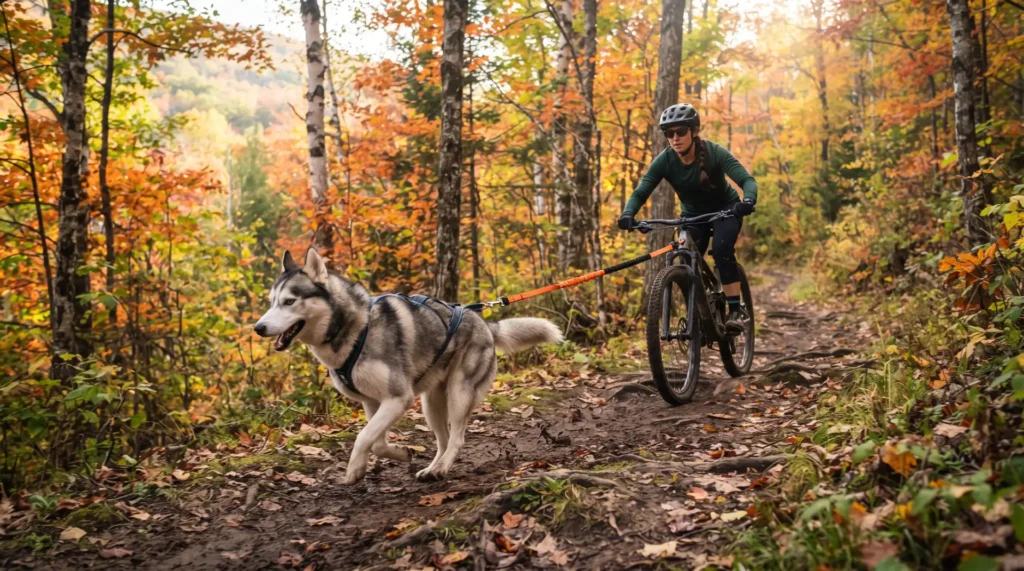
Dog sledding is closely associated with deep snow and frozen trails, but many sled dogs continue working long after winter disappears. Bikejoring has become one of the more recognizable ways to keep that working relationship active. The dog runs ahead of a bicycle while connected through specialized pulling equipment, creating a fast form of dryland mushing that carries many winter trail skills into the off-season.
Interest in bikejoring has expanded beyond established sled dog kennels. The American Kennel Club notes that the sport originated as an off-season conditioning method for sled dog racers and has increasingly gained popularity in the United States. Today, recreational dog owners, competitive athletes, mushers, and outdoor enthusiasts are discovering the sport. The American Kennel Club’s bikejoring guide provides a useful overview of how the activity works and the equipment involved.
For sled dog teams, the attraction is easy to understand. Bikejoring provides speed, pulling resistance, command practice, and trail experience when there is no snow for a sled.
It also requires relatively little equipment compared with operating a complete dryland team.
However, bikejoring is a fast sport. The combination of an enthusiastic sled dog, a bicycle, narrow trails, corners, changing surfaces, and warmer temperatures means responsible training matters.
For U.S. mushers looking for another way to maintain conditioning between winters, bikejoring can become a valuable addition to a broader dryland program.
What Is Bikejoring?
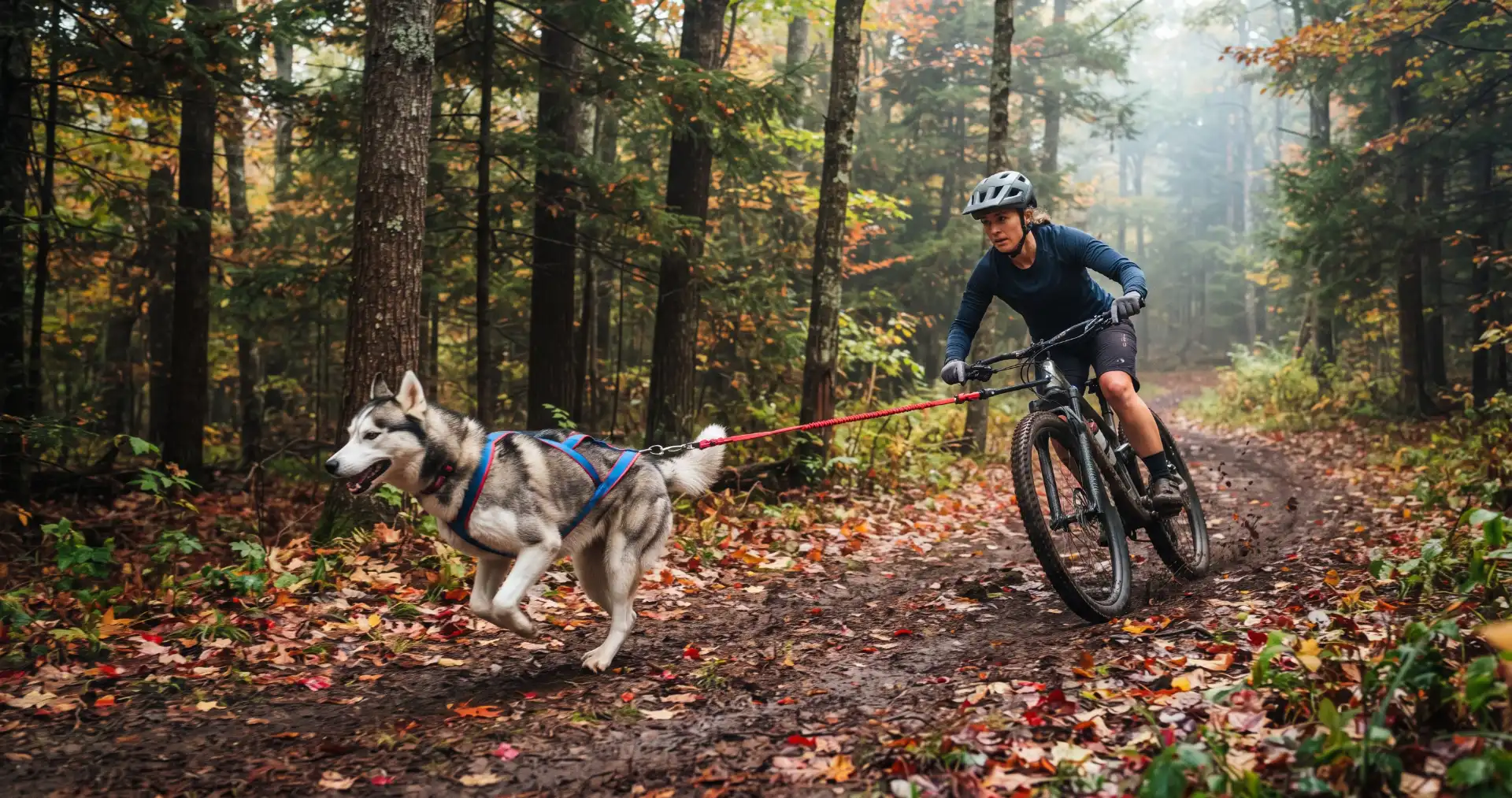
Bikejoring is a dog-powered sport in which one or sometimes two dogs run ahead of a bicycle and help pull the rider along a trail.
The dog wears a specialized pulling harness. A shock-absorbing line connects the dog to the bicycle, normally through a bike attachment that helps keep the line away from the front wheel.
This arrangement differs significantly from simply riding a bicycle while holding a dog’s leash.
During bikejoring, the dog works ahead of the bicycle and is encouraged to pull. The rider pedals as needed while communicating through verbal commands.
The basic concept comes directly from mushing.
Instead of dogs pulling a sled across snow, they provide forward power to a bicycle traveling across dirt or another suitable dry surface.
That connection explains why bikejoring feels familiar to many sled dogs. Harness pressure, forward running, trail commands, and teamwork closely resemble skills used during winter.
If you are interested in the broader transition from winter mushing to snow-free training, Outlaw Ridge’s guide to dryland training for sled dogs looks at the growing importance of year-round conditioning.
Bikejoring Grew Out of Sled Dog Training
Bikejoring did not begin simply as another recreational bicycle activity.
Its history is tied closely to sled dog racing.
Mushers needed ways to maintain fitness and pulling skills when snow disappeared. A bicycle provided a relatively simple solution for working with one or two dogs at greater speeds than running behind them on foot.
According to the American Kennel Club, sled dog racers helped create bikejoring as an off-season method for maintaining their dogs’ fitness. The activity later spread beyond mushing communities and developed into a sport of its own.
That evolution reflects a larger change occurring within dog-powered sports.
Traditional dog sledding remains the foundation, but modern mushers now have multiple ways to work dogs without snow. Canicross, scooterjoring, bikejoring, and wheeled rigs can each provide different forms of training.
Bikejoring occupies an interesting position within that group because its speed can more closely resemble the excitement of a fast sled run.
A fit sled dog can generate considerable forward momentum. When combined with pedaling from the rider, trail speeds can increase quickly.
That makes bikejoring exciting, but it also means control and preparation deserve serious attention.
Why Bikejoring Appeals to Sled Dogs
Many sled dogs have an intense desire to run.
Generations of working-dog development have emphasized traits such as endurance, enthusiasm, responsiveness, and cooperation.
Outlaw Ridge explores these characteristics further in The Science Behind Why Sled Dogs Love to Run.
Bikejoring gives that drive an organized outlet during periods when snow conditions prevent conventional mushing.
Rather than simply taking a dog for a walk or casual jog, the handler can provide a task that resembles its normal working routine.
The dog puts on a pulling harness.
The handler prepares equipment.
The team approaches the trail.
Commands begin.
The dog moves forward and maintains line tension.
For a trained sled dog, these familiar signals can make the activity mentally engaging in addition to physically demanding.
The working relationship is also much more concentrated than in a large sled team.
A dog that normally runs with six, eight, or more teammates suddenly becomes the primary source of pulling power.
That can provide handlers with a close look at individual motivation, confidence, command response, pace, and behavior.
Bikejoring Can Keep Training Active Without Snow
Snow availability can change dramatically from year to year across traditional U.S. mushing areas.
Alaska, Minnesota, Michigan, Wisconsin, Maine, Montana, Colorado, and other northern or mountain regions can experience very different winter conditions within the same season.
When reliable snow arrives late or disappears early, mushers still need ways to maintain their teams.
Bikejoring is one possible answer.
Outlaw Ridge has previously explored how warmer winters are reshaping U.S. sled dog adventures and increasing the relevance of dryland conditioning.
Bikejoring cannot replace every element of winter training.
One dog pulling a bicycle is different from a complete team moving a sled. Snow surfaces also place different demands on paws, muscles, balance, and equipment.
However, bikejoring can preserve several valuable components of training.
Dogs continue spending time in harness. They continue moving ahead of a handler. They hear familiar trail commands. They experience changing terrain and practice maintaining focus while moving at speed.
That continuity can become useful when winter eventually returns.
Bikejoring Equipment Matters
A safe bikejoring setup involves more than a mountain bike and a leash.
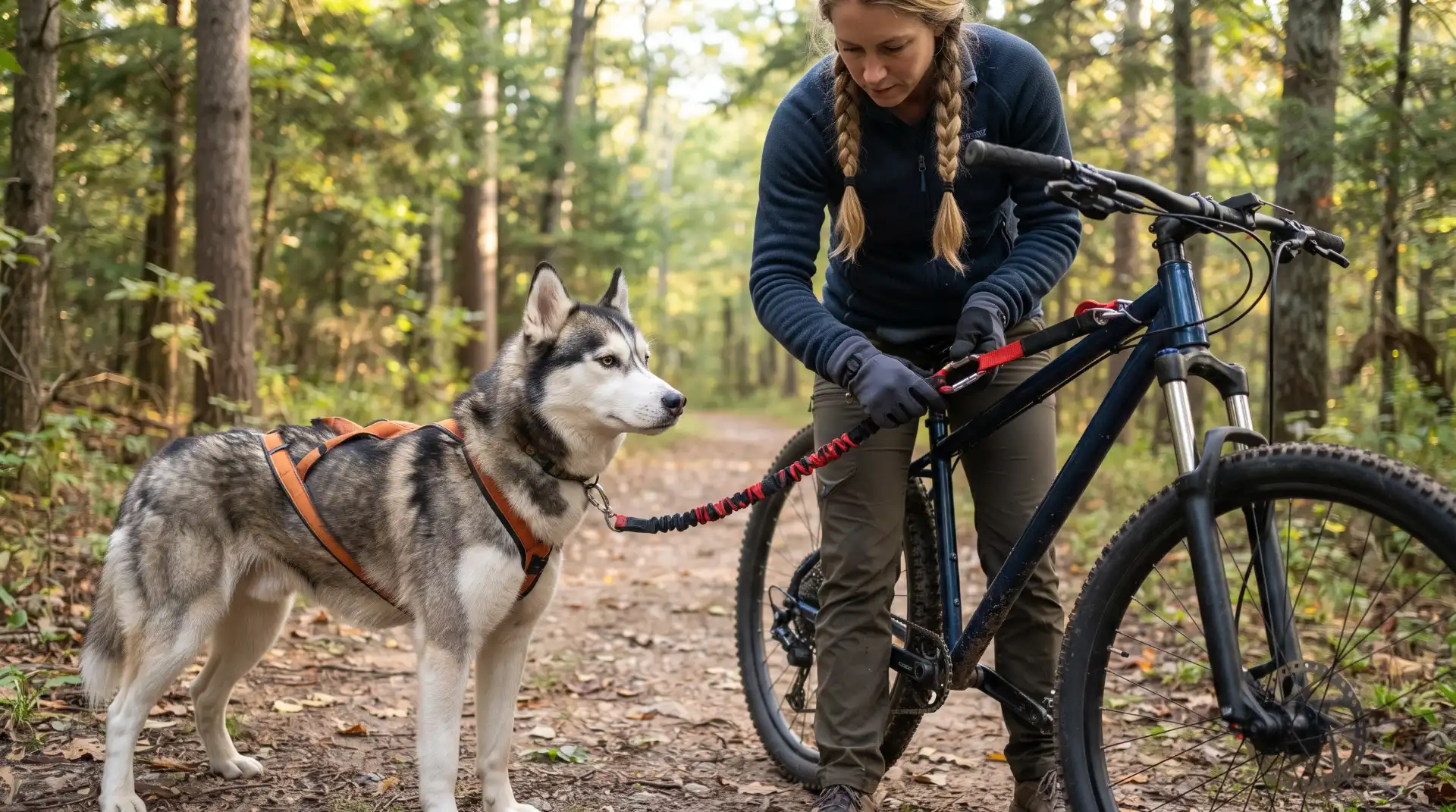
The dog needs a pulling harness designed to distribute force without placing pressure directly on the throat. Harness fit matters because the dog must be able to extend, breathe, and move its shoulders freely while pulling.
The dog is normally connected to the bicycle through a bungee line.
The elastic section helps absorb sudden changes in force as the dog and bicycle move at slightly different speeds.
A bike antenna or line guide extends forward from the bicycle and helps prevent the line from dropping into the front wheel.
This is especially important during moments when the dog slows and tension disappears from the line.
The bicycle itself should be mechanically sound, with dependable brakes and tires appropriate for the trail.
The rider should also wear a properly fitted bicycle helmet.
Gloves and eye protection can provide additional protection from branches, gravel, and falls.
Equipment does not eliminate risk, but appropriate equipment creates a system designed around the specific demands of dog-powered cycling.
A Regular Leash Is Not a Bikejoring Setup
Attaching a standard leash to a collar creates an entirely different situation.
A pulling dog can generate substantial force, and directing that force through the neck is inappropriate for bikejoring.
The AKC specifically advises using a properly fitting harness for bikejoring rather than attaching the line to a dog’s collar.
Holding a leash in one hand while steering a bicycle is also problematic.
The rider needs both hands available for braking, balance, steering, and responding to trail changes.
Purpose-built bikejoring equipment keeps the connection centered on the bicycle while allowing the rider to maintain control.
For people transitioning from ordinary recreational cycling, understanding this distinction is one of the first steps toward learning the sport correctly.
Start Slower Than the Dog Wants to Go
One of the biggest challenges when introducing a sled dog to bikejoring is enthusiasm.
An experienced pulling dog may immediately understand what is expected.
The harness comes out.
The bike appears.
The trail opens ahead.
The dog wants to run.
That enthusiasm can tempt a rider to allow maximum speed during the first session.
A slower approach is more practical.
Even a highly conditioned sled dog may not be accustomed to the specific surfaces, corners, braking patterns, and proximity of a bicycle.
The rider also needs time to become comfortable responding to the dog’s movement.
Short introductory sessions allow both members of the team to learn without creating unnecessary fatigue.
The AKC advises gradually building fitness before participating in fast bikejoring and recommends veterinary evaluation before beginning demanding exercise.
A controlled first session may involve a relatively short stretch of familiar trail.
Distance can increase later.
The first objective is communication and control.
Teach Commands Before Adding Speed
A bicycle can move quickly.
That means directional commands should not be introduced for the first time while traveling downhill at speed.
Dogs benefit from learning essential commands in slower, more controlled settings.
Traditional mushing language transfers naturally to bikejoring.
“Gee” commonly directs the dog toward the right.
“Haw” indicates left.
A start command tells the dog to move forward.
A stop or slowing command helps manage speed.
Commands used for ignoring distractions or passing another trail user can also become valuable.
The exact vocabulary matters less than consistency.
A dog that hears one command during winter sledding and an entirely different command during dryland work may receive mixed information.
Using familiar cues across activities can strengthen communication.
Intersections provide useful opportunities for directional practice once basic control is established.
The rider gives the command before reaching the turn and allows the dog to make the correct choice.
Repeated successful decisions can build confidence that later transfers to other mushing activities.
Lead Dog Skills Can Improve During Bikejoring
A complete sled team provides a social environment.
Dogs respond not only to their musher but also to one another.
Strong lead dogs influence the direction and pace of dogs behind them.
Bikejoring removes most of that support.
A dog running alone must respond directly to the rider.
That makes the sport particularly interesting for developing individual trail skills.
A potential lead dog can practice taking directions without simply following another dog.
A naturally confident dog can learn to maintain forward focus while passing distractions.
A younger dog can begin understanding that working alone still requires listening to the handler.
Bikejoring does not automatically create a lead dog.
Leadership involves temperament, judgment, confidence, responsiveness, and extensive experience.
However, individual dryland sessions can reveal traits that may not be as obvious when a dog is surrounded by teammates.
Fitness Has to Build Gradually
Sled dogs are exceptional athletes, but fitness is activity-specific.
A dog that completed long winter runs several months ago may no longer have the same conditioning after a quieter spring.
Muscles, tendons, cardiovascular capacity, paws, and general endurance require gradual adaptation.
The same applies to the cyclist.
A powerful dog accelerating ahead of the bicycle changes the physical demands of riding. The cyclist has to control speed, absorb bumps, navigate turns, and maintain balance while responding to a moving animal.
Early training sessions can emphasize moderate speeds on relatively flat terrain.
Distance and technical difficulty can increase as both dog and cyclist become more comfortable.
Trying to increase speed, distance, elevation, and trail difficulty simultaneously makes it harder to identify what the team is ready for.
Progressive training creates a clearer picture.
Warm Weather Changes Everything
Bikejoring is an off-season sport, but “off-season” does not mean every snow-free day is appropriate for running sled dogs.
Heat is one of the most significant considerations.
Many sled dogs have coats and body characteristics adapted for cold environments. Exercise generates additional body heat, and a dog running hard in harness may become hot quickly.
Air temperature is only part of the picture.
Humidity, direct sunlight, airflow, trail surface, duration, speed, and individual conditioning also influence the dog’s experience.
An exposed trail at midday can present very different conditions from a shaded forest route shortly after sunrise.
Warm-season riders often choose the coolest available period of the day.
In many U.S. regions, that means training early in the morning.
Some days may simply be unsuitable for bikejoring.
Choosing not to run because conditions are too warm is part of responsible training.
Hot Ground Can Hurt Paws
Air temperature can feel comfortable while asphalt or another exposed surface remains much hotter.
The American Kennel Club warns that hot pavement can burn paw pads and that repetitive running on hard surfaces can also place additional stress on a dog’s body.
Bikejoring is therefore commonly better suited to appropriate natural trails than busy paved roads.
Dirt and forest trails also more closely resemble environments encountered during many forms of dryland mushing.
That does not mean every natural surface is safe.
Loose rocks, roots, sharp gravel, deep mud, sand, and exposed stone can all create problems.
Handlers should evaluate the actual surface before beginning a run.
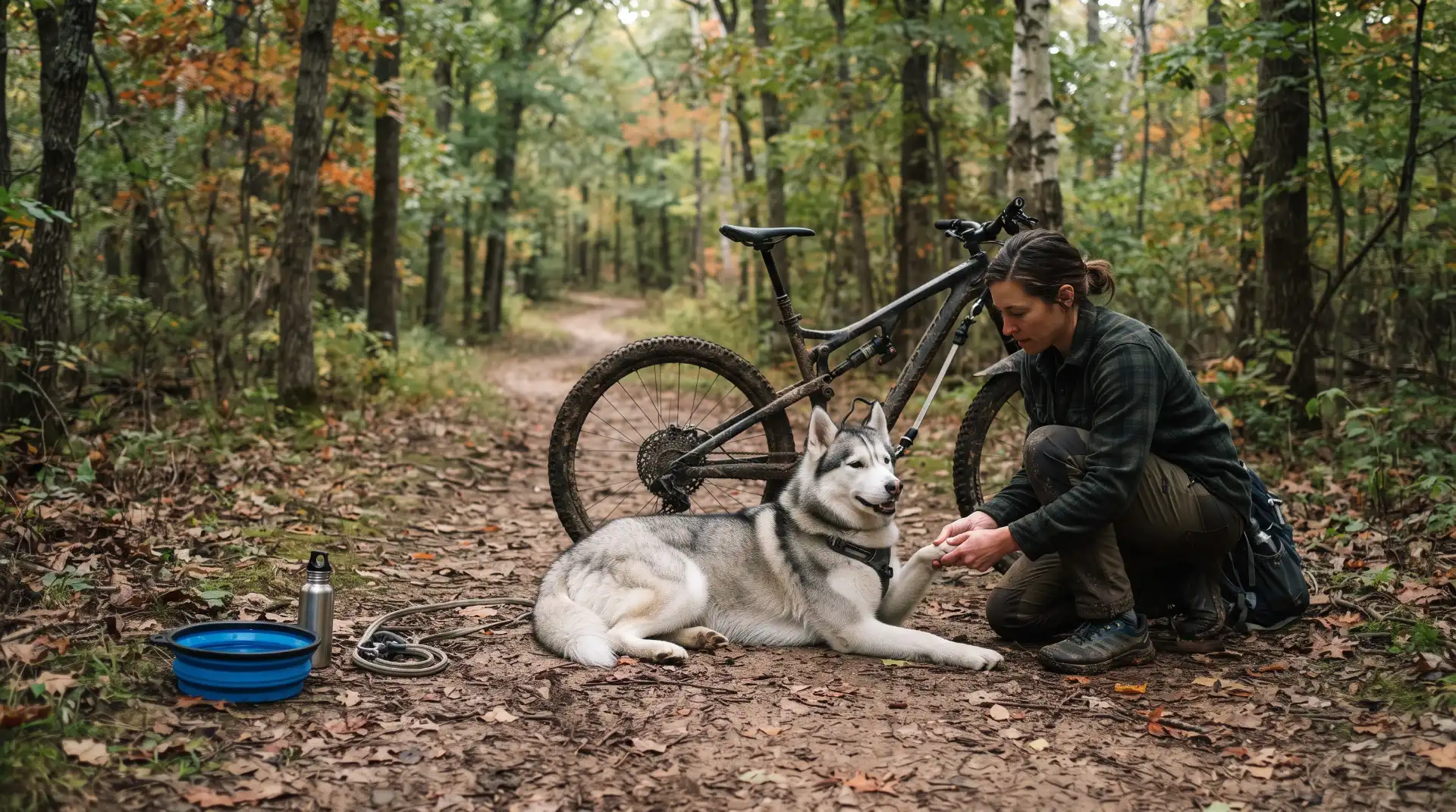
Post-run paw checks are also worthwhile.
Inspect pads and the areas between the toes for abrasions, cuts, debris, or tenderness.
Dogs that repeatedly train on abrasive surfaces may need time for their paws to adapt.
Trail Choice Shapes the Entire Session
A good bikejoring trail provides more than scenery.
It creates room for the dog and cyclist to work without unnecessary hazards.
Wide dirt trails with predictable surfaces can be useful for beginners.
Technical singletrack may appeal to advanced riders but introduces tighter corners, roots, rocks, steep descents, and limited visibility.
Public use should also influence trail selection.
A heavily traveled path filled with hikers, children, loose dogs, horses, or mountain bikers can create constant interruptions.
A quieter trail can allow the bikejoring team to focus on commands and pace.
Local rules also vary.
Some public lands restrict dogs on certain trails. Others require specific leash lengths or prohibit certain activities.
Checking trail regulations before riding can prevent conflicts.
Wildlife is another consideration.
Squirrels, deer, rabbits, and other animals can trigger sudden acceleration.
A strong dog changing direction unexpectedly can destabilize a bicycle almost instantly.
Command training becomes especially valuable in these moments.
Braking Is Part of Mushing
A new bikejorer might assume the dog provides the power while the cyclist simply follows.
In reality, the rider spends considerable time managing speed.
Braking becomes part of communication.
If the bicycle repeatedly rolls into the dog’s hind legs, the rider is allowing too much speed.
If the rider continually brakes heavily while the dog pulls at maximum effort, the dog may be doing unnecessary work.
The objective is cooperative movement.
The rider pedals when appropriate, brakes smoothly, and manages momentum so the dog can maintain a comfortable working rhythm.
Downhill sections require particular caution.
Gravity may cause the bicycle to move faster than the dog.
The rider must control speed and maintain enough distance to avoid crowding the dog.
Experienced riders often develop a feel for the changing tension in the line.
They learn when the dog is actively pulling and when bicycle momentum is doing most of the work.
Passing Other Trail Users Requires Control
Bikejoring teams share many trails with other people.
Good trail etiquette helps make those interactions predictable.
A rider should be prepared to slow considerably when approaching hikers, other dogs, bicycles, horses, or unexpected obstacles.
Passing is not a race.
Dogs should learn to continue forward rather than veering toward distractions.
A passing command can become part of routine training.
When visibility is limited, reducing speed before blind corners can give the rider more time to respond.
Bikejoring can look unusual to people unfamiliar with the sport.
A dog running at the end of a line ahead of a bicycle may initially appear uncontrolled.
Calm passing behavior demonstrates the opposite.
A well-trained team moves with communication and purpose.
Bikejoring Provides Mental Work Too
Physical exercise receives most of the attention, but bikejoring also challenges a dog’s mind.
The dog must listen while running.
It has to interpret directional commands.
It must ignore some distractions and respond to others.
It needs to regulate pace.
It has to navigate trail surfaces and maintain awareness of the rider behind it.
These decisions occur continuously.
For energetic sled dogs accustomed to having a job, that mental engagement can be valuable during months when traditional winter work is unavailable.
A tired body and an engaged mind are not the same thing.
Bikejoring provides both physical activity and a structured task.
That combination helps explain why many working dogs appear enthusiastic when harnesses come out.
Nutrition and Hydration Still Matter Off-Season
Training volume often changes outside winter, which means feeding strategies may also need adjustment.
A dog completing shorter bikejoring sessions does not necessarily require the same calorie intake as a dog pulling a sled for hours in severe winter conditions.
Body condition, workload, weather, and individual metabolism should guide feeding decisions.
Outlaw Ridge’s article on the role of nutrition in sled dog performance explores the relationship between energy, hydration, recovery, and working-dog nutrition.
Hydration deserves particular attention during dryland training.
Dogs should have access to fresh water before and after activity, and riders traveling farther from a trailhead should plan accordingly.
Natural streams should not automatically be treated as reliable drinking-water sources.
Carrying water gives the handler more control over when and what the dog drinks.
Recovery Is Training
A productive training program includes days when the dog does not run.
Rest allows the body to respond to exercise.
Bikejoring sessions can place considerable demands on muscles and joints because dogs may work at relatively high speeds.
Handlers can monitor dogs after each outing.
Look at how the dog walks after cooling down.
Observe whether stiffness appears later in the day or the following morning.
Check paws.
Pay attention to appetite, energy, and enthusiasm.
A dog that appears unusually tired may need additional recovery before the next session.
More training is not automatically better training.
Consistency matters, but recovery helps make consistency possible.
Not Every Dog Should Bikejor
Bikejoring fits many athletic dogs, but it is not appropriate for every dog.
The sport involves speed, pulling, repetitive running, and abrupt changes in terrain.
Growing puppies are generally poor candidates for intense repetitive bikejoring because their bodies are still developing. The AKC also notes that fast bikejoring may not be appropriate for dogs with mobility limitations and advises consulting a veterinarian before beginning.
Individual temperament matters too.
A dog that panics around bicycles or cannot maintain forward focus may require substantial foundational work.
Older dogs may be happier with lower-impact activities.
Breed alone does not determine suitability.
Siberian Huskies, Alaskan Huskies, Chinooks, and other sled dogs may have natural working traits, but health and individual condition remain more important than a breed label.
Readers interested in those differences can explore Meet the Breeds: The Best Dogs for Sledding.
Bikejoring Versus Canicross
Bikejoring and canicross share many fundamentals.
Both involve a dog working ahead in a pulling harness.
Both use a bungee line.
Both rely on trail commands and communication.
The biggest difference is speed.
In canicross, the handler runs behind the dog.
During bikejoring, the bicycle allows both participants to move considerably faster.
That speed changes the risk profile.
A mistake while jogging may result in a stumble.
The same mistake on a fast downhill bikejoring section can lead to a significant crash.
Canicross may therefore provide a useful foundation before moving to bikejoring.
A dog can first learn commands, forward pulling, and passing behavior at running speed.
Once those fundamentals are reliable, the bicycle can be introduced gradually.
Bikejoring Versus Full Dryland Teams
Bikejoring is also different from running a complete sled dog team with a cart or wheeled rig.
A full dryland team practices pack organization and position-specific responsibilities.
Lead dogs navigate.
Swing dogs support turns.
Team dogs provide power.
Wheel dogs work closest to the vehicle.
Bikejoring reduces this complex structure to one or two dogs.
That simplicity is part of its appeal.
A musher can work with an individual dog without preparing an entire team.
It can fit into shorter training sessions and allow highly specific command work.
However, it cannot replace every element of group training.
For established sled dog kennels, bikejoring works best as one tool within a larger conditioning program.
From Fall Trails Back to Winter Snow
As temperatures decrease and snow approaches, bikejoring can help bridge the transition into sled season.
Dogs that have trained throughout the cooler dryland months may enter winter with a stronger conditioning base than dogs returning after a long inactive period.
They have continued working in harness.
They have practiced commands.
They have maintained trail focus.
They have experienced regular exercise.
When enough snow arrives for traditional sled training, the equipment changes but much of the working routine remains familiar.
The transition should still be gradual.
Pulling a bicycle with one dog differs from running within a large team and pulling a loaded sled.
Winter-specific conditioning remains necessary.
Bikejoring simply provides another part of the foundation.
Why Bikejoring Is Growing in the United States
Bikejoring sits at the intersection of several outdoor interests.
It appeals to mushers who need off-season training.
It appeals to mountain bikers who enjoy working with dogs.
It attracts runners transitioning from canicross.
It also gives athletic dog owners another structured activity to explore.
The American Kennel Club reported in its March 2026 update that bikejoring, already established in Europe, continues gaining traction in the United States, with competitive events occurring at local, national, and international levels.
That broader participation helps introduce mushing concepts to people who may never have stood on a traditional dogsled.
Terms such as pulling harness, line-out, trail commands, and dryland training begin moving beyond traditional sled dog circles.
For the mushing community, that crossover can help keep dog-powered sports visible throughout the year.
A Modern Sport With Traditional Mushing Roots
Bikejoring may involve modern mountain bikes, specialized lines, helmets, and technical trail equipment, but the central idea is familiar.
A person and a dog travel together.
The dog works ahead.
The human provides direction.
Both depend on communication.
That relationship has been central to mushing for generations.
The equipment has changed repeatedly throughout the history of the sport. Outlaw Ridge’s guide to the history and evolution of dog sledding explores how working sled dogs moved from essential transportation partners to modern recreational and competitive athletes.
Bikejoring is another chapter in that evolution.
It does not replace dog sledding.
Instead, it gives dogs and handlers another way to maintain the partnership when snow is absent.
For a sled dog that becomes visibly excited at the sight of a harness, the difference between a bicycle and a sled may matter less than people imagine.
There is still a trail ahead.
There is still a job to do.
And there is still a handler behind, ready to follow.