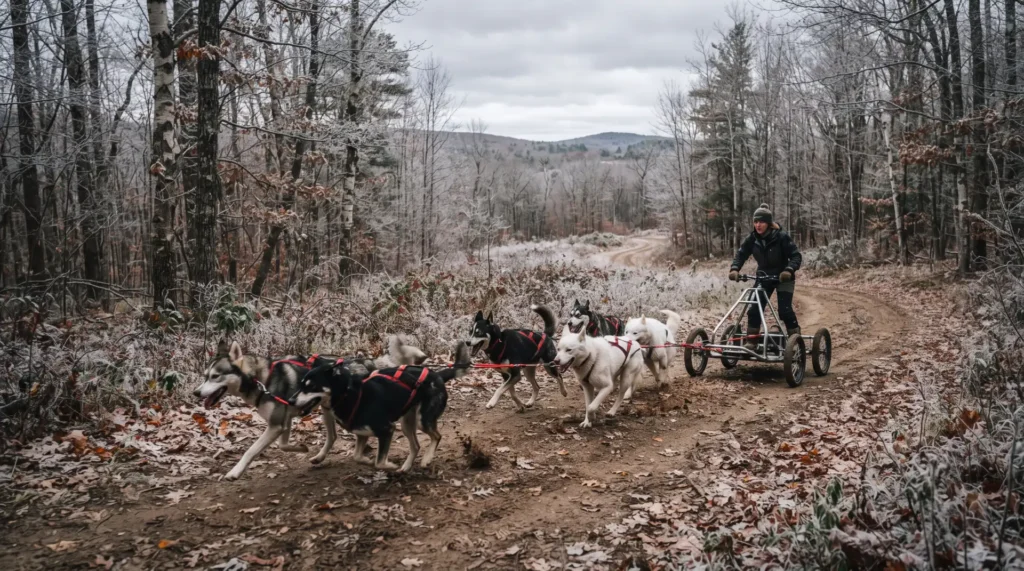
For generations, the arrival of winter snow marked an important turning point for sled dog teams. Cooler weather meant frozen trails, snow-covered routes, and the opportunity to move training from fall conditioning into traditional sled work. Today, however, many U.S. mushers cannot assume that dependable snow will arrive according to a familiar calendar.
Some years bring early storms followed by long thaws. Other seasons stay cold enough for training but produce little usable snow. A trail may be white one weekend and nearly bare the next. For sled dog teams, these changing conditions require a more flexible approach to conditioning, equipment, scheduling, and safety.
Fortunately, sled dogs do not suddenly stop training simply because the sled remains in storage. Modern mushers have developed sophisticated ways to maintain fitness and reinforce teamwork during extended snow-free periods. Wheeled rigs, canicross, bikejoring, controlled conditioning runs, command work, recovery monitoring, and careful weather planning can all contribute to the preseason program.
The result is a training system that is increasingly based on conditions rather than calendar dates. Snow remains an important part of traditional mushing, but waiting for perfect winter weather is no longer the only way to prepare a team.
Why Late Snow Changes the Training Calendar
Sled dogs are endurance athletes. Like other athletes, they benefit from conditioning that develops gradually rather than beginning suddenly when favorable conditions appear.
If a musher waits until deep snow covers the trail before starting meaningful conditioning, the team may lose valuable weeks of preparation. Dogs could then be asked to increase mileage too quickly, placing unnecessary stress on muscles, paws, joints, and cardiovascular systems.
Late snow can be particularly significant for teams preparing for winter recreational trips, organized races, backcountry expeditions, or longer touring seasons. The dogs need time to build endurance before they are expected to handle demanding mileage.
For this reason, many teams begin conditioning during fall rather than waiting for winter.
This does not mean simply running dogs whenever the ground is bare. Temperature, humidity, trail surface, individual fitness, and workload all matter. Athletic northern dogs can generate considerable body heat while exercising, making cool conditions an essential part of responsible dryland training.
The broader shift toward year-round dog-powered sports is also visible in organized competition. The United States Federation of Sleddog Sports recognizes dryland disciplines including canicross, scooter, and bikejoring in addition to traditional sled and Nordic events. That structure illustrates how modern mushing extends well beyond snow-covered trails.
Outlaw Ridge readers can learn more about this trend in Dryland Training for Sled Dogs: How Warmer Winters Are Changing Mushing in 2026.
Dryland Training Keeps the Team Moving
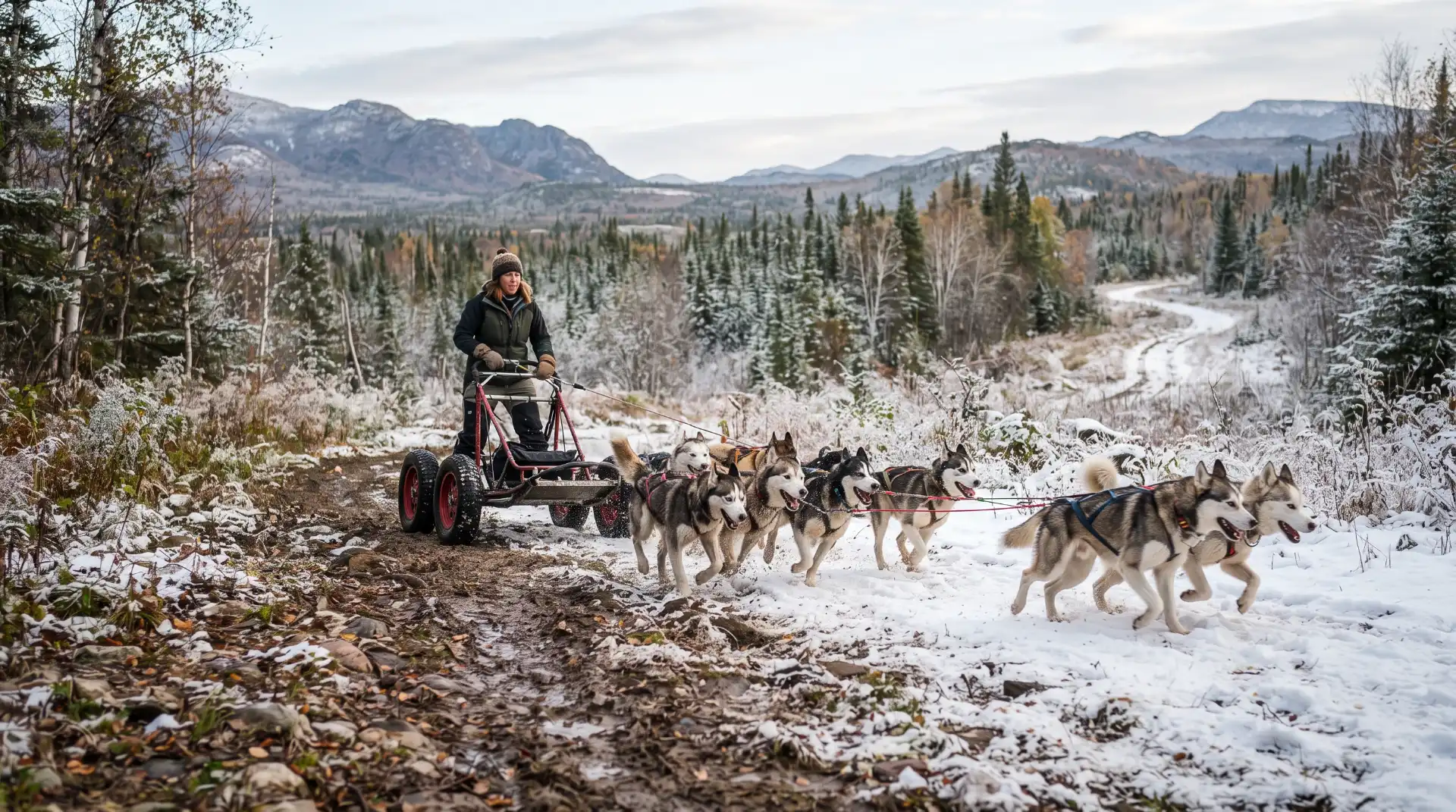
Dryland mushing uses many of the same principles as traditional sledding, except the dogs pull equipment designed for snow-free surfaces.
For larger teams, this may involve a wheeled training rig. Smaller teams may work with a dog scooter, bikejoring setup, or canicross equipment. The exact method depends on the number of dogs, trail conditions, experience level, and training objective.
The objective is not simply to tire the dogs. Good training develops aerobic fitness while reinforcing the skills that make a sled team function as a coordinated unit.
Dogs learn to maintain tension on the line, start together, settle into a sustainable pace, follow directional commands, ignore distractions, and work comfortably alongside teammates.
This makes dryland training particularly valuable during a late-snow year. Even if runners cannot yet touch snow, much of the communication system used during winter can already be practiced.
Wheeled Training Rigs
Wheeled rigs are among the closest dryland alternatives to traditional sled work for multi-dog teams. Depending on their design, these rigs allow several dogs to work together while the musher controls braking and direction from behind.
Because wheels roll differently than sled runners glide, mushers must account for terrain and resistance carefully. Long downhill sections can be particularly challenging because the rig may gain speed faster than the team should be expected to run.
Safe routes tend to offer enough space for the entire team, predictable footing, good visibility, and manageable grades.
Rough pavement is generally undesirable for extended pulling because of abrasion and heat. Dirt roads, forest trails, and other suitable natural surfaces are often preferred when local rules permit dog-powered activity.
Canicross and Bikejoring
Not every training session needs an entire team.
Canicross allows one dog to run ahead of a runner connected through a pulling harness, bungee line, and waist belt. Bikejoring follows a similar principle but connects the dog to a bicycle using equipment specifically designed for dog-powered cycling.
These disciplines can be useful when mushers want to work individually with particular dogs. A potential lead dog, for example, can receive extra practice responding to commands without the distraction of a large team behind it.
Individual work can also help handlers observe gait, focus, enthusiasm, and recovery more closely.
Temperature Matters More Than the Date
A late November morning may look like winter on the calendar while still being too warm for demanding dog-powered exercise. Conversely, an unusually cold October morning may offer excellent conditions for a controlled conditioning session.
That is why experienced mushers pay attention to actual environmental conditions rather than assuming a particular month is automatically safe.
Temperature is only one factor. Humidity, direct sunlight, wind, trail exposure, training intensity, surface temperature, and individual dog characteristics can influence heat stress.
A forest road shaded from the sun can feel very different from an exposed trail even when weather stations report the same air temperature.
Many teams therefore train during the coolest part of the day. Early mornings are particularly useful during fall because the ground has had the entire night to cool.
When temperatures are unsuitable, postponing a run is part of responsible training. Conditioning gains are never worth overheating a dog.
Late Snow Creates an Opportunity to Build Fundamentals
More time without snow does not have to mean more mileage.
One advantage of an extended preseason is the opportunity to improve skills that can become harder to address once long-distance training begins.
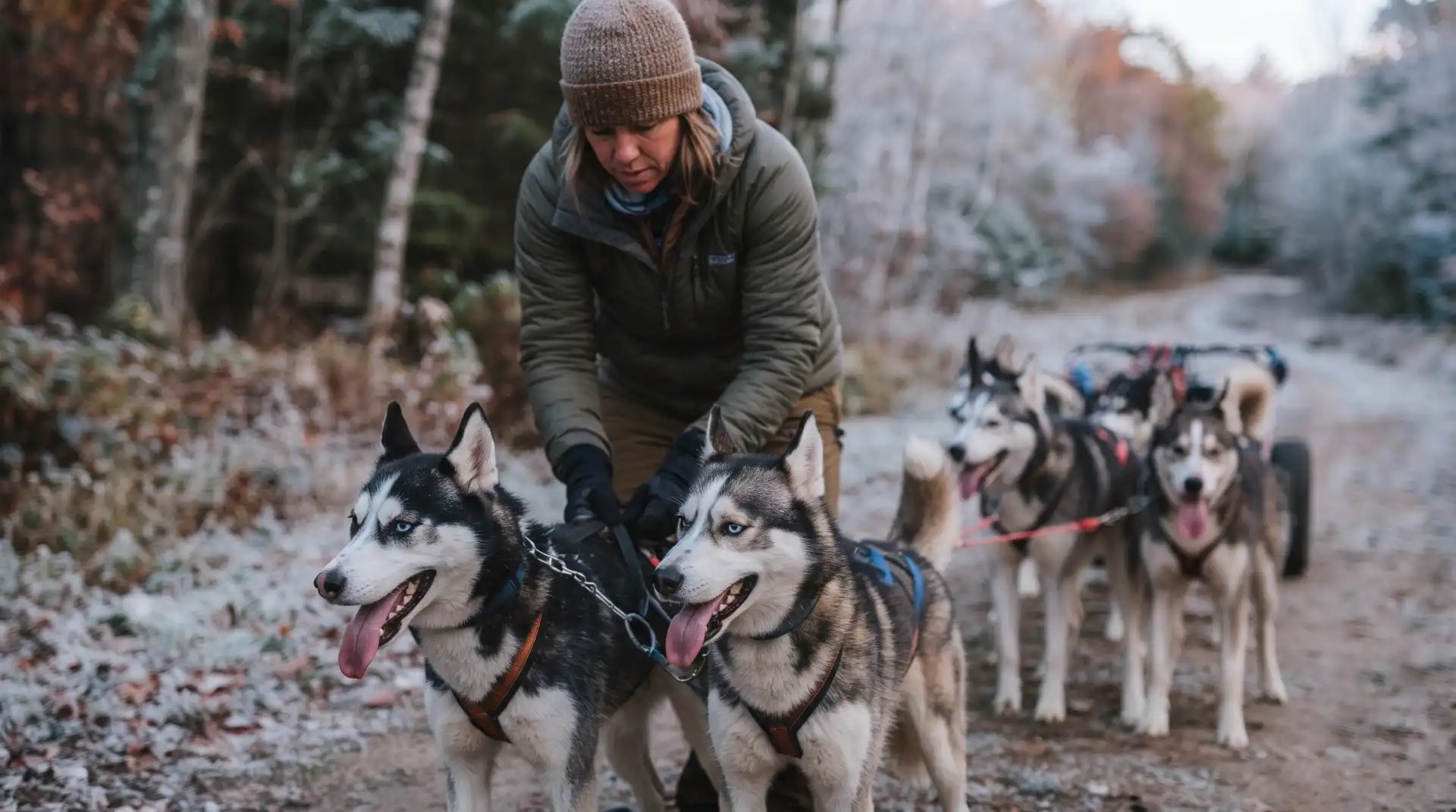
Lead dogs can practice turns and intersections. Younger dogs can become comfortable in harness. Teams can work on smooth starts. Dogs can learn to pass people, bicycles, other dogs, or other appropriate distractions without losing focus.
These fundamentals become increasingly important when the team eventually reaches faster winter trails.
Strengthening Directional Commands
Voice communication is one of the defining features of mushing.
A musher cannot steer the lead dogs with reins. Instead, dogs are trained to respond to verbal cues for direction, starting, stopping, slowing, and continuing past distractions.
Dryland training gives teams repeated opportunities to practice these cues.
Intersections are particularly valuable. A lead dog that consistently understands left and right commands can make winter travel considerably smoother once snow hides familiar visual landmarks.
Developing Young Dogs Carefully
Younger dogs often learn by running beside experienced team members.
A veteran dog can demonstrate rhythm, line position, and responsiveness while the younger dog gains confidence in harness.
Late snow provides time for these shorter learning sessions without immediately asking inexperienced dogs to tackle long winter runs.
Progress should remain gradual. Physical maturity varies among dogs, so appropriate exercise and workload should be discussed with a veterinarian familiar with the individual animal.
Conditioning Without Chasing Mileage
Distance is easy to measure, which sometimes makes mileage seem like the most important training number. It is not.
A five-mile run on soft terrain, rolling hills, or a heavy rig can represent a very different workload from five easy miles on a firm trail.
Mushers therefore consider pace, terrain, temperature, elevation, team size, resistance, and recovery along with distance.
Early-season training often emphasizes consistency rather than impressive mileage. Several controlled sessions that dogs recover from comfortably may provide a better foundation than one overly ambitious run followed by excessive fatigue.
The goal is to arrive at winter fit enough to continue progressing, not exhausted before the snow season begins.
Nutrition Changes as Workload Increases
A dog that spends summer resting and playing does not necessarily have the same nutritional requirements as that same dog during an active training schedule.
As mileage and intensity increase, energy needs can increase as well. Sled dogs performing sustained endurance work may require carefully managed diets that provide sufficient calories, protein, fat, vitamins, minerals, and hydration.
Diet should not be increased automatically simply because the team has started training. Body condition, individual metabolism, workload, environmental temperature, and veterinary recommendations all matter.
Handlers should also avoid major food changes immediately before demanding exercise. Digestive consistency is important for working dogs.
For a deeper look at fueling canine athletes, see The Role of Nutrition in Sled Dog Performance.
Hydration Still Matters in Cool Weather
Hydration sometimes receives less attention once temperatures fall, yet dogs continue losing water through respiration and physical activity.
A team may feel cool while still completing significant aerobic work.
Mushers should monitor water intake throughout the conditioning season and learn what normal hydration looks like for each dog.
A sudden change in drinking, appetite, energy, or recovery can provide useful information that something deserves closer attention.
For prolonged or demanding training programs, veterinarians can help determine an appropriate feeding and hydration strategy for individual dogs.
Recovery Becomes Part of the Training Plan
Training does not end when the dogs return to the kennel.
Recovery is when handlers can observe how well each dog tolerated the workload.
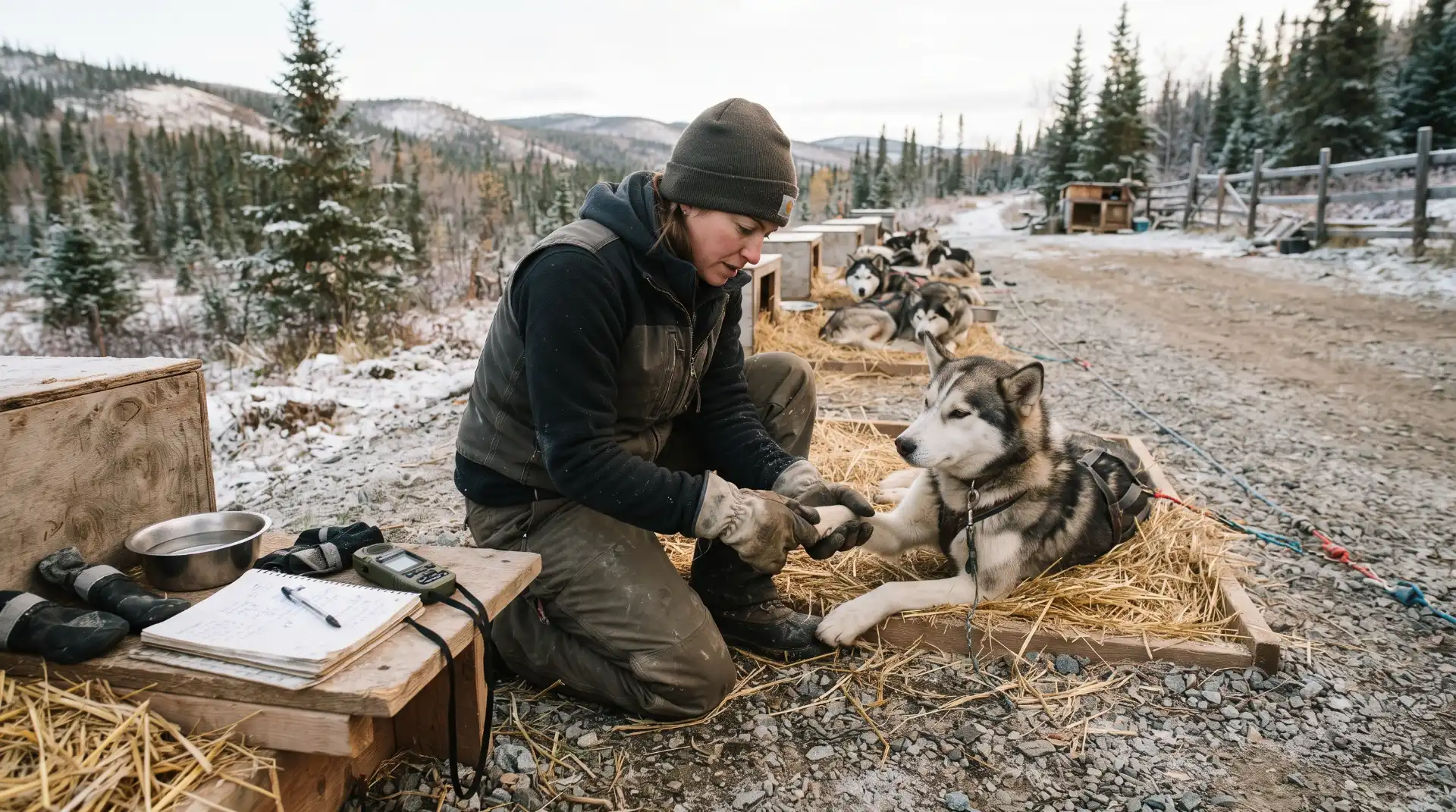
After a run, mushers may examine paws, check harness contact areas, monitor breathing, watch the dog walk, offer appropriate hydration, and evaluate overall attitude.
A dog that appears enthusiastic on the trail can still show stiffness or tenderness afterward. For that reason, post-run observation is just as valuable as watching performance while the team is moving.
Rest days are also part of training. Muscles, tendons, paws, and other tissues need time to respond to increasing workloads.
A well-designed conditioning schedule alternates effort and recovery instead of demanding maximum work every day.
This is especially important when late snow suddenly arrives. Dogs that have already completed weeks of dryland conditioning may be fit, but changing from wheels to sled runners still alters the workload.
Paw Care Changes With the Surface
A sled dog running across cool dirt faces different paw challenges than one traveling on packed snow.
Gravel may cause abrasion. Rough ground can create small cuts. Mud can soften pads. Roots and stones add uneven footing. Once snow arrives, ice accumulation, crust, and hard-packed surfaces introduce a different set of concerns.
Regular paw inspections help mushers recognize these changes early.
Dryland mileage should increase progressively so pads have time to adapt. When a team later moves onto snow, checks should continue rather than assuming winter automatically means easier footing.
Booties can be useful in certain conditions, although their use depends on terrain, dog, fit, and purpose.
Using Training Logs Instead of Guesswork
One of the most useful modern tools for late-snow seasons is also one of the simplest: a training log.
Mushers can record distance, duration, temperature, trail conditions, pace, team configuration, individual observations, appetite, paw condition, and recovery.
Over several weeks, patterns begin to appear.
Perhaps a particular dog needs more recovery after longer runs. Maybe one trail creates consistently slower speeds because of elevation. A younger dog may perform better beside a certain teammate. A team may recover noticeably faster at cooler temperatures.
GPS watches and tracking devices can provide additional information, but technology works best when paired with direct observation.
Readers interested in how technology is influencing the sport can also explore The Evolution of Mushing: Modern Technology and Training Techniques Revolutionizing Dog Sledding.
Making the Transition From Wheels to Snow
When meaningful snow finally arrives, the temptation is understandable: harness the team, bring out the sled, and immediately start covering winter distances.
A gradual transition is usually more sensible.
Pulling a wheeled rig and pulling a sled are related activities, but snow introduces different resistance, footing, cornering, and braking characteristics.
The first snow can also hide hazards. Rocks, branches, drainage channels, thin ice, open water, and uneven ground may sit beneath a shallow white surface.
Early winter routes should therefore be inspected carefully.
Mushers may begin with familiar, controlled trails before progressing into more demanding terrain. Shorter snow runs allow dogs and handlers to readjust to sled handling while maintaining the conditioning already developed during fall.
Thin Ice Requires Extra Caution
Late snow often accompanies an uneven freeze-up period.
A lake, river, or wetland that normally becomes part of a winter route may not yet have dependable ice simply because nearby trails contain snow.
Frozen waterways require specific local knowledge and conservative judgment. Ice conditions can vary dramatically over short distances because of currents, springs, changing water levels, snow insulation, and recent temperature changes.
When there is uncertainty, choosing a land-based route is the safer option.
Remote winter travel involves additional hazards beyond ice. Outlaw Ridge readers planning longer routes can review Emergency Preparedness for Remote Mushing Trips before heading farther into the backcountry.
Weather Forecasts Become Training Tools
Modern mushers can use weather information for far more than deciding what jacket to wear.
Forecast temperatures help determine whether a dryland session should happen in the morning or be postponed. Precipitation forecasts can indicate whether trails may become muddy. Freeze-thaw cycles can warn of icy conditions. Longer-range forecasts can help teams plan the transition from wheeled equipment to sleds.
The NOAA Climate Prediction Center provides official U.S. climate outlooks that can help outdoor users understand broader temperature and precipitation patterns.
However, a seasonal outlook is not a trail forecast. Mushers should still check current local weather and assess actual trail conditions before every run.
Late Snow Does Not Affect Every U.S. Region the Same Way
Talking about a “late winter” can be misleading because the United States contains very different climates.
Alaska, Minnesota, Maine, Michigan, Montana, Colorado, Wyoming, and other areas associated with dog-powered winter recreation do not receive snow at the same time or under the same conditions.
Even within one state, elevation can make an enormous difference.
A mountain trail may have excellent winter conditions while a valley route only a short drive away remains bare.
Rather than assuming national weather trends describe every training location, mushers need to respond to local conditions.
This flexibility is one of the central skills of modern team management.
Dryland Racing Shows How the Sport Is Evolving
Dryland training is not merely an emergency substitute for snow. It has developed into an established branch of dog-powered sport.
USFSS includes canicross, scooter, bikejoring, and other dryland competition alongside traditional snow disciplines. The organization also handles U.S. participation in international sled-dog competition.
This means techniques once associated mainly with fall conditioning now exist as sports in their own right.
For recreational mushers, the growth of dryland activity provides more opportunities to stay involved outside the traditional winter season. For competitive athletes, it creates disciplines that require their own equipment, strategies, conditioning, and technical skills.
Most importantly, it demonstrates that the relationship between dog and handler is not dependent on snow.
Do Not Let Competition Override Dog Welfare
A delayed winter can create pressure when a race, trip, or planned season is approaching. That pressure should never dictate the workload placed on the dogs.
Training plans must remain adjustable.
If temperatures are too warm, the team can rest. If a dog is sore, that dog can sit out. If trail conditions are poor, a route can be shortened or changed. If the entire team needs another week before increasing mileage, the calendar should not overrule their condition.
The dogs are not pieces of equipment being prepared for a deadline. They are athletes whose health and enthusiasm determine whether the team succeeds at all.
That perspective is especially important for anyone new to mushing. Experienced handlers become skilled not only at making dogs run but also at recognizing when they should not run.
Prepare Equipment Before the First Major Snow
One advantage of an extended fall is extra time to inspect winter equipment.
Waiting until the first major storm to discover a worn line, damaged runner, broken attachment, or missing piece of emergency gear wastes valuable training time and can create safety problems.
Harnesses should be checked for wear and fit. Ganglines and tug lines should be examined carefully. Sled hardware, brakes, snow hooks, storage equipment, lighting, and communication devices should be ready before the team needs them.
Dryland equipment deserves the same attention. Brakes, tires, steering components, and attachment points on rigs, scooters, or bicycles should be inspected routinely.
Keep the Dogs Mentally Engaged
Physical conditioning is only one part of a sled dog’s preparation.
Working dogs also benefit from mental stimulation and positive training experiences.
Short command sessions, individual walks, social time, controlled exploration, harness practice, and changing trail routes can keep training interesting without adding excessive physical stress.
Some dogs thrive on variety. Others perform best with highly predictable routines. Knowing the personalities within a team allows the musher to design sessions that keep dogs enthusiastic.
That enthusiasm is central to dog-powered sports. The most effective team is not simply fit. It is made up of dogs that understand their job, trust the handler, and remain eager to work together.
For more about the motivation behind this behavior, see The Science Behind Why Sled Dogs Love to Run.
Have More Than One Training Plan
One of the smartest ways to manage an unpredictable winter is to stop relying on a single schedule.
A musher might maintain one plan for cool dryland conditions, another for transitional snow, and another for established winter trails.
If weather changes unexpectedly, training can shift between those plans instead of stopping completely or pushing dogs into unsuitable conditions.
This approach also makes it easier to manage individual dogs. A team member returning from rest may receive a lighter session while fully conditioned dogs continue with a different workload.
Flexibility becomes a strength rather than an inconvenience.
What Late Snow Can Teach a Sled Dog Team
It is easy to view delayed snow entirely as a problem. For mushers, however, challenging seasons can encourage better training habits.
They force handlers to pay closer attention to temperature rather than dates. They encourage more careful tracking of workload. They create opportunities to improve commands before distance increases. They introduce handlers to dryland disciplines. They make equipment preparation more deliberate and highlight the value of adapting rather than rushing.
When snow finally arrives, a well-managed team may already have weeks or months of controlled conditioning behind it.
The sled changes, but the foundation of the work does not.
Training for the Conditions in Front of You
Sled dog mushing has always required adaptability. Trails change. Storms arrive. Temperatures rise and fall. Dogs develop at different rates. Equipment breaks. Routes that were excellent one week may be unsuitable the next.
Late snow is another variable for modern mushers to manage.
Instead of waiting impatiently for winter, teams can use cool snow-free periods to build aerobic fitness, reinforce commands, develop young dogs, strengthen lead-dog communication, monitor nutrition, improve paw conditioning, and practice the teamwork that will matter once sled runners finally meet snow.
Dryland training should never become an excuse to exercise dogs in excessive heat or unsuitable conditions. Likewise, the first snowfall should not be treated as permission to increase mileage recklessly. Conditioning remains a gradual process throughout the season.
For U.S. sled dog teams, that may be the most important lesson of an unpredictable winter: successful mushing is no longer about following a fixed date on the calendar. It is about watching the dogs, studying the weather, understanding the trail, and choosing the right form of training for the conditions available today.
When those pieces come together, a late start to the snow season does not have to mean a late start to training. The dogs can already be building fitness, confidence, communication, and teamwork long before the landscape finally turns white.