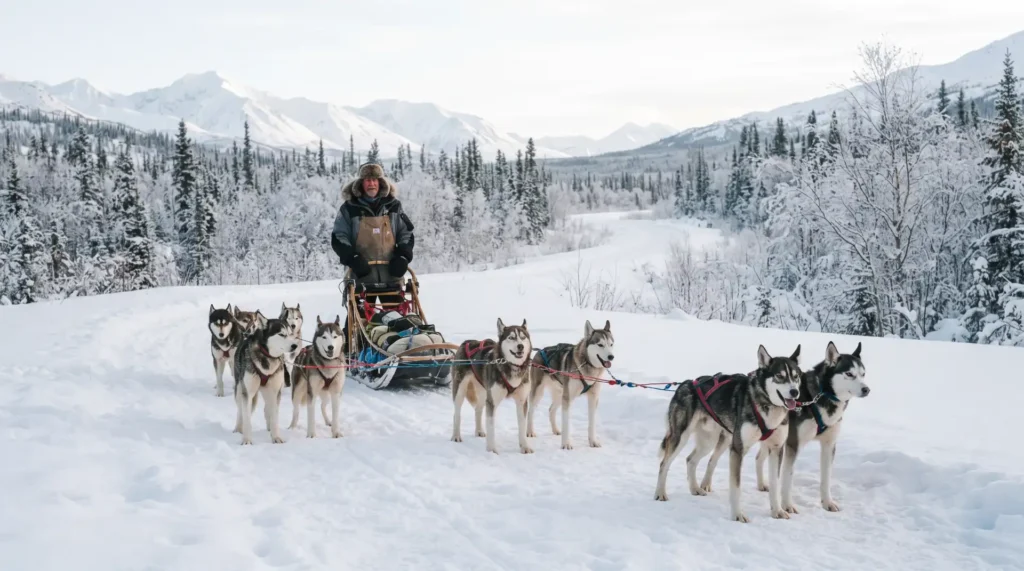
Watching a sled dog team move across a snowy trail can make the entire operation look almost effortless. The dogs run in rhythm, the gangline remains organized, and the musher appears to guide the team with only a few spoken commands. Behind that smooth performance, however, is a great deal of preparation.
One of the most important decisions a musher makes is determining the running order of the sled dog team.
Dogs are not simply attached to the gangline according to size or randomly placed wherever space is available. Each position has a particular purpose, and each dog brings a different combination of strength, speed, intelligence, confidence, endurance, temperament, experience, and relationship with the other dogs.
A successful musher learns those differences over months and years of training.
The ideal lineup may also change from one day to another. A dog that leads confidently on a familiar forest trail may be better suited to another position during difficult weather. A powerful wheel dog may move farther forward during a lighter training run. Young dogs may be paired with experienced veterans so they can learn the routines of the team.
That flexibility is one of the fascinating parts of mushing.
Understanding the sled dog team running order provides a much deeper appreciation for the teamwork involved in dog sledding and for the individual abilities of the canine athletes pulling the sled.
The Four Main Positions in a Sled Dog Team
Traditional sled dog teams are generally organized into four major position groups: lead dogs, swing dogs, team dogs, and wheel dogs.
The exact number of dogs varies depending on the type of run, training program, race, expedition, trail conditions, and equipment. However, the basic responsibilities of these positions remain similar.
Lead dogs run at the front. They respond to the musher’s directional commands, help establish the pace, and guide the rest of the team.
Swing dogs, sometimes called point dogs, run immediately behind the leaders. They help move or “swing” the gangline around turns.
Team dogs fill the middle portion of the lineup and supply much of the sustained pulling power required to keep the sled moving.
Wheel dogs run directly in front of the sled. They work close to the equipment and help manage the force of the sled, particularly through turns and changes in terrain.
Although these labels make the team look highly specialized, many sled dogs are capable of working in more than one position. Experienced mushers often develop versatile dogs rather than assuming that a particular animal must remain in the same spot throughout its career.
That versatility can become extremely valuable when conditions change on the trail.
Lead Dogs: More Than Just the Fastest Dogs
The dogs at the front of a sled dog team receive plenty of attention, but speed alone does not make a great leader.
Lead dogs need an unusual combination of intelligence, responsiveness, confidence, athletic ability, and willingness to work independently.
Unlike dogs running farther back, leaders have no teammates immediately in front of them to follow. They must listen closely to the musher while simultaneously evaluating the trail ahead.
Commands such as “gee” for right and “haw” for left are traditionally associated with mushing. A dependable leader must understand directional instructions and respond even when the correct path is not immediately obvious.
The musher therefore looks carefully at how a potential lead dog behaves during training.
Does the dog stay focused when another trail crosses the route?
Will it maintain forward movement when distractions appear?
Can it follow commands even when the rest of the team seems interested in going somewhere else?
Does the dog remain confident when entering unfamiliar terrain?
These behavioral qualities may matter just as much as raw athletic ability.
Some dogs naturally enjoy running at the front. They seem comfortable making decisions and maintaining focus without another dog ahead of them. Others may be powerful athletes but perform better when they can follow an experienced teammate.
Neither type is inherently better. They simply have different strengths.
Good mushers recognize those differences rather than forcing every dog into the same role.
Why Mushers Often Use Two Lead Dogs
Many modern sled dog teams use two dogs together in lead.
Running two leaders creates several advantages. An experienced leader can help a developing dog learn commands, trail behavior, and the expectations associated with working at the front.
The pair can also provide each other with confidence.
This becomes particularly helpful on difficult trails, in changing weather, or when the team encounters an unfamiliar situation.
The personalities of the two dogs matter enormously.
Two talented leaders will not necessarily create a great pair if they constantly compete with each other or prefer different running rhythms. One dog may naturally maintain a steady pace while another continually tries to accelerate.
A musher therefore looks for compatibility as well as individual ability.
Sometimes the best combination includes one extremely dependable veteran paired with a younger, enthusiastic dog. The veteran provides confidence and experience while the younger dog contributes energy.
On another team, two experienced dogs with complementary personalities may work best together.
Finding those combinations requires observation.
That is why mushers spend so much time training dogs in different pairings before deciding on an important lineup.
Swing Dogs Help the Team Navigate Turns
Immediately behind the leaders are the swing dogs.
Their position may not receive as much attention from casual spectators, but it is extremely important.
When the lead dogs turn onto a new trail or move around a curve, the entire gangline must follow efficiently. Swing dogs help guide that movement.
Think of a long sled dog team entering a turn. The leaders may already be moving in a new direction while the dogs farther back are still approaching the corner. The swing position helps transition the team smoothly through that change.
Dogs working here need to be attentive and responsive.
For that reason, potential future leaders frequently gain useful experience in swing.
They can observe established leaders immediately in front of them while becoming accustomed to commands, changes in direction, and the responsibility associated with running near the front.
A musher evaluating a young dog may therefore move it into swing before giving it extensive time in lead.
The process allows the musher to observe whether the dog remains focused and understands what is happening at the front of the team.
Team Dogs Supply the Sustained Power
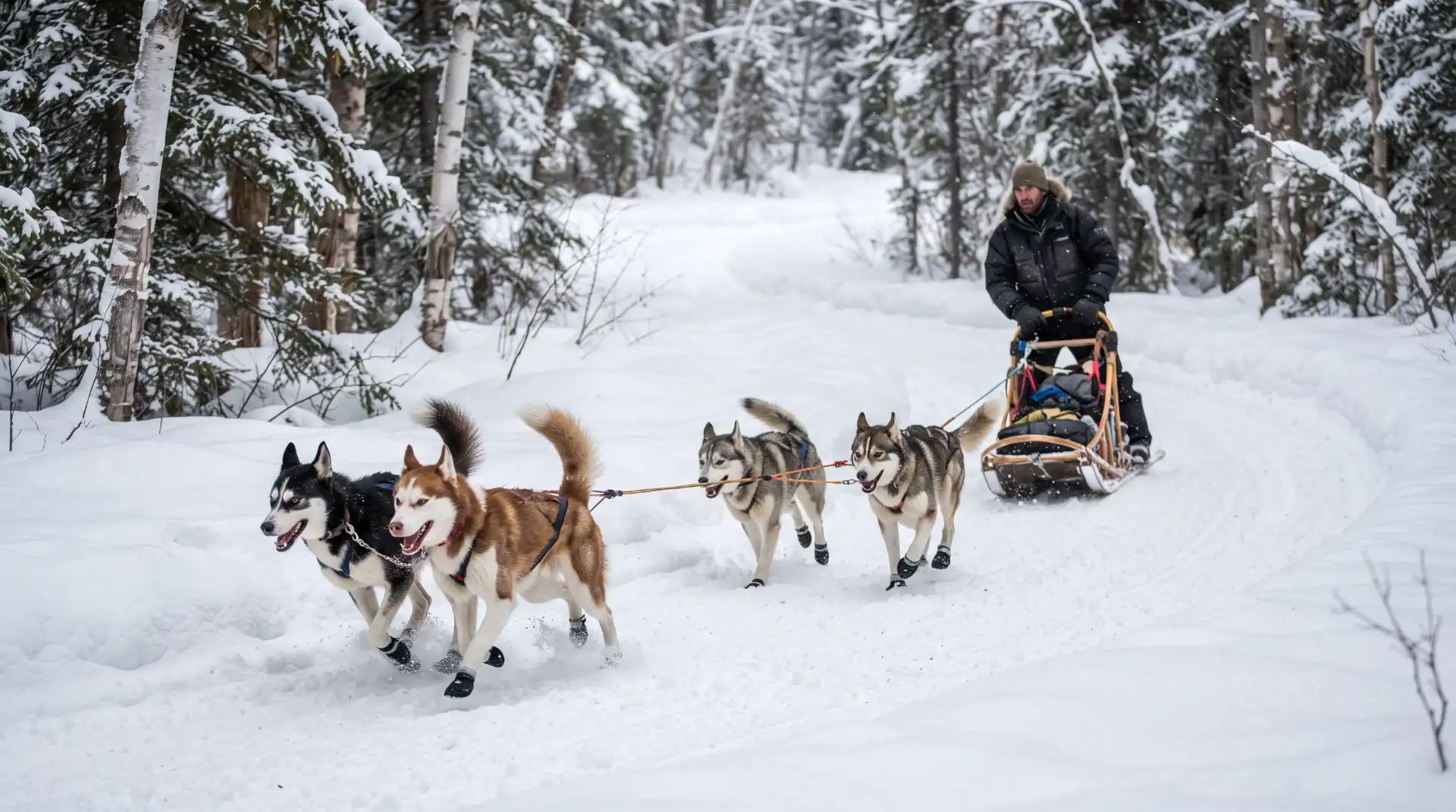
Behind the swing dogs are the team dogs.
In a larger lineup, this section can contain the majority of the dogs.
The name may sound generic, but these athletes provide much of the sustained power required to move the sled down the trail. They need excellent endurance, a dependable work ethic, proper conditioning, and the ability to run comfortably beside their partners.
Team dogs demonstrate why sled dog mushing is fundamentally a team sport rather than a collection of individual performances.
A musher does not simply search for the fastest dog and repeat that choice throughout the lineup. A sustainable team must find a rhythm.
Dogs running next to each other should ideally have compatible gaits and attitudes. If one dog constantly pulls faster than its partner, the pair may not work as efficiently as two dogs with similar running styles.
Relationships matter as well.
Dogs have individual personalities. Some enjoy running beside almost anyone. Others may perform particularly well with certain kennel mates.
Experienced mushers learn these preferences by changing pairings throughout training.
This is one reason the running order seen on one outing may look completely different during another.
The musher is constantly gathering information.
Wheel Dogs Work Closest to the Sled
Wheel dogs occupy the position immediately ahead of the sled.
Because of their location, they experience forces that are different from those acting on dogs farther forward.
When the sled moves around a turn, the wheel dogs are close to the large piece of equipment following behind them. They help pull the sled through the corner and keep the back of the team moving in the correct direction.
Strength is therefore particularly valuable in this position.
Large, powerful, composed dogs are often excellent candidates for wheel, although size by itself does not determine placement.
A wheel dog must also be comfortable working close to the sled.
The sound and movement of the equipment can be more noticeable there. On rough trails, the sled may bounce, slide, or move from side to side. A dog that becomes nervous around that motion may be happier elsewhere in the team.
Confidence and steadiness become important characteristics.
Experienced wheel dogs understand what is happening behind them and continue working without becoming distracted.
For spectators, the leaders naturally draw the eye. For mushers, however, reliable wheel dogs are among the foundations of a well-balanced team.
Strength Is Only One Part of the Decision
It would be easy to assume that mushers arrange dogs according to a simple formula: intelligent dogs in front and strong dogs in back.
In practice, the decision is considerably more complicated.
Physical ability is only one factor.
Mushers also evaluate temperament, confidence, responsiveness, endurance, recovery, experience, age, communication skills, running style, relationships between dogs, and the demands of the particular trail.
Consider two dogs with nearly identical physical ability.
One remains calm regardless of conditions, while the other becomes highly excited at the beginning of every run.
The calmer dog might be especially valuable in a position where steadiness is important. The energetic dog might perform beautifully beside a partner that helps regulate its pace.
The objective is not necessarily to find the individually “best” dogs.
The objective is to create the best functioning team.
That distinction is critical.
Pairing Dogs by Personality
Dogs running beside one another spend considerable time working as a pair.
Their personalities therefore matter.
Some combinations seem almost effortless. The dogs settle into matching gaits, maintain similar speeds, and appear comfortable working together.
Other combinations may require adjustment.
One dog might continually try to move ahead while the other prefers a steady rhythm. Two highly competitive personalities may spend too much energy challenging each other instead of settling into efficient movement.
A musher notices these behaviors during training.
Repeated observation helps reveal which partnerships make each dog perform naturally.
There can also be social considerations outside of running. Dogs that have comfortable kennel relationships may make effective partners on the gangline, although everyday friendship does not automatically guarantee the best working combination.
The trail ultimately provides the answer.
How Training Runs Help Determine the Lineup
Training is essentially a long evaluation process.
Mushers may experiment with numerous combinations before deciding which arrangement works best for a major run, race, or expedition.
One day, a developing leader might run beside a veteran.
During another session, the same dog might move into swing.
A strong team dog may be tested at wheel. A versatile veteran may spend time in several locations.
Each change teaches the musher something.
How quickly does the dog respond?
How does its gait change in a different position?
Does it appear more confident or less comfortable?
How does its partner respond?
Does the entire team become smoother after the change?
Modern mushing increasingly combines traditional observation with structured training and performance monitoring. Conditioning programs, training records, GPS data, recovery information, and other tools can help mushers understand how individual dogs respond to work.
This development connects naturally with the broader evolution of modern dog sledding. Training science and technology have expanded the information available to mushers, but familiarity with the dogs remains irreplaceable.
A data point can show speed.
It cannot completely explain why two particular dogs suddenly work beautifully together.
That understanding develops through experience.
Trail Conditions Can Change the Running Order
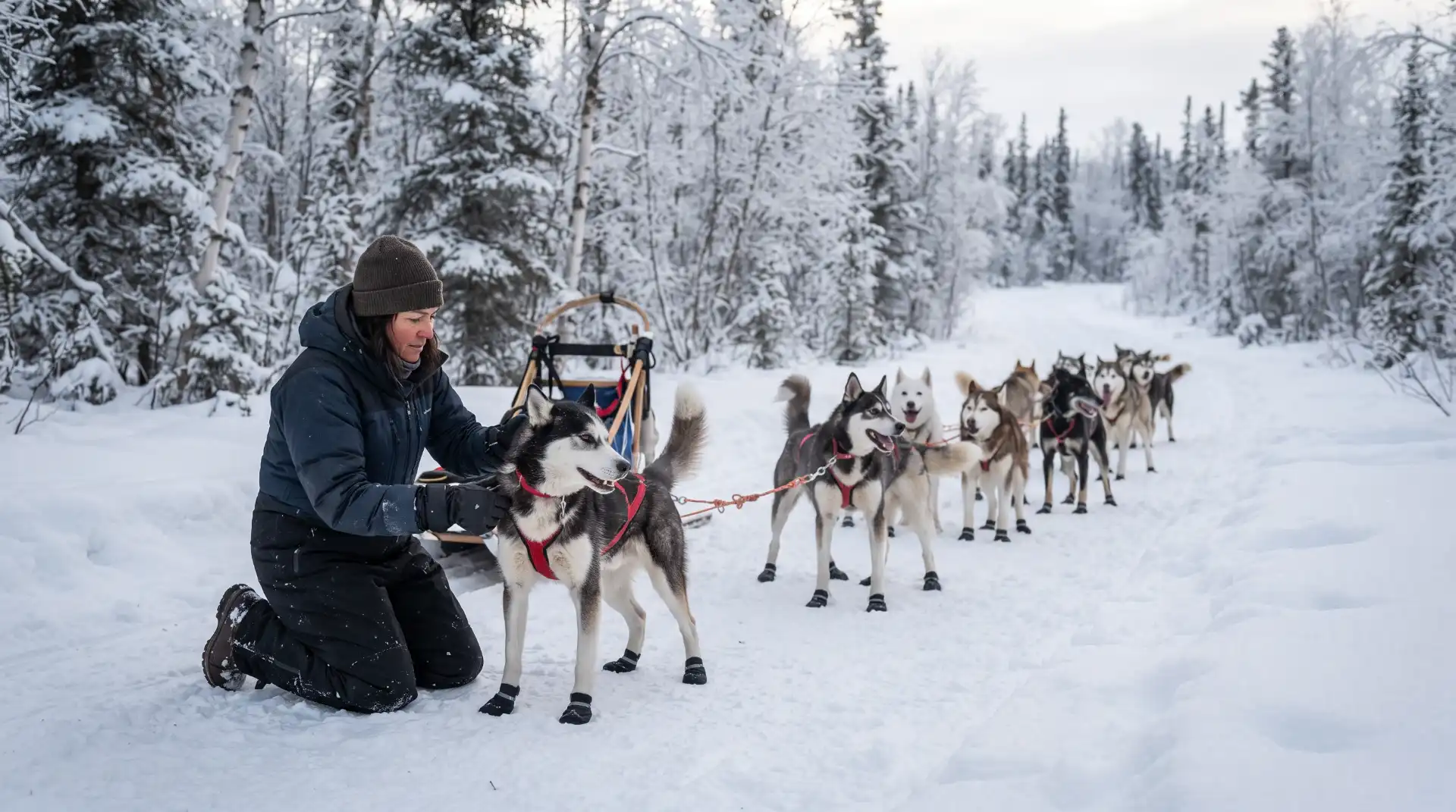
There is no perfect running order for every trail.
Terrain and weather can influence which dogs are placed where.
A leader that performs beautifully on clearly defined wooded trails may not be the musher’s first choice for a run requiring difficult route finding.
Another dog might demonstrate exceptional confidence in blowing snow or low visibility.
Some leaders may excel on fast, firm trails, while others perform particularly well on technical routes or unfamiliar terrain.
Experience also becomes valuable when obstacles appear.
A veteran dog that has encountered bridges, road crossings, steep descents, tight corners, frozen waterways, or crowded trail intersections may help stabilize younger teammates.
For this reason, the starting lineup is not merely a ranking from strongest to weakest.
It is a tactical response to the conditions expected that day.
Distance Matters Too
The ideal team for a short recreational run may differ from the lineup chosen for a long-distance outing.
Speed becomes important in some situations, while endurance and consistency matter more in others.
For longer runs, mushers think carefully about energy management.
A dog that starts extremely fast may need a partner capable of settling it into a sustainable pace. A veteran leader known for maintaining steady forward progress might be preferred over a younger dog that runs faster but wastes energy early.
Conditioning and nutrition are closely connected to these decisions.
Sled dogs are endurance athletes. Their ability to maintain performance depends on appropriate training, hydration, feeding, rest, and recovery.
Readers interested in the athletic side of mushing can explore Outlaw Ridge Sled Dogs’ guide to the role of nutrition in sled dog performance, which looks more closely at how feeding supports working sled dogs.
Team placement and conditioning ultimately work together. The best lineup cannot compensate for inadequate preparation.
Age and Experience Influence Placement
Young sled dogs typically need time to learn.
A promising youngster may have tremendous speed and enthusiasm but little experience with commands, distractions, turns, unusual terrain, or the routines of a full team.
Mushers usually create opportunities for these dogs to learn from veterans.
Running beside an experienced dog can provide structure. The youngster begins to understand pace, harness pressure, trail behavior, and the rhythm of working with the gangline.
As confidence increases, the musher may experiment with new positions.
This process can eventually reveal talents that were not obvious at first.
A young dog that initially seemed suited only to the middle of the team may develop into an outstanding swing dog. Another may demonstrate the focus required for leadership after gaining enough experience.
Experienced dogs remain valuable teachers throughout this development.
The knowledge within a sled dog team is not transmitted only from musher to dog. Dogs learn from one another as well.
Why Mushers Rotate Dogs
A position is a responsibility, not necessarily a permanent job title.
One of the most useful qualities a sled dog can develop is versatility.
A dog capable of working effectively in several positions gives the musher more options.
If a lead dog needs rest, another trained leader can move forward.
If trail conditions make a different type of leader preferable, the lineup can change.
If two dogs are not working particularly well together that day, their partners can be switched.
Rotation also helps mushers continue developing the team’s skills.
A dog that normally works in the middle might spend time in swing to improve responsiveness. A leader may occasionally run farther back rather than always carrying the mental responsibility of working at the front.
According to Iditarod educational materials, mushers may try dogs in different roles and rotate them according to their abilities, training needs, and the conditions encountered on the trail.
The ability to adapt is a defining characteristic of an experienced sled dog team.
What Happens When the Team Is Changed During a Run?
Long outings sometimes require adjustments after the team has already started.
A musher might decide that a different leader is better suited to the next section of trail. A dog may appear tired, distracted, or simply more comfortable in another position.
Changes can therefore happen during breaks.
Experienced mushers constantly observe their dogs rather than waiting for an obvious problem.
They pay attention to gait, enthusiasm, pulling effort, behavior, appetite, hydration, and interactions with teammates.
Small changes can reveal a great deal.
A dog that normally pulls strongly but suddenly has a loose tug line may need attention. A leader that begins repeatedly looking backward may not be as focused as usual.
Recognizing those subtle signals is part of knowing the team.
There Is No Single Perfect Sled Dog Lineup
Newcomers to dog sledding sometimes expect every successful team to follow one exact formula.
Mushing does not work that way.
The general positions are well established, but the dogs filling them depend on the team.
One kennel may have several exceptional leaders. Another may rely heavily on a particularly dependable veteran. Some wheel dogs are among the largest athletes in the kennel, while other successful wheel dogs are simply strong, confident, and exceptionally comfortable near the sled.
The lineup also evolves over time.
Young dogs mature.
Veterans gain experience.
Partnerships develop.
Fitness improves.
Trail conditions change.
A musher’s understanding of each dog becomes more detailed with every season.
The sled dog team running order is therefore a living system rather than a fixed chart.
The Musher Is Part of the Team
It is impossible to discuss running order without recognizing the role of the musher.
The person standing on the runners is not merely a passenger giving directions.
The musher trains the dogs, observes their behavior, cares for their health, learns their individual strengths, decides the lineup, manages the sled, reads the trail, and makes changes when necessary.
Communication between musher and dogs develops through repetition and trust.
The best leaders understand what is expected of them because they have spent many hours working with their musher.
The musher, in turn, understands how those dogs react in different situations.
This relationship is one of the reasons dog sledding cannot be reduced entirely to equipment, statistics, or racing strategy.
Modern technology can support training, but the foundation of the sport remains the partnership between people and dogs.
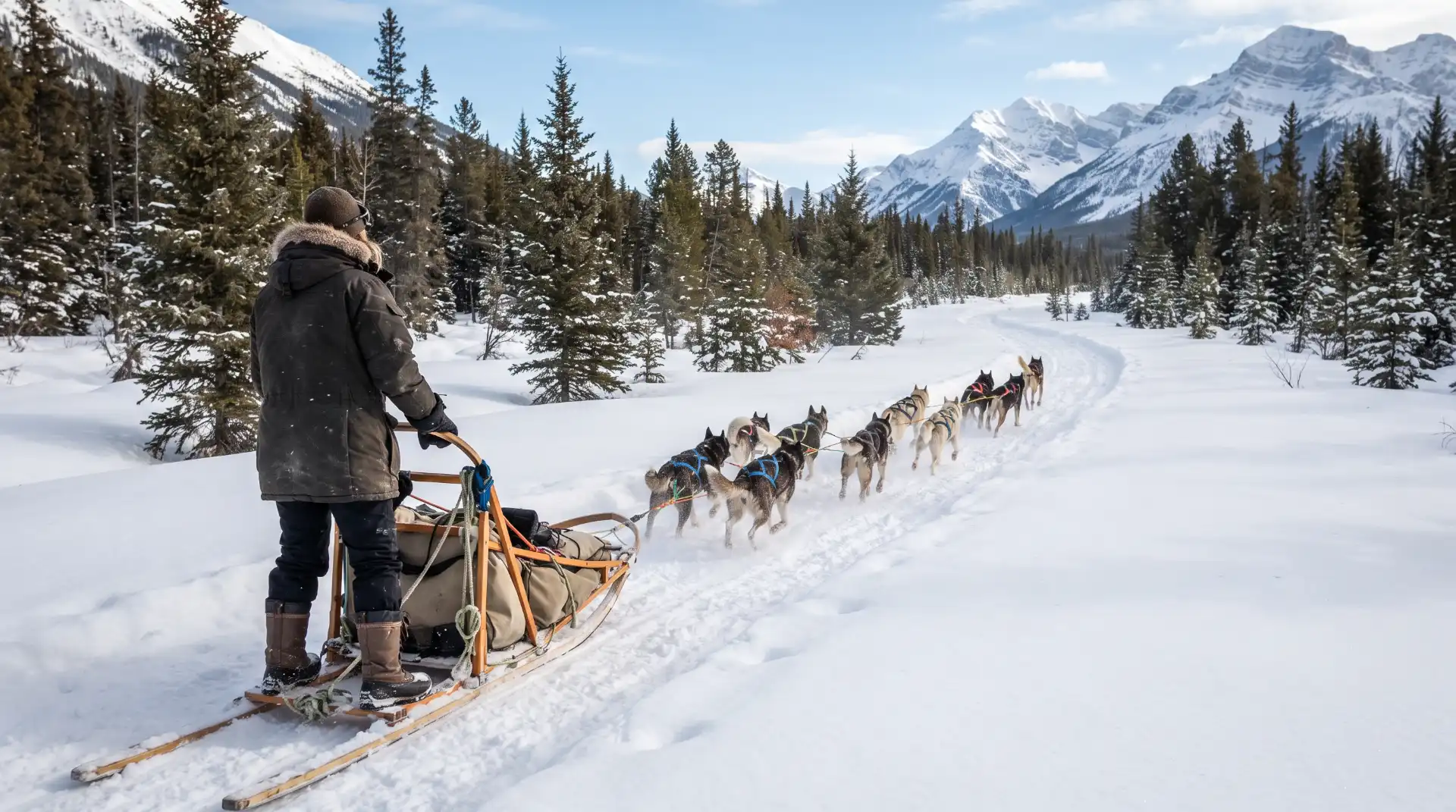
What Visitors Can Look for When Watching a Sled Dog Team
Understanding running order makes watching a sled dog team much more interesting.
Instead of seeing only a group of dogs pulling a sled, visitors can begin identifying the jobs being performed.
Look toward the front and watch how the leaders respond when the musher gives a command.
Notice how the dogs behind them follow through a turn.
Watch the middle of the team settle into a steady pulling rhythm.
Then look at the wheel dogs as the sled moves through a corner and observe how close they work to the equipment.
It becomes easier to see that the team is not simply moving forward through brute strength.
It is coordinated.
Visitors who are new to the activity can also benefit from learning the fundamentals before heading onto the trail. Outlaw Ridge Sled Dogs’ beginner guides explain what newcomers can expect from the broader dog sledding experience and provide useful background for understanding how a working team operates.
Once you recognize the positions, every run begins to tell a story.
Running Order Reflects the Individual Dogs
Perhaps the most important lesson behind sled dog positioning is that every dog is an individual.
One may be an extraordinary problem solver.
Another may possess tremendous pulling strength.
A third may maintain an incredibly consistent pace over long distances.
Another may excel at helping young dogs remain calm.
Some naturally want to lead. Others seem happiest providing dependable power from the middle.
Successful mushing depends on recognizing these characteristics and allowing the dogs to contribute where they perform confidently and effectively.
That is what separates a collection of athletic dogs from a true sled dog team.
Final Thoughts
Deciding the running order of a sled dog team combines experience, observation, training, strategy, and deep familiarity with the dogs.
Lead dogs provide direction and respond to the musher’s commands. Swing dogs help the team move smoothly through turns. Team dogs supply sustained pulling power, while wheel dogs work immediately in front of the sled and help manage the demands of that challenging position.
But those basic definitions tell only part of the story.
Mushers must also consider personality, partnerships, age, conditioning, experience, trail conditions, distance, weather, and the individual strengths of every dog.
The lineup that works perfectly today may be adjusted tomorrow.
That adaptability is not a sign that the musher has failed to determine the correct order. It is evidence of thoughtful team management.
A skilled musher knows that every dog has something different to contribute.
By placing the right dogs together and giving them roles suited to their abilities, the musher creates something much greater than individual strength: a coordinated team capable of moving confidently through the winter landscape.
The next time you see a sled dog team charging down a snowy trail, look beyond the speed.
Watch the leaders read the route. Notice the swing dogs follow them through the turn. Observe the steady work happening through the middle of the team and the strength of the wheel dogs closest to the sled.
Every position has a purpose.
Every dog has a role.
And the way those roles come together is one of the skills that makes mushing such an extraordinary partnership between humans and dogs.