
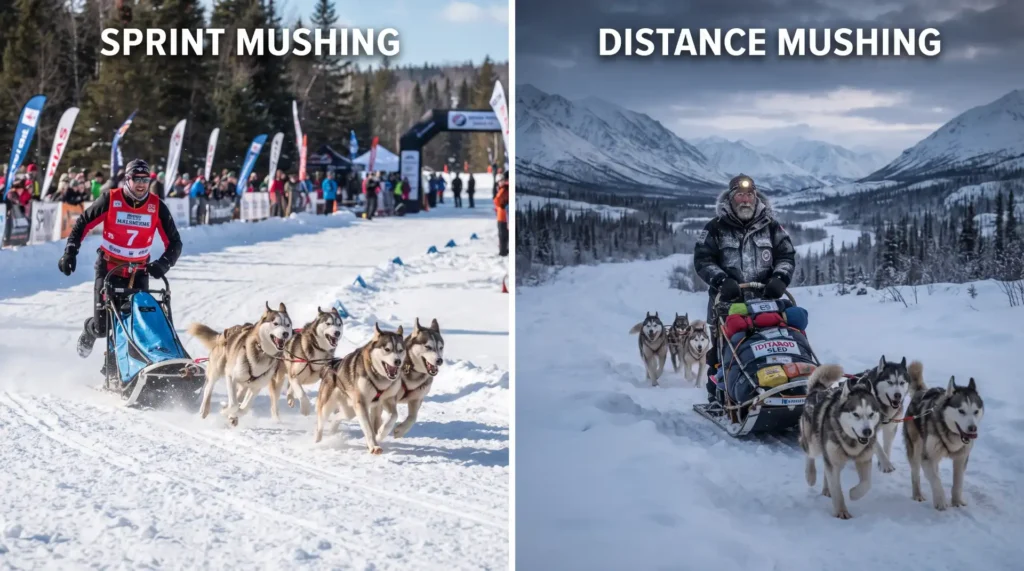
Dog sledding can look deceptively simple from the sidelines. A team of eager dogs lines up in harness, the musher steps onto the runners, and within moments the entire team is moving across the snow. Yet sled dog racing is not a single type of competition. Different forms of mushing place remarkably different demands on the dogs, the musher, the equipment, and the training program.
Two of the most recognizable forms are sprint mushing and distance mushing.
The easiest way to describe the difference is that sprint racing emphasizes speed over relatively short courses, while distance racing requires teams to travel much farther while managing endurance, rest, nutrition, weather, and changing trail conditions. That simple explanation, however, only begins to show how different the two disciplines really are.
A sprint team may race at a high pace while mushers think about seconds, efficient turns, and maintaining momentum. Distance mushers must think hours or even days ahead. They manage feeding, rest schedules, dog health, changing temperatures, equipment, checkpoints, sleep, trail strategy, and the challenge of keeping an athletic team performing efficiently over hundreds of miles.
Both disciplines demand highly conditioned dogs and knowledgeable mushers. Neither is simply an easier version of the other.
Understanding sprint mushing vs. distance mushing reveals how varied the sport has become in the United States and why different dogs, training methods, equipment, and strategies may excel in each discipline.
What Is Sprint Mushing?
Sprint mushing is the speed-oriented side of sled dog racing.
According to the International Sled Dog Racing Association’s sprint racing rules, sprint racing takes place at a faster pace than mid-distance or distance competition. Teams travel shorter courses, often over successive days, with classes organized partly according to the number of dogs in the team.
The exact race format varies among events. In some competitions, teams run the same or comparable courses on consecutive days, with their times combined to determine the final result. Because the distances are short compared with long-distance races, teams can maintain speeds that would not be practical during a journey lasting hundreds of miles.
For spectators, sprint racing can be particularly exciting because everything happens quickly.
Teams leave the starting area with enormous energy. Dogs accelerate rapidly, snow flies behind the sled, and mushers concentrate on maintaining the fastest efficient line around corners and across changing sections of trail.
Tiny differences matter.
A slow turn, brief tangle, poor start, or momentary loss of momentum can influence the final standings. Sprint mushers therefore spend considerable time developing speed, synchronization, command response, and efficiency.
It is not simply a matter of telling the dogs to run as fast as possible. Successful sprint teams must be controlled, coordinated, and exceptionally well conditioned.
What Is Distance Mushing?
Distance mushing sits at the other end of the competitive spectrum.
In major distance events, sled dog teams may travel hundreds of miles over several days. Speed still matters because competitors are trying to complete the course efficiently, but the way that speed is managed becomes completely different.
A team traveling hundreds of miles cannot approach every section like a sprint heat. Mushers must establish a sustainable pace while accounting for rest, feeding, hydration, terrain, temperatures, weather, dog condition, and their own physical and mental fatigue.
Well-known American races, particularly those held in Alaska, have helped make long-distance mushing one of the most recognizable forms of the sport. These events may involve extensive travel through remote winter landscapes where trail conditions and weather can change dramatically from one section to another.
Distance racing therefore becomes a combination of athletic competition, animal care, wilderness travel, logistics, trail knowledge, and strategic decision-making.
Sprint Mushing vs. Distance Mushing: The Core Difference
The simplest distinction between sprint and distance racing is the type of performance the team is expected to sustain.
Sprint racing emphasizes high speed and maximum efficiency over a relatively short course. Distance racing asks dogs and mushers to sustain productive movement over far greater distances while repeatedly managing work and recovery.
A sprint musher may focus heavily on acceleration, fast command response, smooth turns, and maintaining an efficient racing line. A distance musher must think about those same fundamentals while also considering what today’s pace will mean many miles later.
The difference is somewhat similar to comparing a human track athlete with an ultramarathon runner. Both are highly trained athletes, but the physical and strategic demands are very different.
Different Athletic Demands on Sled Dogs
All competitive sled dogs are athletes, but athletes can specialize.
Sprint dogs must develop the ability to generate and maintain high speeds over comparatively short distances. Efficient gait, acceleration, enthusiasm, coordination, cardiovascular fitness, and the ability to work at high intensity become particularly important.
Distance dogs face another type of challenge.
They must continue performing after the excitement of the opening miles has passed. They may encounter climbing, wind, soft snow, hard-packed trail, darkness, rapidly changing temperatures, and many hours of repetitive work.
Their greatest athletic talent may be consistency.
A successful distance dog needs more than the ability to run. The dog must recover efficiently, eat and drink appropriately, remain mentally engaged, and be ready to work again following scheduled rest.
This makes recovery almost as important as the running itself.
How Sprint Sled Dog Teams Train
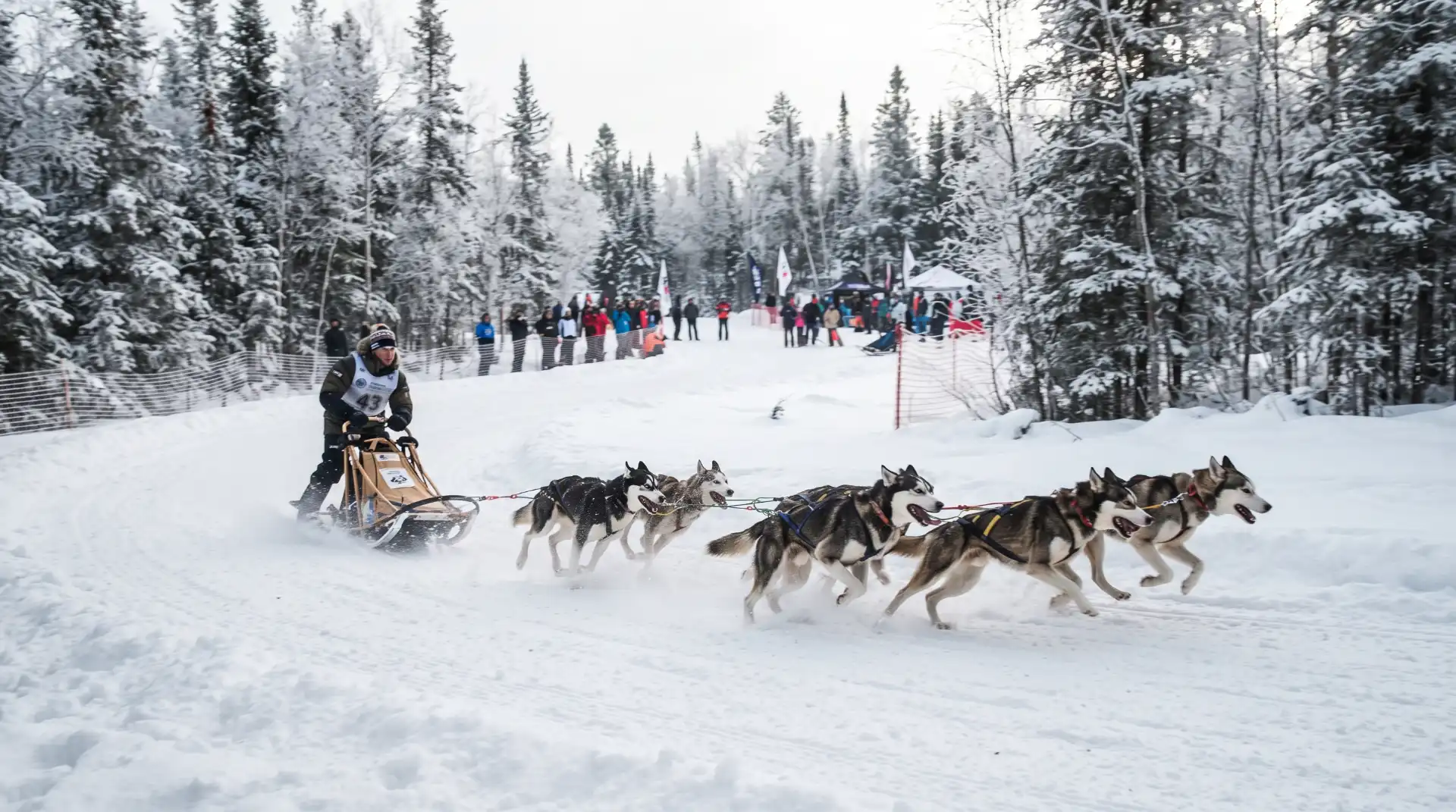
Sprint training generally revolves around developing speed without sacrificing control or efficiency.
Mushers gradually condition dogs rather than beginning a season with maximum-speed runs. Early training may involve shorter sessions designed to rebuild fitness, reinforce trail commands, evaluate pairings, and restore the team’s working rhythm.
As conditioning improves, speed-oriented training becomes increasingly important.
The musher pays attention to how smoothly each dog moves, how well partners run together, and whether the entire gangline remains organized. A very fast dog that disrupts the rhythm of its partner may not make the overall team faster.
Team composition therefore becomes a major part of sprint preparation.
The dogs need to accelerate together and settle quickly into an efficient pace. Leaders should respond promptly to commands. Wheel dogs need confidence close to the sled, while the musher must avoid unnecessary braking or corrections.
Warmer fall conditions can complicate preseason preparation in many parts of the United States. That is why dryland training for sled dogs can play an important role when reliable snow has not yet arrived.
Dryland conditioning allows mushers to reinforce commands, teamwork, fitness, and pulling behavior using appropriate wheeled equipment and carefully selected conditions before winter trails become available.
How Distance Sled Dog Teams Train
Distance training also builds gradually, but the central question changes.
Instead of asking only how fast a team can travel, the musher must determine whether the dogs can maintain productive movement for extended periods and recover well enough to repeat the effort.
Mileage becomes increasingly important as the season progresses.
Long-distance dogs need experience spending extended periods on the trail. They learn a rhythm that can include running, stopping, resting, eating, sleeping, and returning to work.
Mushers learn just as much during these training sessions. They observe which dogs eat readily after demanding runs, how quickly individual dogs recover, which animals remain mentally confident under difficult conditions, and how leaders respond after hours instead of minutes of work.
Training can incorporate hills, varied snow, darkness, long stretches between stops, and other situations teams may encounter during actual distance events.
That preparation is psychological as well as physical.
Speed Means Something Different in Each Discipline
One misconception about distance racing is that it is slow.
Distance teams can travel impressively quickly on favorable sections of trail. The key difference is that their pace must remain sustainable.
A sprint musher enters a heat knowing the dogs only need to maintain race effort for a relatively short period.
A distance musher must consider what an aggressive pace now could mean many hours later.
Running too hard early may temporarily gain time while making recovery more difficult later. This creates one of the central strategic challenges of long-distance mushing: deciding when additional speed is worthwhile and when patience will produce better overall performance.
Experienced mushers continuously evaluate trail conditions, temperatures, upcoming terrain, the condition of individual dogs, and opportunities for rest.
The fastest team at a particular moment is not necessarily the team best positioned to reach the finish efficiently.
Nutrition Is Especially Important in Distance Mushing
Food matters in every form of sled dog competition, but its importance becomes especially obvious as distance increases.
Working sled dogs expend substantial energy. Teams traveling extended distances need an appropriate plan for replenishing that energy while allowing dogs to continue performing and recovering.
Mushers therefore pay close attention to feeding, appetite, hydration, body condition, and recovery.
Readers who want to explore this subject further can read Outlaw Ridge Sled Dogs’ guide to the role of nutrition in sled dog performance, which examines how feeding and hydration relate to the demands placed on canine athletes.
Nutrition also demonstrates why sprint and distance racing cannot be compared only by speed.
As race length increases, managing the dogs between periods of running becomes an increasingly important part of successful mushing.
Equipment Changes With the Type of Race
Sprint equipment is generally selected with speed, efficiency, safety, and the requirements of the particular race class in mind.
The musher does not need to transport the same quantity of supplies that might be necessary during extended wilderness travel. Avoiding unnecessary weight can matter when small differences in time influence race results.
Distance racing creates a different equipment challenge.
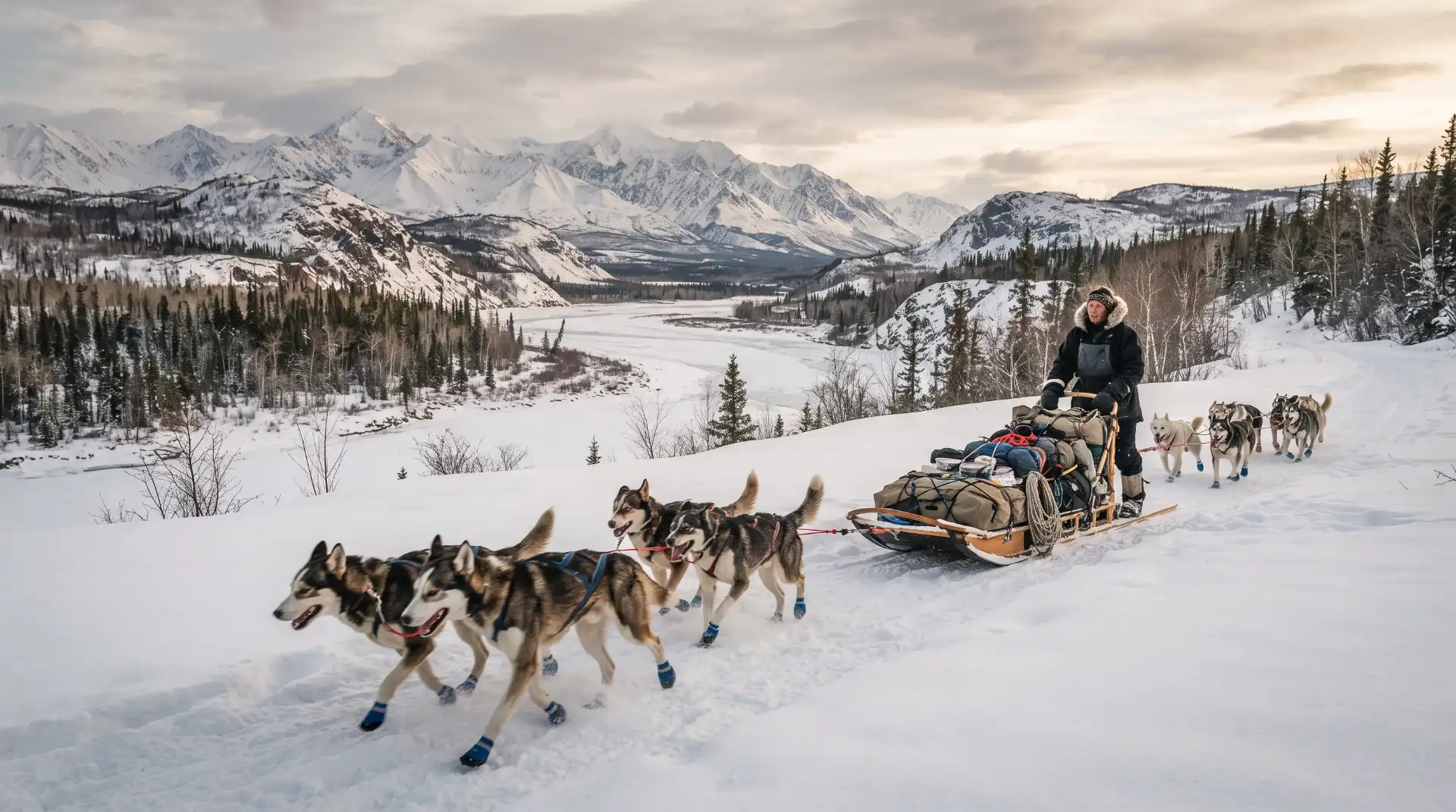
Depending on the event and its rules, mushers may need supplies related to dog care, personal survival, repairs, feeding, navigation, weather protection, and extended trail travel.
The sled consequently becomes more than a racing platform. It must help transport what is needed to move safely and efficiently through long sections of winter terrain.
Equipment reliability becomes especially important. A minor problem close to a sprint-race venue can be very different from a failure encountered in remote country.
Team Size and Composition Can Differ
There is no universal number of dogs for every sled race.
Sprint competition includes several classes, and ISDRA’s sprint sled standards include classes ranging from small dog teams to larger and unlimited teams.
Individual distance races establish their own rules concerning starting team size and other requirements.
Beyond the number of dogs, mushers must think about what type of athletes make the strongest overall team.
Sprint mushers may place particular value on dogs whose speed, gait, enthusiasm, and physical characteristics allow them to perform efficiently at a high pace.
Distance mushers need dogs with outstanding endurance and recovery. They value animals that remain eager after substantial mileage, eat and rest appropriately, tolerate changing conditions, and cooperate well with teammates over extended periods.
Leadership requirements can also differ.
A sprint leader needs quick responsiveness and strong command recognition because there may be little time for hesitation when approaching turns at speed.
A distance leader requires those same qualities but may also be asked to navigate unfamiliar trails, darkness, wind, changing snow, and difficult conditions after many hours of work.
Rest Is Part of Distance-Racing Strategy
Rest is one of the most misunderstood parts of long-distance mushing.
A new spectator may see one team resting while another continues down the trail and assume the stationary team is simply losing time.
Sometimes it is. In other situations, however, planned recovery can help a team maintain stronger performance across the entire race.
Distance mushers think about the relationship between work and recovery. A well-timed stop can provide an opportunity for dogs to eat, rest, and regain energy before beginning another demanding section.
Choosing when to stop therefore becomes strategic.
Rest too much and competitors may create a substantial gap. Rest too little and the team may struggle to maintain its strongest sustainable performance later.
Sprint teams also require recovery, particularly during competitions held over several heats or days, but rest does not usually dominate in-race strategy in the same way.
The Musher Faces Different Physical Challenges
The dogs are not the only athletes.
Sprint mushers may kick, pedal, shift their weight, work aggressively through turns, and stay highly active to avoid creating unnecessary resistance for the team.
The effort is intense and precise.
Distance mushers may perform many of those same actions, but fatigue accumulates on a much larger scale.
They can spend many hours outdoors, sleep irregularly, work in severe winter conditions, organize equipment, care for dogs, manage food and water, make repairs, navigate trails, and then continue traveling.
Mental fatigue can become equally important.
The musher still has to make sound decisions when tired, including decisions about individual dogs and whether they should continue, change positions, rest, or receive additional attention.
Long-distance mushing therefore rewards patience, organization, resilience, and disciplined decision-making in addition to sled-driving skill.
Weather Can Affect Sprint and Distance Teams Differently
Winter weather influences every sled dog event.
Fresh snow can slow a sprint course. Wind may cover established tracks. Temperature can change the texture and speed of the trail.
Distance mushers face the additional challenge that conditions may change dramatically during the same event.
A team might start beneath clear skies and later encounter wind, fresh snow, bitter cold, warmer daytime conditions, or trail sections transformed by weather.
Surfaces can also change. Hard-packed snow may be comparatively fast, while loose or newly fallen snow creates additional resistance. Hills, frozen waterways, forests, exposed terrain, and wind can all affect the workload.
The musher and team must adjust continuously.
Mid-Distance Mushing Bridges the Gap
Sprint and distance racing are not the only two forms of competitive mushing.
Mid-distance competition occupies important territory between them.
These events may introduce more significant endurance and pacing requirements without reaching the scale of races covering several hundred miles.
For developing dogs and mushers, this can offer valuable experience.
A team interested in progressing toward longer competitions can gradually increase distance as conditioning, trail experience, teamwork, and recovery improve.
That progression reflects a fundamental principle of responsible sled dog conditioning: demanding workloads should be developed gradually rather than introduced all at once.
What Does Long-Distance Mushing Feel Like?
Distance racing is not simply a sprint race that lasts longer. The character of the experience changes as the miles accumulate.
Early in a race, teams may be surrounded by competitors, race crews, spectators, handlers, and excitement.
Farther down the trail, the environment can become remarkably quiet.
The team may travel for extended periods with little more than the sound of paws, runners, breathing, harnesses, and winter wind.
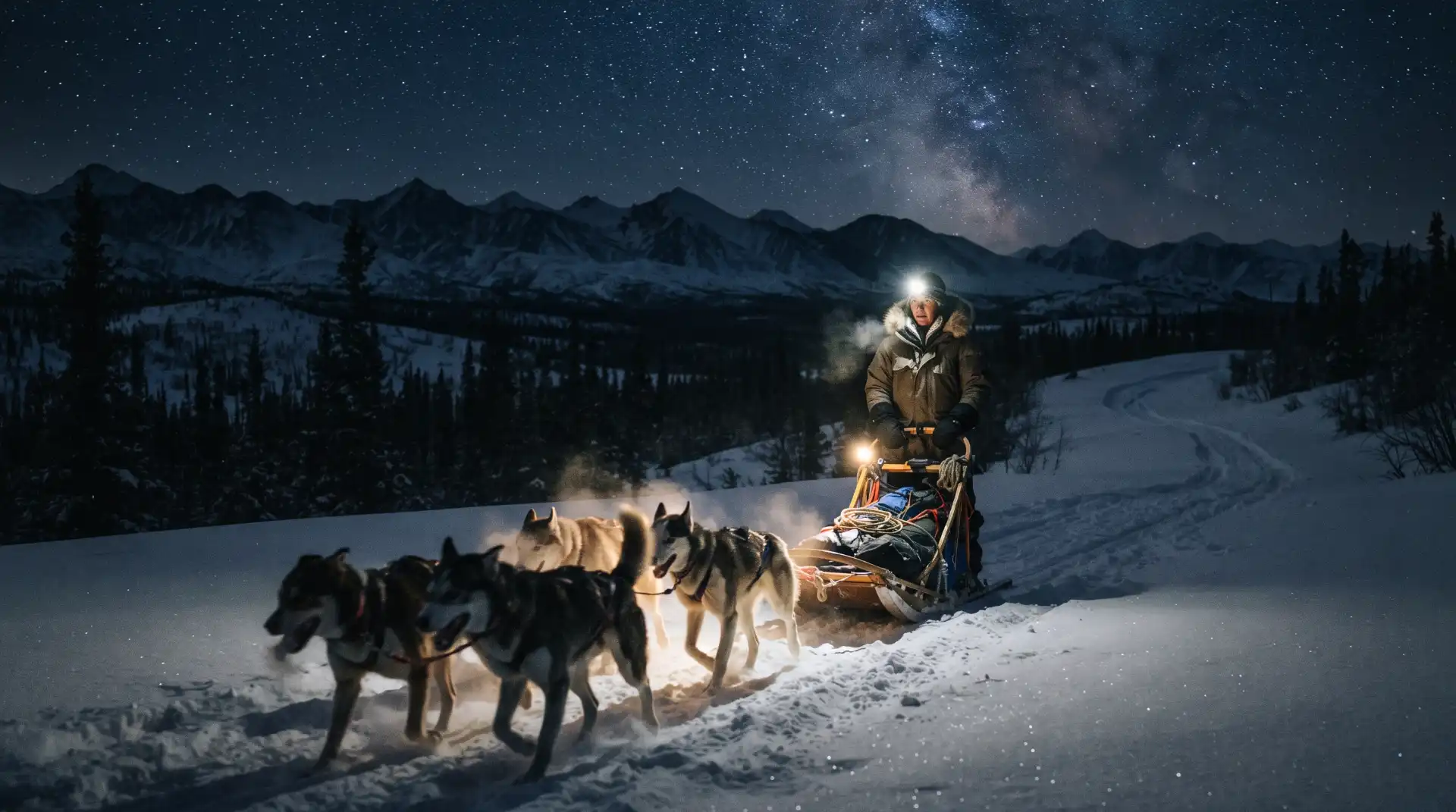
Night travel changes the experience again.
Headlamps illuminate only part of the trail, temperatures may fall, and familiar landmarks can become harder to see. The musher increasingly depends on experienced leaders, preparation, and established routines.
Those interested in the extended wilderness side of the sport can also explore Outlaw Ridge Sled Dogs’ article about multi-day sled dog expeditions. Although recreational expeditions and competitive races are different activities, both demonstrate how dramatically the experience changes when a dog sled journey extends far beyond a short outing.
Sprint racing has an atmosphere all its own.
Starts are energetic. Teams often know that something exciting is about to happen, and managing that enthusiasm before departure can require considerable skill.
Once released, the dogs accelerate quickly.
Their athleticism becomes immediately visible as the team settles into an efficient gait and the musher works behind them.
Turns are especially interesting to watch.
A well-organized team can move through a corner with remarkably little disruption. Leaders choose the route, dogs behind them follow the arc, and the musher handles the sled while trying to preserve momentum.
Because sprint courses are relatively short, small improvements in efficiency may have a significant influence on the final time.
That precision is a major part of the discipline’s appeal.
Why Distance Mushing Captures So Much Attention
Distance mushing tells a different type of story.
America’s well-known northern sled dog races have attracted attention because they combine competition with wilderness travel, weather, changing race strategies, canine athleticism, and the relationship between mushers and their teams.
Instead of following only a brief heat, fans may watch a race evolve over days.
Which teams are moving? Which are resting? Has a musher changed strategy? How is the weather affecting the trail? Which dogs are running in lead?
The answers change continuously.
That uncertainty turns long-distance mushing into a very different spectator experience from sprint racing.
Sled Dog Welfare Matters in Every Discipline
Despite their differences, sprint and distance mushing share one fundamental responsibility: sled dogs must receive appropriate care.
Training should match the workload being asked of the dog.
A sprint dog should not suddenly be expected to perform an intense competition effort without progressive conditioning. Likewise, distance dogs should not jump abruptly from short training runs to extreme mileage.
Appropriate conditioning, rest, nutrition, hydration, veterinary care, properly fitted equipment, paw care, and careful observation all support responsible sled dog management.
The discipline may change, but the musher’s responsibility for the dogs does not.
Can the Same Dog Compete in Sprint and Distance Mushing?
Some sled dogs are versatile enough to participate in different styles of mushing, but an individual dog’s ideal discipline depends on its characteristics, conditioning, experience, and training.
One dog may show exceptional high-speed ability and thrive during shorter efforts. Another may demonstrate outstanding endurance and recover rapidly from longer runs.
Others may be particularly well suited to the middle ground.
Mushers identify these differences through observation. They watch gait, enthusiasm, pulling behavior, recovery, appetite, confidence, and relationships with teammates.
The goal should not be to force every dog into the same role or discipline. It is to understand the individual animal and build a team suited to the work being performed.
Recreational Mushing Borrows Lessons From Both
Most people who experience dog sledding will never enter a competitive sprint or distance race.
Even so, recreational mushing uses lessons found in both disciplines.
Shorter outings rely on controlled movement, clear communication, conditioned dogs, appropriate equipment, and efficient teamwork.
Longer adventures introduce some of the considerations associated with extended travel, including pacing, weather preparation, equipment management, and spending more time on the trail.
If you are completely new to the activity, Outlaw Ridge Sled Dogs’ guide to dog sledding for beginners provides a useful introduction to sleds, harnesses, commands, training, trail safety, and the basics of working with a dog team.
Which Style of Mushing Is Harder?
There is no universal answer because the disciplines test different abilities.
Sprint mushing demands speed, precision, athletic conditioning, efficient teamwork, and control. Mistakes can matter considerably because the course provides little time to recover lost seconds.
Distance mushing demands endurance, logistics, patience, dog care, recovery management, wilderness experience, and the ability to make sound decisions despite fatigue.
The challenges are different rather than simply greater or lesser.
It is similar to asking whether a track sprinter or an ultramarathon runner participates in the harder sport. Each athlete is being pushed toward a different type of performance.
That diversity is one of the qualities that makes dog mushing so interesting.
Final Thoughts on Sprint Mushing vs. Distance Mushing
The biggest difference between sprint mushing and distance mushing is not simply the number of miles between the start and finish.
Sprint racing is built around speed and efficiency. Teams travel comparatively short courses at high intensity, where acceleration, teamwork, rapid command response, smooth turns, and precise sled handling can influence the outcome.
Distance mushing transforms the challenge into one of sustained performance. Dogs and mushers may travel hundreds of miles while managing rest, feeding, weather, equipment, terrain, recovery, and strategy.
Sprint teams are trying to cover a relatively short course as efficiently and quickly as possible.
Distance teams must determine how to remain efficient across an enormous one.
Both depend on carefully conditioned sled dogs. Both require communication between dogs and musher. Both reward preparation, observation, and teamwork. And both demonstrate the remarkable athletic abilities of dogs trained to work together.
The next time you see a sled dog race, look beyond the speed.
Consider the size of the team, the distance ahead, the equipment being carried, the dogs’ running rhythm, and the musher’s movement behind the sled.
Those details begin to reveal what kind of challenge the team is facing.
Whether they are racing several fast miles over a groomed trail or traveling hundreds of miles through northern wilderness, the foundation remains remarkably similar: healthy, conditioned dogs and an experienced musher working together as one coordinated team.
That partnership remains at the heart of every form of mushing.