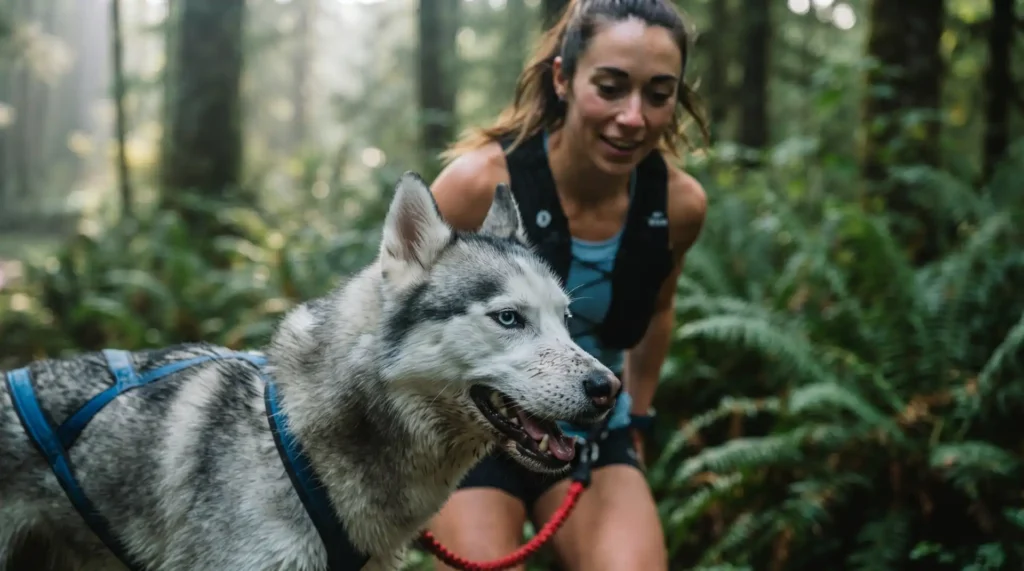
Sled dogs may be famous for running across snowy landscapes, but their conditioning does not have to disappear when winter ends. Canicross training gives sled dogs and their handlers another way to practice pulling, commands, teamwork, and controlled endurance when snow is unavailable. During warmer months, however, training plans need to place temperature, trail surfaces, hydration, workload, and each dog’s condition ahead of mileage.
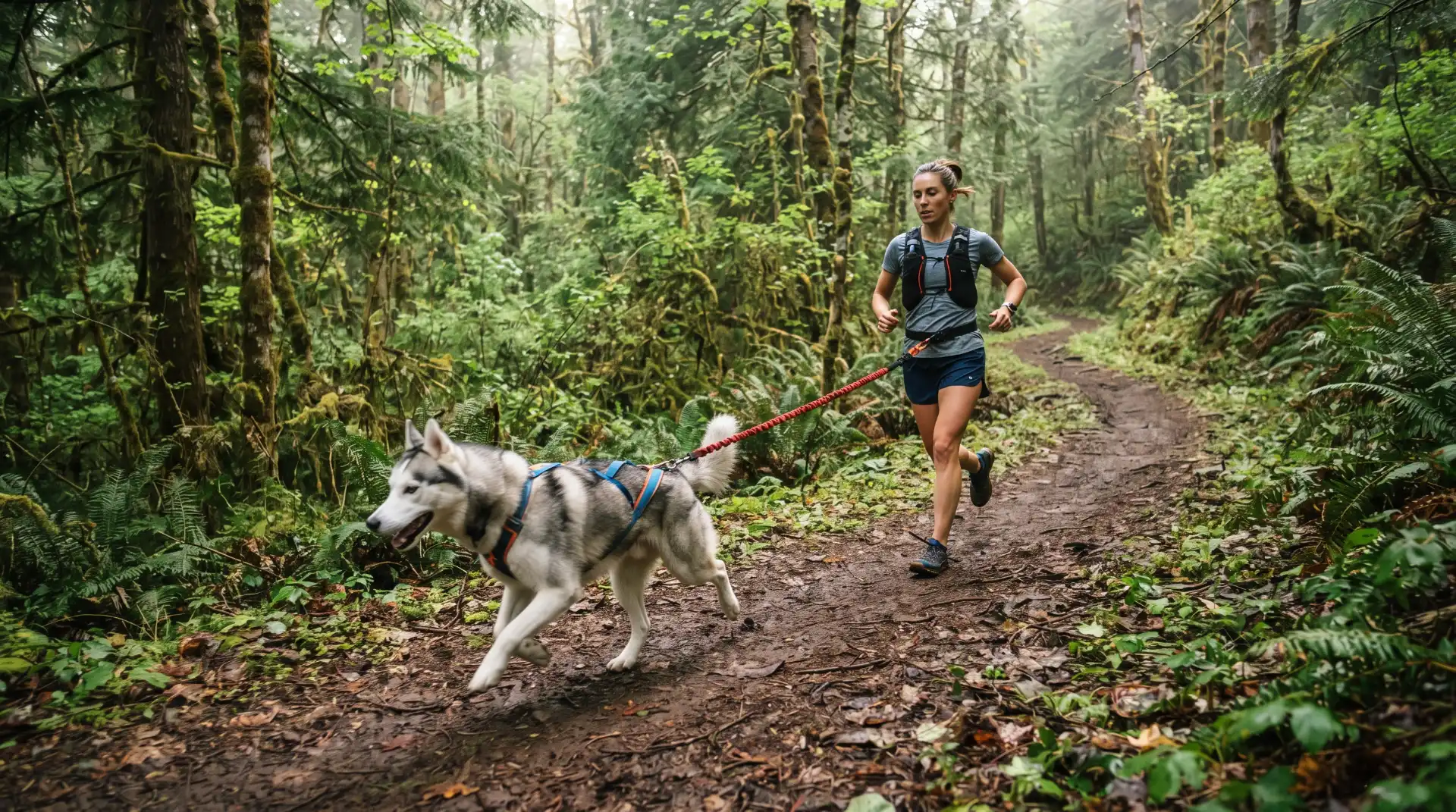
For U.S. mushers dealing with increasingly variable shoulder seasons, canicross can become a useful part of a broader dryland program. Instead of attaching a dog to a sled, the dog runs in front of a person while wearing a pulling harness. A bungee line connects the harness to a belt worn by the runner.
The result resembles a very small mushing team, with the dog maintaining forward position while responding to directional and pace commands.
Canicross is not simply taking a dog jogging. The sport incorporates pulling behavior, specialized equipment, trail communication, and teamwork. Those similarities make it particularly interesting for sled dog handlers looking for ways to maintain familiar working habits away from snow.
The American Kennel Club describes canicross as a sport in which a dog runs in front of a runner and is connected through a bungee line attached around the runner’s waist. Its guidance also emphasizes gradually building endurance and using equipment designed for pulling.
For sled dogs, those principles fit naturally into many established mushing routines.
What Is Canicross Training?
Canicross combines cross-country running with canine pulling. The dog runs ahead while the person follows behind, connected through a flexible line.
Unlike conventional leash running, the dog is generally encouraged to maintain tension on the line and move forward. That creates a working pattern familiar to dogs trained for sledding, skijoring, bikejoring, and other pulling sports.
A typical setup includes a pulling harness fitted to the dog, a shock-absorbing bungee line, and a waist or hip belt for the runner.
Specialized equipment matters because a conventional walking harness may not distribute pulling pressure appropriately. A pulling harness is designed to allow freer shoulder movement while distributing force across the dog’s body.
This distinction becomes particularly relevant for sled dogs. They already understand that certain harnesses and commands signal work. Moving from a winter sled setup to canicross can preserve some of those familiar associations.
Canicross also requires fewer dogs and less equipment than most forms of dryland mushing. A handler can work individually with one dog, making it easier to focus on command response, confidence, pacing, and behavior.
For people interested in the larger transition from snow mushing to warm-season conditioning, our guide to dryland training for sled dogs explores how changing winter conditions are influencing modern training programs.
Why Canicross Fits Sled Dog Training
Sled dogs possess qualities that translate naturally into canicross. They often enjoy running, understand harness work, and have experience responding to commands while moving ahead of a handler.
The scale, however, changes considerably.
A sled dog working within an eight-dog team responds to both the musher and the surrounding dogs. During canicross, that same dog may work alone with the runner.
This creates an interesting training opportunity.
A dog that normally depends on stronger teammates may become more confident when asked to work independently. A potential lead dog may receive additional command practice without distractions from an entire team. A young dog can begin learning that harness time means controlled forward movement.
Canicross can also help handlers understand individual personalities.
One dog might immediately pull confidently down the trail. Another might constantly look back for reassurance. Some naturally maintain an even pace, while others surge forward before slowing down.
Those differences may become easier to observe when only one dog and one runner are involved.
Understanding individual behavior can later help when organizing a larger sled team. Our article about sled dog breeds and their working characteristics provides additional background on the traits commonly associated with dogs bred for mushing.
Warmer Months Require a Different Mindset
Warm-season training should not simply copy a winter conditioning program.
Sled dogs are exceptional cold-weather athletes. Many traditional northern breeds have dense coats and physiological characteristics suited to cold conditions. Those same qualities make careful heat management especially relevant during warmer weather.
Training conditions across the United States vary significantly.
A cool September morning in Alaska is different from an August morning in Minnesota, Colorado, Montana, or the Northeast. Humidity, direct sunlight, elevation, wind, ground temperature, and trail surface can all affect the conditions a dog experiences.
For this reason, calendar dates alone are not enough for deciding whether to train.
Handlers should evaluate actual conditions each day.
Even when the air seems comfortable to a person, dogs may experience heat differently. Exercise generates additional body heat, and running dogs rely heavily on panting for cooling.
Canicross sessions during warmer periods often work better when they are shorter, slower, and scheduled during cooler portions of the day.
Many handlers favor early mornings when overnight temperatures have reduced both air and ground temperatures. Shaded dirt or forest trails may also provide better conditions than exposed pavement.
The American Kennel Club cautions that hot pavement can burn paws and contribute to overheating. Checking the surface before training is therefore just as relevant as checking the weather.
Temperature Matters More Than Mileage
Distance can be tempting as a measure of progress.
A three-mile run sounds better than a one-mile run. A five-mile outing might appear better still.
Sled dog conditioning, however, is not simply a contest to accumulate miles.
A short, controlled run under appropriate conditions may contribute more to productive training than pushing through excessive heat simply to reach a distance target.
Warm-season training should focus on quality.
A dog that finishes an appropriate session eager, responsive, and moving comfortably may gain more than a dog completing excessive mileage while struggling with heat.
Handlers can gradually increase workload as cooler weather approaches and the dog’s conditioning develops.
Age, health, fitness, coat, previous conditioning, and individual heat tolerance also matter. A veterinary evaluation can help determine whether a particular dog is suitable for a new running program, especially when health concerns or previous injuries are present.
Puppies require additional consideration because strenuous repetitive running is generally inappropriate while their bodies are still developing.
Start With Short Canicross Sessions
Even an accomplished winter sled dog may need time to adapt to canicross.
Winter pulling and summer trail running involve different conditions. The absence of snow changes footing. The handler runs closer behind the dog. Trail distractions might also differ significantly.
Initial sessions can therefore remain simple.
A handler might begin with a short familiar trail during cool conditions. The primary goal can be establishing forward movement and reinforcing commands rather than achieving substantial distance.
As the dog becomes comfortable, the route can gradually become longer or more varied.
The process is also useful for the human athlete.
Running while attached to a pulling dog changes body mechanics. Sudden acceleration, downhill sections, corners, roots, rocks, and unexpected stops can challenge balance.
Both members of the team need conditioning.
Moving too quickly into demanding runs can increase strain for the runner as well as the dog.
Use the Right Canicross Harness
Equipment plays a major role in comfortable pulling.
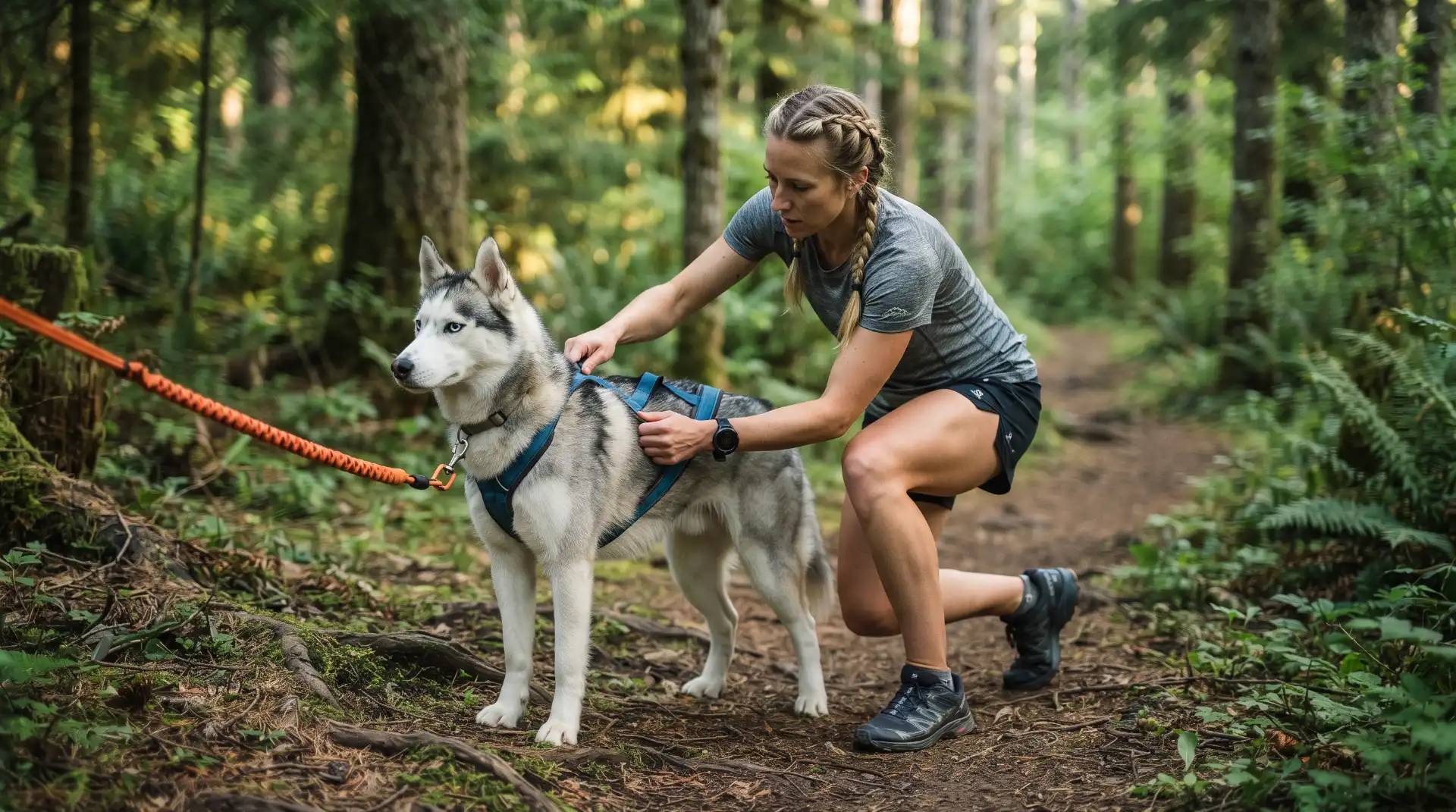
A collar is not an appropriate connection point for canicross pulling. Pressure should instead be distributed through a harness designed for the activity.
The harness needs to fit the individual dog correctly.
Poorly fitting equipment can restrict shoulder movement, create rubbing, shift under load, or place pressure where it should not.
Sled dog handlers may already own several pulling harnesses, but that does not automatically mean every harness works equally well for canicross.
Fit should be evaluated while the dog is actually pulling rather than only while standing.
The line between dog and runner usually incorporates an elastic or shock-absorbing section. This reduces abrupt force when either member of the team changes speed.
The runner typically wears a low-fitting belt designed to distribute pulling force around the hips.
Together, these components create a system that allows the dog to pull naturally while helping the runner maintain control.
Train Commands Without Snow
One of the strongest reasons to include canicross in sled dog training is command practice.
Snow is not necessary for reinforcing trail communication.
A dog can practice directional commands, stopping, starting, passing distractions, maintaining pace, and continuing forward while working on a dirt trail.
Consistency matters.
Handlers should generally use the same verbal cues that dogs encounter during their regular mushing work.
If “gee” indicates right during winter, it should continue to mean right during dryland training. If “haw” indicates left, that meaning should remain consistent.
Repeated practice can strengthen the connection between verbal cues and movement.
Trail intersections are particularly useful training environments when conditions permit. They create natural opportunities to practice directional decisions.
For potential lead dogs, individual canicross sessions can offer concentrated command work that may be more difficult to provide within a large team.
Build Endurance Gradually
A sled dog’s enthusiasm may exceed its current conditioning.
Many working dogs remain eager to run even after a seasonal break. That enthusiasm does not necessarily mean muscles, connective tissues, feet, and cardiovascular conditioning are prepared for a large workload.
Gradual progression provides a more controlled approach.
A warm-season program might begin with walking, easy trotting, and short pulling intervals before progressing toward sustained canicross runs.
Terrain can also be added progressively.
Flat trails generally demand less than steep climbs. Technical trails with roots, rocks, and tight corners require more concentration and physical control.
Instead of increasing distance and difficulty simultaneously, handlers can adjust one variable at a time.
This approach also provides more opportunities to observe the dog’s response.
Watch the Dog, Not Just the Running Pace
Technology can provide useful data, but the dog remains the most valuable source of information.
A GPS watch might show distance, elevation, speed, and elapsed time. Those measurements cannot fully communicate whether a dog is comfortable.
Handlers should pay attention to posture, gait, enthusiasm, responsiveness, breathing, and recovery.
Changes may indicate that the session needs to end.
Excessive panting, weakness, confusion, poor coordination, vomiting, or collapse can be associated with heat-related emergencies and require immediate attention.
Dogs that appear distressed should not be encouraged to continue merely because the planned route is unfinished.
Canicross is training, not a mileage obligation.
Choose Trails Carefully
Trail selection becomes particularly important during warmer months.
Snow-covered winter routes often hide surfaces that become completely different after thawing. Rocks, roots, mud, loose gravel, bicycle traffic, hikers, wildlife, and water crossings may appear.
Shaded natural trails are often attractive for canicross because trees reduce direct sun exposure and softer surfaces may be more comfortable than pavement.
Handlers should still inspect conditions.
Sharp rocks can damage paws. Deep mud can create slipping hazards. Loose gravel may reduce traction. Heavy bicycle use can create collision risks.
Public-trail regulations also vary throughout the United States.
Some parks require shorter leashes, restrict dogs from particular trails, or have seasonal rules. Checking local regulations before training avoids unnecessary conflicts.
Wildlife deserves consideration as well. Deer, rabbits, squirrels, and other animals can trigger a strong chase response.
A sled dog suddenly accelerating toward wildlife can pull a runner off balance.
Practicing commands under gradually increasing distraction can help build more controlled trail behavior.
Protect Sled Dog Paws During Dryland Training
Paws face different challenges during summer and fall than during snow season.
Winter teams often deal with snow accumulation, ice, and extreme cold. Warm-season runners encounter abrasive dirt, sharp stones, dry ground, and potentially hot pavement.
Regular paw checks should become part of the training routine.
Look at pads and the areas between the toes after running. Minor abrasions can become more problematic if a dog repeatedly trains on rough surfaces before the area has recovered.
Surface temperature also matters.
Asphalt and pavement can become much hotter than surrounding air. Natural trails generally reduce this concern, although exposed rock and sand can also become hot in direct sunlight.
Training early in the day can reduce both environmental heat and surface temperature.
Hydration During Canicross Training
Water planning should begin before leaving the kennel or trailhead.
Dogs should have regular access to fresh water, and handlers should carry appropriate supplies when traveling away from reliable water sources.
Do not assume that streams or ponds along a trail provide safe drinking water.
For longer outings, carrying water gives the handler greater control over hydration.
The amount needed varies with conditions, dog size, exercise intensity, and duration.
Warm weather may also require more frequent opportunities to rest.
A shaded break can help handlers evaluate breathing, movement, and general condition before deciding whether to continue.
The objective is to support training without turning a conditioning run into a struggle against environmental conditions.
Canicross Can Strengthen the Human-Dog Partnership
Mushing depends heavily on communication.
The dogs cannot receive detailed instructions at every moment. Mushers depend on learned commands, routine, trust, and the dog’s ability to make appropriate decisions.
Canicross places that partnership under a microscope.
With only one dog attached, every movement becomes noticeable.
The runner feels when the dog accelerates, hesitates, pulls strongly, loses focus, or changes direction.
The dog also receives immediate information from the runner’s movement.
Over time, both participants can become more aware of each other’s pace and behavior.
This makes canicross more than physical conditioning. It can become communication training.
Readers interested in the relationship between mushers and their teams can explore a day in the life of a sled dog team for a broader look at training, care, and working routines.
Using Canicross Alongside Other Dryland Training
Canicross does not need to replace other forms of sled dog conditioning.
It can complement walking, free running where appropriate, cart training, bikejoring, swimming, strength work, and other forms of exercise.
Each method provides different benefits.
Canicross is particularly useful when handlers want direct interaction with one dog.
Cart training more closely resembles team pulling. Bikejoring provides greater speed. Hiking can provide lower-intensity conditioning.
A varied program can reduce monotony while allowing handlers to adjust activity according to weather.
On warmer days, the appropriate choice might even be rest.
Skipping an exercise session because conditions are unsuitable does not undo a conditioning program.
Transitioning From Canicross Back to Snow
As fall temperatures decrease, canicross training can become part of the transition toward winter mushing.
Sessions may gradually become longer as conditions allow. Additional dogs can begin working through other dryland activities, and team training can become more prominent.
The skills reinforced during canicross remain relevant.
Dogs have continued responding to commands.
They have maintained familiarity with harness work.
They have practiced forward movement and trail focus.
They have maintained some level of conditioning.
When snow eventually arrives, the shift back to sled training may therefore feel more familiar than beginning after a completely inactive off-season.
This seasonal adaptability has become increasingly relevant as mushers encounter winters with inconsistent snow. Our article on warmer winters and U.S. sled dog adventures explores some of the broader changes affecting trails and mushing activities.
Can Beginners Try Canicross?
Canicross is not limited to professional mushers or traditional northern breeds.
Many healthy dogs that enjoy running and pulling may participate when their physical condition, equipment, training, and environment are appropriate.
For beginners, the learning curve is often manageable because the basic equipment setup is relatively simple.
The more difficult part is learning to operate as a team.
Dogs need basic obedience and reliable communication. Runners need balance and enough fitness to respond safely when the dog accelerates.
Starting slowly provides time for both partners to learn.
The American Kennel Club’s guide to getting started in canicross provides additional information about equipment, introductory training, and building endurance.
A veterinarian can also evaluate whether a particular dog is physically suited for strenuous running or pulling.
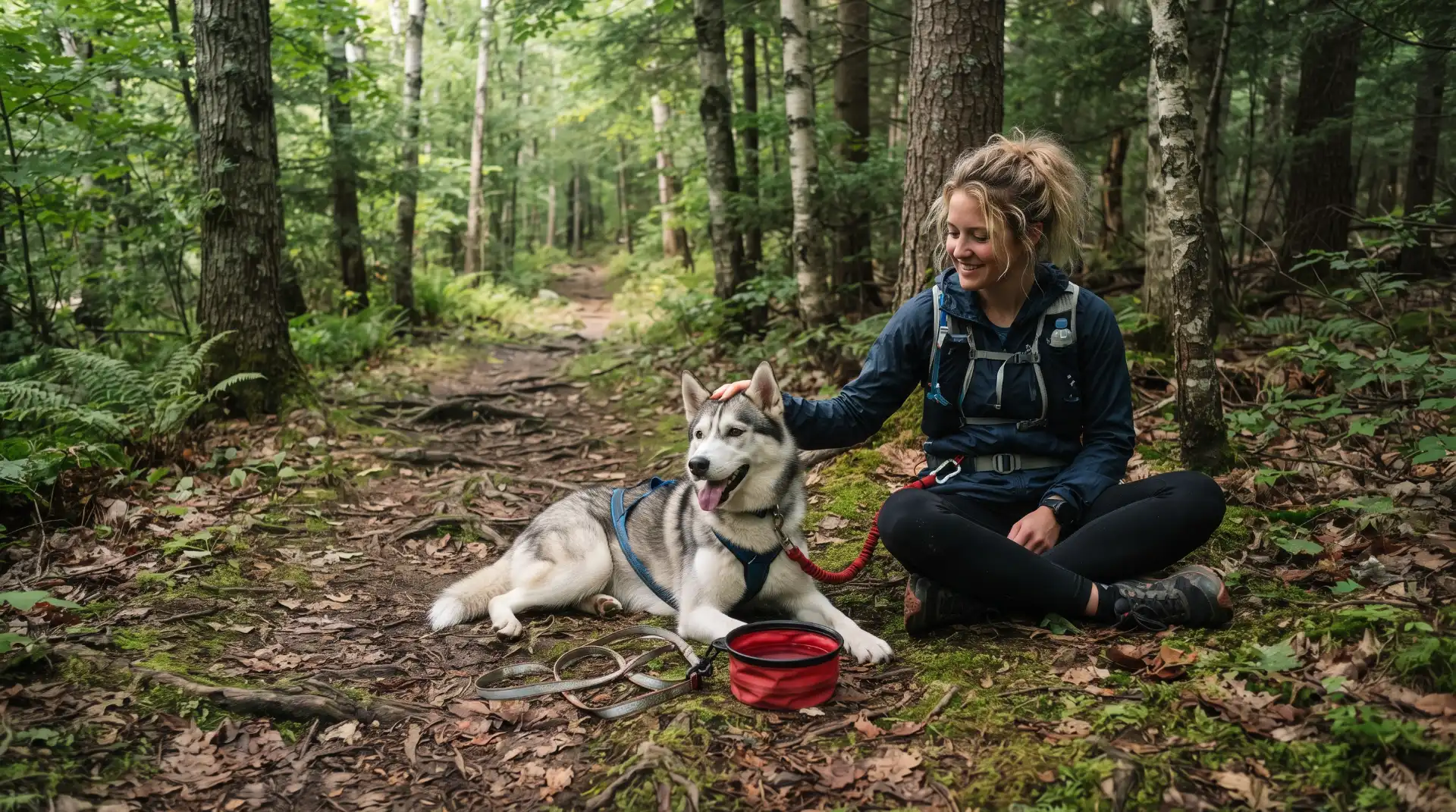
Keep Warm-Weather Training Flexible
The best warm-season training schedule is not necessarily the one with the most miles.
It is the one that adapts.
Temperature may rise unexpectedly. Humidity might increase. A trail might become crowded. A dog may appear tired from a previous session.
Handlers should be prepared to shorten, change, or skip a workout.
That flexibility is part of responsible working-dog management.
Sled dogs are enthusiastic athletes, and many continue trying even when conditions become difficult. The person controlling the training session therefore has an important role in deciding when enough is enough.
Training plans should serve the dog rather than forcing the dog to serve the training plan.
Why Canicross Has a Place in Modern Mushing
Dog sledding has always adapted to its environment.
Mushers have changed sled designs, equipment, feeding strategies, communications, navigation tools, and training methods throughout the history of the sport. You can explore some of those changes in our article about the evolution of mushing and modern training technology.
Canicross represents another useful adaptation.
It allows handlers to work directly with individual dogs when snow is absent. It provides opportunities for command practice, conditioning, confidence building, and communication. It also introduces people outside traditional mushing communities to the experience of working with a dog that loves to run ahead in harness.
The key is respecting the season.
Warmer weather changes what sled dogs can reasonably be asked to do. Temperature, humidity, trail conditions, surfaces, hydration, fitness, and recovery should shape every training decision.
When conditions are suitable, canicross can help bridge the months between winter sledding seasons while preserving the working relationship at the heart of mushing.
A sled may be absent, snow may be months away, and the trail may be green instead of white. The familiar partnership between dog and handler, however, remains very much alive.