Some of the most valuable lessons a young sled dog learns do not come directly from the musher. They come from another dog.
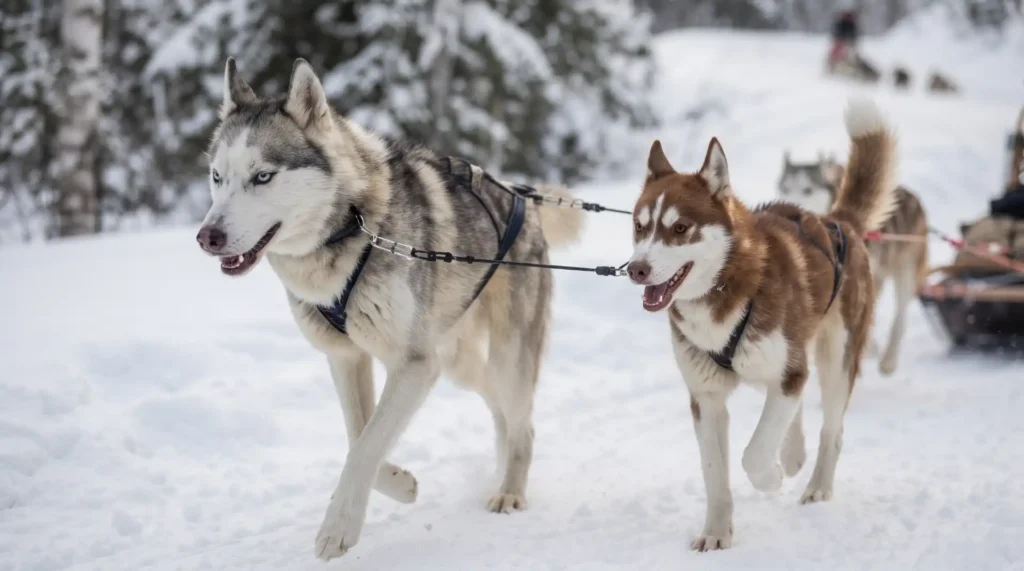
Within an established sled dog team, an experienced leader can become an important example for younger or less experienced teammates. A veteran dog already understands the rhythm of running in harness, the expectations of the trail, the musher’s commands, and the importance of maintaining focus when distractions appear. When a developing dog is paired beside that experienced leader, many of those lessons can become easier to understand.
This approach has been used by mushers for generations because sled dogs are not working independently. They operate as a coordinated team. Each dog responds to the musher, but every dog is also influenced by the behavior, pace, confidence, and movement of the dogs running nearby.
Training beside an experienced leader can therefore help a younger dog become more comfortable at the front of the team without immediately carrying the entire responsibility of leadership.
That does not mean every young dog should become a lead dog. Some dogs ultimately perform better in swing, team, or wheel positions. However, giving promising dogs experience beside a reliable leader can reveal whether they have the confidence, responsiveness, judgment, and enthusiasm required for more responsibility.
Why Experienced Leaders Matter in Sled Dog Training
The lead position is unlike any other position in a sled dog team.
Lead dogs run farthest from the musher. They must respond to verbal directions without physical steering while keeping the gangline stretched forward and guiding the rest of the team along the intended route.
A dependable lead dog may need to turn at an intersection, continue straight past a tempting side trail, slow the team, maintain forward momentum when other dogs hesitate, and remain focused around wildlife, people, vehicles, or other teams.
These responsibilities can be overwhelming for a dog that has never worked at the front.
Pairing that dog with an experienced leader reduces some of the pressure. Instead of being solely responsible for every decision, the younger dog can observe and follow a teammate that already understands the job.
Traditional mushing guidance has long recognized this benefit. Once a lead dog has been trained reliably, younger or inexperienced dogs can often be introduced alongside established dogs and learn team expectations through repeated experience.
For readers interested in the broader responsibilities of lead dogs, Outlaw Ridge Sled Dogs also covers the fundamentals of sled dog training and team development throughout its mushing guides.
What Makes an Experienced Leader Worth Following?
Experience alone does not automatically make a dog a good teacher.
The ideal veteran is steady, responsive, confident, and predictable. A dog that becomes easily distracted or ignores commands may pass those habits to the younger dog instead of providing a useful example.
A strong leader generally knows the team’s normal verbal cues and reacts without excessive hesitation. The dog should also be comfortable maintaining position at the front and willing to continue working when the trail becomes unfamiliar.
Temperament matters as much as technical skill.
A calm dog may help settle a nervous young teammate. A highly motivated but controlled leader can encourage a hesitant dog to keep moving. An experienced dog that behaves appropriately around other teams can demonstrate what is expected during passing situations.
The relationship between the two dogs is also important. Even two individually excellent sled dogs may not work comfortably side by side. Mushers need to observe whether the pairing creates cooperation or unnecessary tension.
Learning Commands Through Repetition and Example
Lead dogs must understand the vocabulary used by their musher. Although command systems vary between kennels, traditional mushing terminology commonly includes cues such as “gee” for right, “haw” for left, and commands for starting, slowing, stopping, or continuing past distractions.
The younger dog still needs to learn what the musher’s voice means. The experienced leader simply helps make the correct response clearer.
Imagine two leaders approaching a trail junction. The musher gives a turn command. The veteran immediately moves toward the correct path. The young dog feels the line shift, watches its partner turn, and follows.
Over repeated sessions, the younger dog begins connecting the spoken cue with the physical action.
Eventually, the musher can evaluate whether the young dog understands the command independently rather than merely following its partner.
This distinction matters. A dog that always turns correctly on one familiar trail may simply know the route. Similarly, a young dog paired with an experienced leader may initially follow the veteran instead of truly understanding the verbal instruction.
For this reason, training should eventually include different intersections and unfamiliar routes. Variety helps determine whether the developing leader is responding to the musher rather than relying entirely on memory or its teammate.
Start With Simple Training Runs
A promising young leader does not need to begin with a long expedition or complicated race trail.
Short, controlled runs can provide better learning opportunities because the musher can focus on specific behaviors without overwhelming the dog.
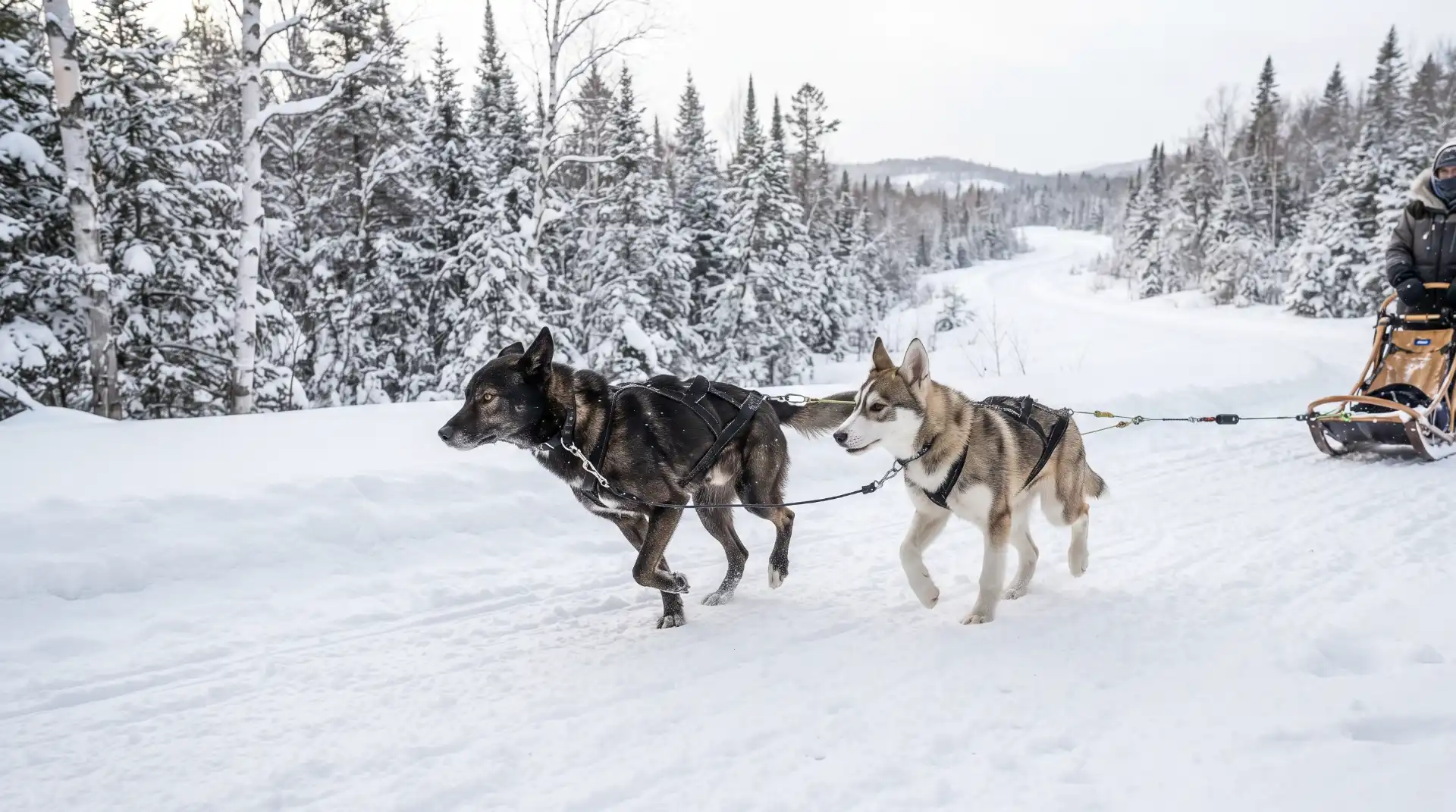
A quiet trail with several simple intersections may be ideal. The experienced leader already knows how to work, while the young dog gains experience with line tension, pace, commands, and team movement.
The first objective is not speed.
Instead, the musher should look for confidence, willingness to move forward, responsiveness, and comfortable interaction between the paired dogs.
A young dog that finishes a shorter session enthusiastic and relaxed may learn more than one pushed through an exhausting run.
Confidence Is One of the Biggest Lessons
Leadership requires confidence.
A sled dog at the front cannot constantly look backward for reassurance. The leader needs to move forward even when the trail changes, the snow becomes deeper, or something unfamiliar appears ahead.
Young dogs sometimes hesitate when first moved into lead because the position feels different from running farther back in the team.
When running in a team position, a dog follows other dogs directly ahead. At lead, there are suddenly no teammates in front showing where to go.
An experienced partner changes that.
The younger dog still has another dog beside it, creating a sense of familiarity while introducing the responsibilities of the front position.
As confidence increases, the younger dog may begin initiating movement rather than simply following the veteran.
Those moments are important. A dog that confidently responds to commands and contributes to decision-making may be developing genuine leadership ability.
Learning to Maintain the Gangline
A good leader helps keep the gangline stretched forward.
This behavior is particularly useful while the musher is preparing the rest of the team. Some mushers teach their leaders a command that asks them to remain forward and maintain tension instead of turning around or walking back toward the sled.
Young dogs may initially struggle with this expectation.
They may turn around to look at the musher, investigate another dog, or wander sideways while waiting.
Running beside a veteran leader provides a physical and behavioral example. If the experienced dog remains facing forward, the younger dog is more likely to settle into the same position.
Over time, maintaining the line becomes part of the routine.
Teaching Young Dogs to Handle Trail Distractions
A perfect leader on an empty trail is only part of the goal.
Real-world mushing includes distractions.
A team may encounter another dog team, cross-country skiers, snowshoers, wildlife, road crossings, parked vehicles, trail equipment, unfamiliar people, or tempting side paths.
Developing dogs need to learn that these things do not automatically mean training stops.
An experienced leader can make an enormous difference in these situations.
If the veteran continues forward calmly when another team approaches, the young dog has a strong example to follow.
The musher can reinforce the desired response with the team’s normal passing command and praise the dogs once they successfully move beyond the distraction.
Training should progress gradually. A young dog should not be intentionally overwhelmed with numerous difficult distractions during its first sessions in lead.
The goal is to build successful repetitions.
Why Passing Other Teams Is an Important Skill
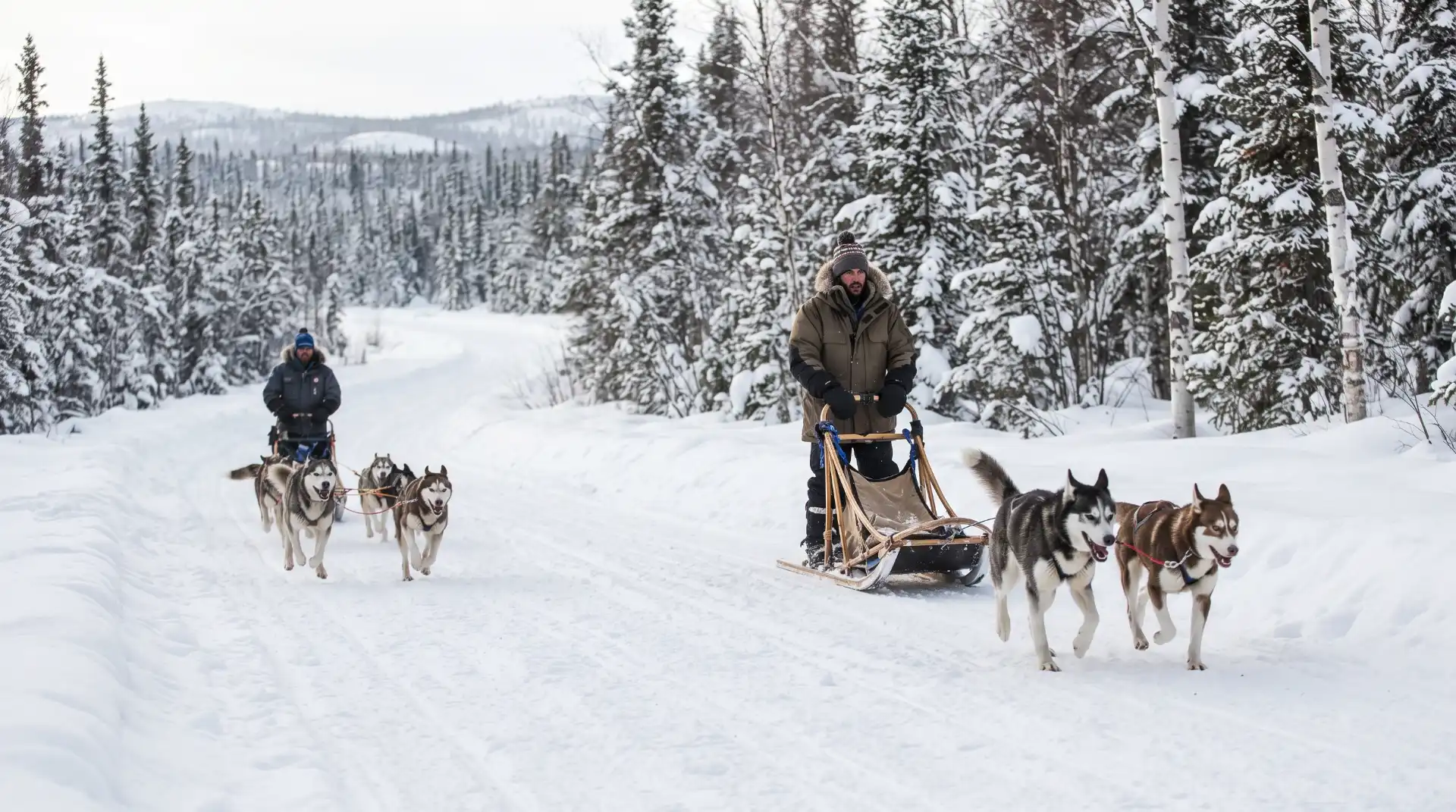
Passing can be challenging because sled dogs naturally notice other dogs.
A team coming from the opposite direction can create excitement. A slower team ahead may tempt dogs to accelerate suddenly. Dogs resting beside a race trail can also pull attention away from the musher.
A seasoned leader already familiar with these situations can help keep the younger dog moving.
The lesson is not that other dogs should be ignored completely. It is that the working team should remain responsive to the musher despite their presence.
This becomes especially important in organized events where several teams may use the same trail.
The United States Federation of Sleddog Sports serves U.S. participants in sled-dog disciplines and provides information about organized dog-powered sport. People interested in competition should always review the specific rules and safety requirements of the event they intend to enter.
An Experienced Leader Can Help Establish Pace
Young sled dogs are often enthusiastic.
That enthusiasm is valuable, but a developing dog may initially want to sprint rather than settle into a sustainable working pace.
A veteran leader can help provide rhythm.
When paired together, the younger dog feels the experienced dog’s stride and pace through the shared line. Rather than repeatedly surging ahead, it begins learning what steady forward movement feels like.
This is especially useful for endurance-oriented teams where efficiency matters more than a brief burst of speed.
Pace should still be controlled by the overall training plan, trail conditions, temperature, distance, and fitness of the dogs.
The older dog is a training partner, not a substitute for responsible workload management.
Pairing Personality Types Carefully
Mushers often discover that choosing a partner for a developing leader is partly about personality.
A timid young dog might benefit from a confident but calm veteran. A highly energetic youngster might work better beside a leader that maintains a steady pace rather than encouraging constant acceleration.
Two extremely competitive dogs may push each other too hard.
Two hesitant dogs may spend too much time waiting for the other to make a decision.
There is no universal combination that works for every team.
Experienced mushers watch the dogs closely and make changes when a pairing is not productive.
This flexibility is part of building a successful team. The best arrangement is the one that allows both dogs to run confidently and safely.
Do Not Expect the Veteran to Do All the Teaching
It can be tempting to assume that placing an inexperienced dog beside an excellent leader will automatically create another excellent leader.
That is not how training works.
The musher still has to communicate consistently, choose appropriate routes, reinforce correct behavior, manage distractions, and recognize when the young dog is confused.
The experienced dog provides an example, but the human trainer remains responsible for the training process.
Commands should be given clearly and consistently. If one word means turn right today, that same word should not be used casually for something unrelated tomorrow.
Timing also matters.
A directional command delivered after the leaders have already passed an intersection creates confusion. The cue should give dogs enough time to recognize and execute the requested action.
Gradually Give the Developing Dog More Responsibility
Once a young dog consistently performs well beside an experienced leader, training can evolve.
The musher might pair the developing dog with a different leader or place it beside another young but capable dog. Eventually, the dog may be tested as the more experienced member of a new pairing.
This progression helps reveal whether the dog has genuinely learned the role.
For example, when the veteran hesitates at an intersection, does the developing dog respond correctly to the musher’s command? When a distraction appears, does it keep moving without depending on its usual partner?
These moments show whether confidence and understanding have become independent skills.
Running a Young Dog in Single Lead
For suitable teams and conditions, a developing leader may eventually be tested alone at the front.
This should happen only after the dog has demonstrated reliable command response and confidence during paired training.
Single lead removes the influence of another dog. The musher can clearly see whether the developing leader understands directions and is comfortable making decisions at the front.
The first sessions should generally be simple.
A familiar trail can reduce pressure while still allowing the dog to experience full leadership responsibility.
As proficiency grows, routes can become more varied.
Not Every Dog Needs to Become a Lead Dog
One of the most important principles in sled dog training is recognizing individual strengths.
A dog may be powerful, enthusiastic, healthy, and dependable without enjoying the responsibility of lead.
That dog can still be enormously valuable elsewhere in the team.
Wheel dogs, positioned closest to the sled, often need strength and composure because they experience unique forces while maneuvering the sled. Team dogs provide much of the pulling power. Swing dogs help guide the team through turns behind the leaders.
Each position contributes to the whole.
A training program should therefore explore a dog’s abilities rather than force every promising athlete toward lead.
Age and Physical Development Still Matter
Young dogs may begin learning commands and routines before they are physically ready for demanding pulling work.
Early training can include walking, socialization, basic obedience, exposure to equipment, and simple verbal cues without placing excessive physical demands on growing bodies.
When structured pulling begins should depend on the individual dog’s maturity, breed, size, health, and veterinary guidance.
Owners should avoid treating a specific age as a universal rule.
The American Kennel Club’s information about mushing and dog-powered sports can provide newcomers with additional background on recreational activities involving dogs in harness.
Use Positive Training Experiences
Sled dogs should associate the harness with enjoyable, purposeful activity.
A young dog that becomes frightened or repeatedly frustrated during lead training may lose enthusiasm for the position.
Short successful exercises are often more productive than prolonged conflict.
When the developing dog makes the correct turn, passes a distraction cleanly, or maintains position beside the veteran, the musher can reinforce that success with praise and an encouraging tone.
Training does not have to be silent or mechanical.
Many teams respond strongly to the musher’s enthusiasm and recognizable voice.
Monitor Fatigue Because It Changes Behavior
A young leader that performs beautifully during the first several miles may become less responsive when tired.
That does not necessarily indicate poor training.
Fatigue can affect concentration, pace, coordination, and decision-making.
Mushers therefore need to separate a genuine training problem from a dog that has simply reached the appropriate limit for that day’s workload.
Gradual conditioning helps extend the distance over which a dog can remain focused.
Readers interested in developing endurance safely can also review The Role of Nutrition in Sled Dog Performance for more information about fueling active sled dogs.
Dryland Training Can Develop Future Leaders Too
Snow is not necessary for every leadership lesson.
During suitable cool weather, dryland mushing can provide opportunities to practice commands, line position, starts, passing behavior, and teamwork.
An experienced leader can be paired beside a developing dog in front of an appropriate wheeled rig or other dog-powered setup.
The same principles apply: controlled progression, appropriate equipment, suitable surfaces, and attention to temperature.
For teams working through inconsistent winters, see Dryland Training for Sled Dogs: How Warmer Winters Are Changing Mushing in 2026.
Keep Training Varied
A dog that always trains on the same route can become exceptionally good at following that particular route.
That is different from becoming an adaptable leader.
Once basic skills are reliable, using varied trails can help confirm that the dog understands commands instead of merely memorizing intersections.
Different routes also introduce new terrain, smells, sounds, and situations.
Training variety should increase gradually so the dog continues to succeed while encountering new challenges.
Experienced Leaders Can Teach More Than Commands
The influence of a seasoned leader extends beyond gee and haw.
A younger dog can learn how to settle before a run, wait in position, start smoothly, maintain a steady pace, ignore unnecessary distractions, keep forward tension, and remain composed when the trail changes.
These behaviors are difficult to explain to a dog verbally.
They make more sense when the younger dog experiences them beside a teammate already performing the job correctly.
This is one reason veteran sled dogs can remain extraordinarily valuable even when they are no longer the fastest athletes in a kennel.
Their experience becomes part of the team’s knowledge.
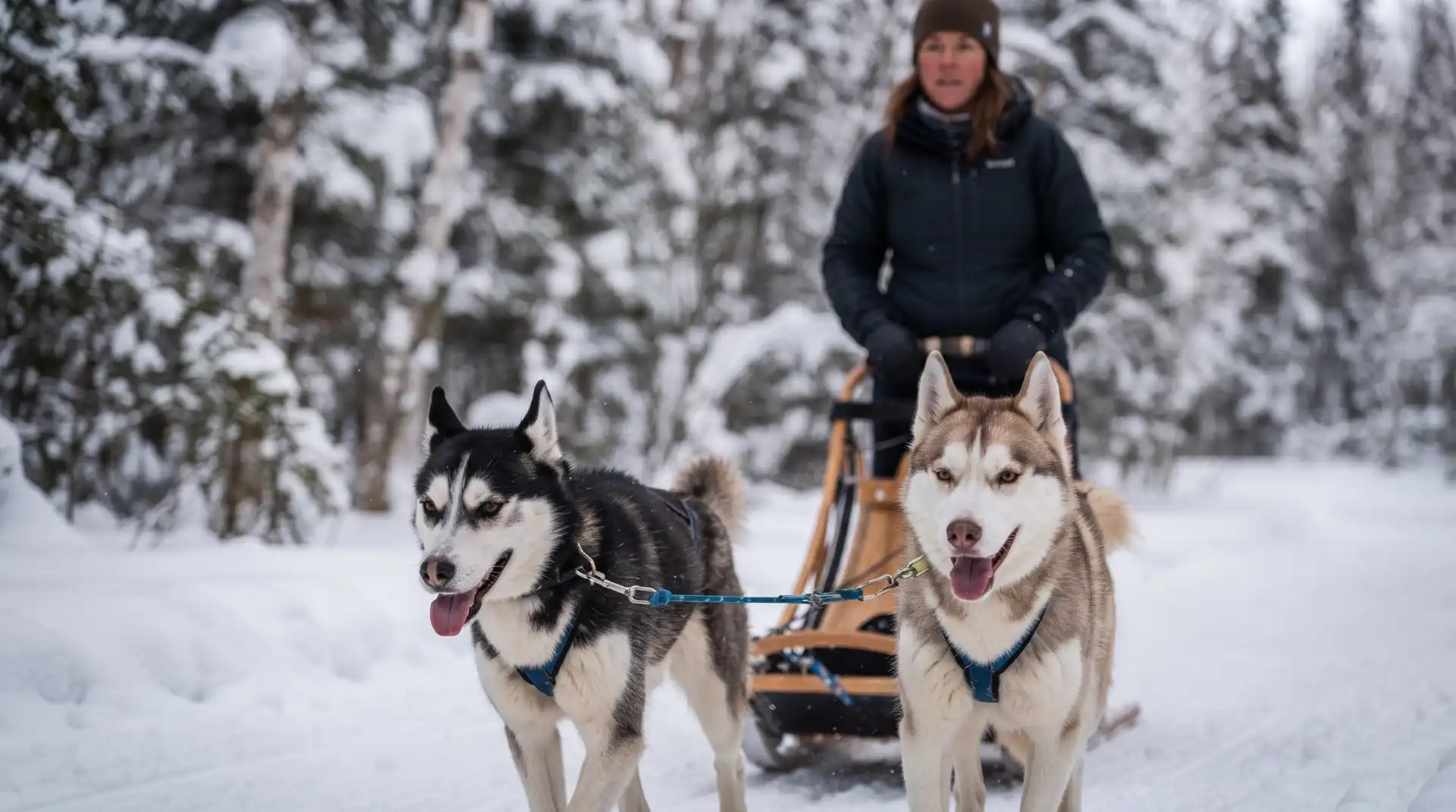
Watch the Relationship Between the Two Dogs
Training decisions should never be based solely on performance numbers.
Observe how the dogs interact before, during, and after runs.
Does the young dog seem comfortable beside the veteran? Does one dog repeatedly crowd the other? Do they settle into a natural rhythm? Does the younger dog become more confident as the run continues?
Small details can reveal whether the pairing is beneficial.
If conflict repeatedly appears, changing partners may produce better results than trying to force the relationship.
Experienced Dogs Are Mentors, Not Machines
Veteran leaders also have limits.
They need appropriate rest, nutrition, veterinary care, recovery, and reasonable workloads.
A dependable older dog should not be asked to train every developing dog simply because it is reliable.
Mushers need to protect the experienced dog’s enthusiasm and physical condition as carefully as they protect the younger dog’s development.
Rotating compatible leaders can distribute the training responsibility across the team.
How Long Does It Take to Develop a Lead Dog?
There is no universal timetable.
Some dogs understand the front position quickly. Others require an entire season or more before they become dependable in unfamiliar situations.
Some may confidently lead on familiar recreational routes but never become the best choice for complicated race conditions.
Experience accumulates through repetition.
Every successful intersection, clean pass, difficult trail section, and unfamiliar route adds to the dog’s understanding.
This is why experienced leaders are so valuable. Their reliability represents hundreds or thousands of decisions made over time.
Leadership Also Depends on Trust
Ultimately, lead-dog training is about communication between the dog and musher.
The musher needs the dog to respond to commands, but the relationship should not become blind obedience.
Working dogs sometimes perceive trail conditions differently because they are physically ahead of the musher. A confident leader may hesitate because footing is uncertain, an obstacle is hidden, or something about the route feels different.
Experienced mushers learn to distinguish distraction from meaningful hesitation.
This type of communication develops through time on the trail.
Pairing a developing dog with an experienced leader gives the younger animal an opportunity to participate in that relationship before being asked to manage every decision alone.
Building the Next Generation of Sled Dog Leaders
Strong sled dog teams are built over years, not individual training sessions.
Experienced leaders eventually age, workloads change, and younger dogs need opportunities to step into greater responsibility. A kennel that never develops new leaders may suddenly find itself without experienced dogs capable of guiding the team.
Training beside an established leader creates a natural bridge between generations.
The veteran continues doing a job it understands while the younger dog gains experience in a supportive position. With repeated exposure, clear commands, appropriate conditioning, and thoughtful progression, the developing dog can gradually take on more responsibility.
Some will become dependable leaders. Others will reveal talents better suited to different positions.
Both outcomes are useful because good mushing is about understanding what each dog contributes.
Final Thoughts on Training Beside an Experienced Leader
Putting a young sled dog beside an experienced leader is one of the most practical ways to introduce the responsibilities of the front position.
The veteran demonstrates pace, focus, line position, directional response, passing behavior, and confidence while giving the developing dog a familiar teammate beside it.
The approach works best when the musher remains actively involved. Pairing alone does not create a leader. Clear commands, varied training routes, gradual progression, appropriate conditioning, positive reinforcement, and close observation are still essential.
Over time, the younger dog should begin doing more than copying its partner. It should start responding independently, maintaining focus when the veteran hesitates, and showing confidence in unfamiliar situations.
That is when the musher begins seeing the transition from student to leader.
Perhaps the most meaningful part of this process is that sled dog knowledge is passed forward through the team itself. An experienced dog that once learned beside an older leader may eventually become the veteran teaching the next generation.
In that way, leadership within a sled dog team is never simply about which dog runs at the front. It is a continuing process of experience, communication, trust, and teamwork passed from one generation of working dogs to the next.