
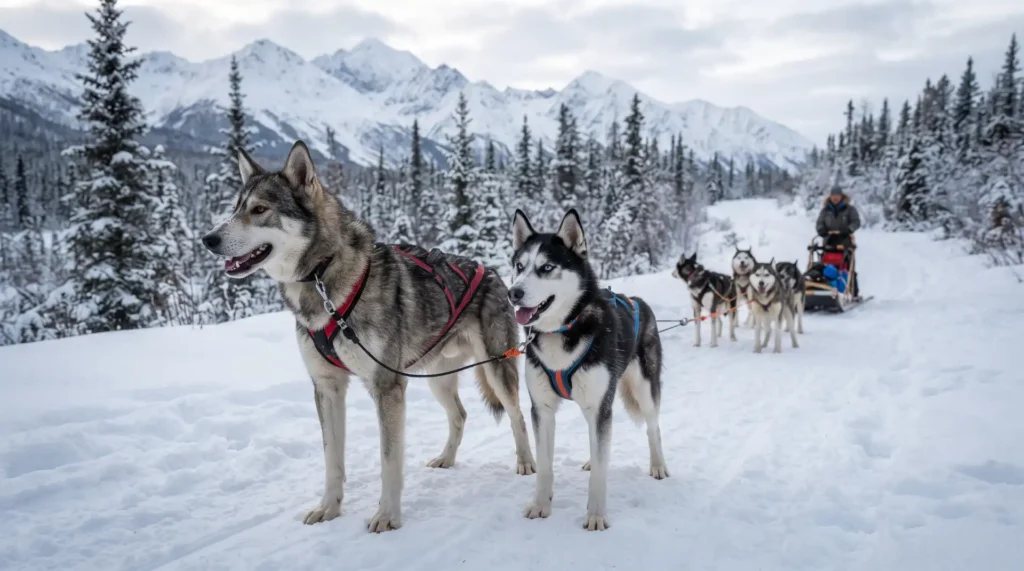
When most people in the United States hear the words “sled dog,” they immediately picture a Siberian Husky. The breed’s thick double coat, pointed ears, curled tail, striking facial markings, and athletic appearance have made it one of the most recognizable dogs in America. Siberian Huskies have become popular family companions as well as working and sporting dogs, and their connection with northern transportation has made them an important part of sled-dog history.
However, the dogs pulling many modern racing sleds may look very different from the classic Siberian Husky. In competitive mushing, Alaskan Huskies are extremely common, and some of them have much leaner bodies, shorter coats, different colors, and less familiar facial features. Someone unfamiliar with modern mushing might wonder whether these dogs are actually Huskies at all.
They are, but the distinction between an Alaskan Husky and a Siberian Husky is more complicated than appearance alone.
The Siberian Husky is a recognized purebred dog with an established breed standard and a documented history extending back to northeastern Asia. The Alaskan Husky, by contrast, is generally considered a performance-oriented sled-dog type rather than a standardized breed. Alaskan Huskies have been selectively bred for generations with an emphasis on traits that help them work effectively on the trail.
That difference has had a major influence on modern sled-dog sports in the United States.
Rather than selecting dogs primarily for a consistent appearance, many Alaskan Husky breeding programs have emphasized speed, endurance, efficient movement, working temperament, recovery, and the ability to cooperate within a team. As a result, there is considerable variation among Alaskan Huskies.
Understanding this distinction can help newcomers appreciate why today’s sled-dog teams do not always resemble the dogs they have seen in movies or television. It also provides a better understanding of how working-dog breeding has evolved as mushing has changed from an essential form of winter transportation into a combination of competitive sport, recreation, cultural tradition, tourism, and wilderness activity.
What Is an Alaskan Husky?
The term Alaskan Husky can be confusing because it does not describe a conventional purebred breed in the same way that Siberian Husky does.
Instead, Alaskan Husky generally refers to a working sled-dog type developed through generations of selective breeding for performance. Breeding practices have varied between kennels and regions, and the dogs can have diverse ancestry. The goal has traditionally been to produce dogs capable of doing a particular job rather than producing animals that all look alike.
This performance-based approach explains why Alaskan Huskies can be difficult to identify simply by appearance.
One may have a coat that resembles a traditional northern breed, while another may have a much shorter coat and a slimmer racing build. Some have blue eyes, some have brown eyes, and some have different-colored eyes. Coat colors can also vary significantly.
Their body structure can vary as well.
Dogs bred primarily for racing may have relatively light, athletic bodies designed for efficient movement. Other working lines may have somewhat different physical characteristics depending on the distances, weather conditions, terrain, and type of mushing for which they were developed.
The lack of a strict appearance standard is actually one of the defining characteristics of the Alaskan Husky.
In modern racing, the question is not necessarily whether a dog looks like the traditional image of a sled dog. The more important questions concern whether the dog can run efficiently, maintain an appropriate pace, work with other dogs, respond to commands, remain mentally engaged, and recover properly after exercise.
The Iditarod Trail Committee’s explanation of Alaskan and Siberian Huskies provides useful background on the distinction between the two types of dogs and their roles in mushing.
What Is a Siberian Husky?
The Siberian Husky has a more clearly defined identity.
The breed originated in northeastern Asia and has a long association with the Chukchi people, who developed dogs capable of transporting relatively light loads across difficult Arctic terrain. These dogs needed to be efficient rather than excessively powerful because long-distance travel required careful management of energy.
That historical purpose continues to influence the modern breed.
The American Kennel Club’s Siberian Husky profile describes the Siberian Husky as a medium-sized working dog known for endurance and its ability to pull relatively light loads over long distances.
Siberian Huskies became particularly well known in North America during the early twentieth century. Their participation in sled-dog transportation and racing helped establish the breed’s reputation in Alaska and beyond.
The 1925 serum relay to Nome is one of the most famous events in American sled-dog history. Teams of sled dogs helped transport diphtheria antitoxin across difficult winter terrain toward Nome during a public-health emergency. Siberian Huskies played an important role in this historic relay, contributing to the breed’s lasting place in American popular culture.
Today, Siberian Huskies continue to participate in mushing, skijoring, dryland sports, recreational sledding, and other activities that make use of their athletic abilities.
They are also common companion animals throughout the United States.
That combination of working heritage and companion-dog popularity has made the Siberian Husky one of the most recognizable northern breeds in the country.
The Biggest Difference: Breed vs. Working Type
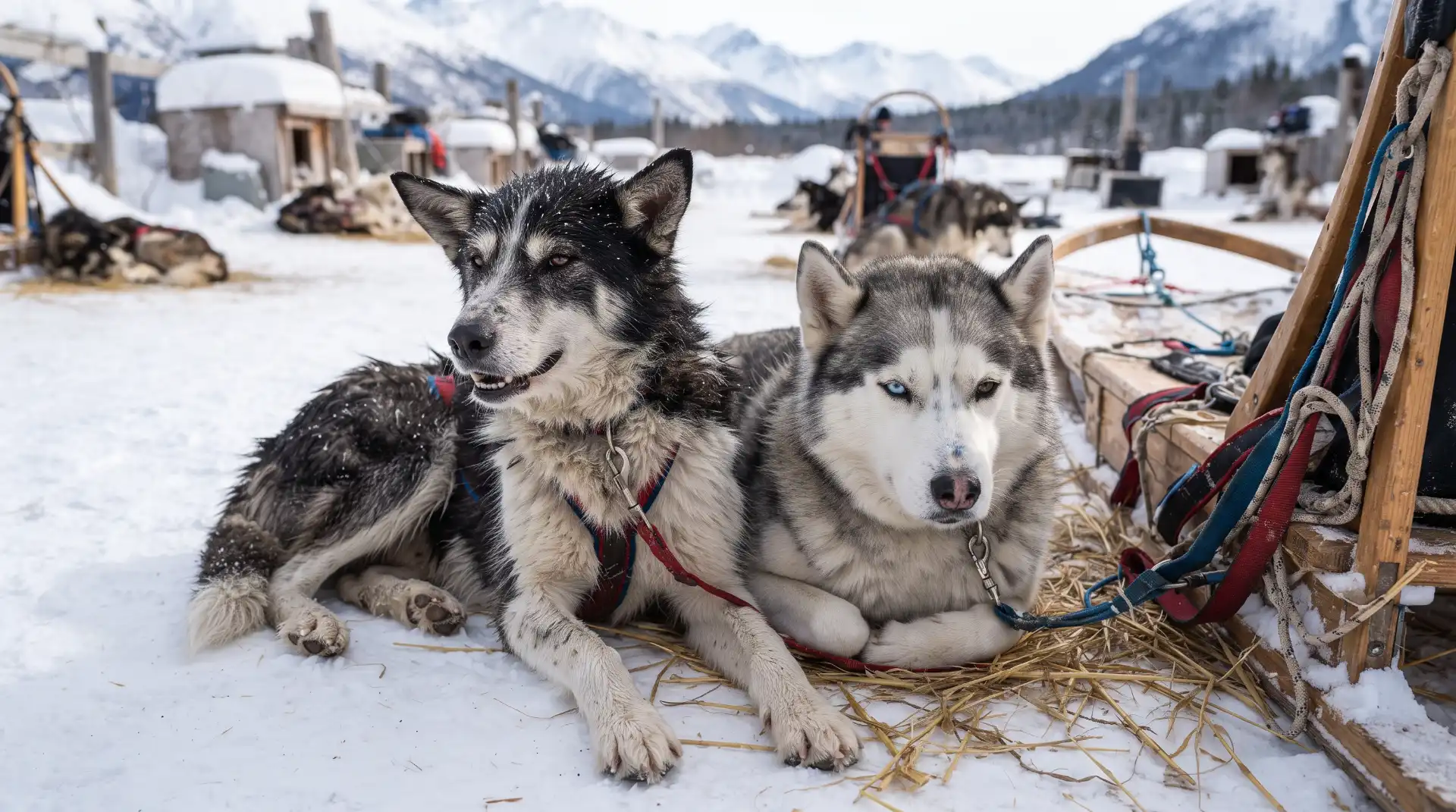
The easiest way to understand the Alaskan Husky versus Siberian Husky comparison is to recognize that they were shaped by different breeding systems.
The Siberian Husky is a standardized breed. Breed organizations establish physical and structural characteristics that define what a Siberian Husky should generally look like.
The Alaskan Husky is a working type. Its defining characteristic is not a particular appearance but its association with sled-dog performance.
This difference has important consequences.
A Siberian Husky generally looks like a Siberian Husky. There can certainly be individual variation, but the breed’s overall appearance remains recognizable.
An Alaskan Husky can look very different from another Alaskan Husky.
Two dogs from different working kennels might have noticeably different coats, body shapes, sizes, and facial characteristics. Yet both can be considered Alaskan Huskies because the term refers primarily to their working heritage and performance-oriented development.
This is why someone visiting a modern mushing kennel for the first time may be surprised by the appearance of the dogs.
The dogs pulling a competitive sled may not look like the Siberian Huskies they have seen at a dog park.
That does not mean they are somehow less connected to the sled-dog tradition. In many cases, their appearance reflects decades of selective breeding focused specifically on modern working requirements.
Appearance and Body Structure
Physical differences are among the most noticeable distinctions between the two.
Siberian Huskies generally have a balanced, medium-sized athletic build. Their bodies are designed for efficient movement rather than extreme bulk. The breed’s proportions, coat, ears, tail, and overall structure contribute to the familiar Siberian Husky appearance.
According to the Siberian Husky Club of America, adult males generally stand around 21 to 23.5 inches at the shoulder and weigh approximately 45 to 60 pounds, while females generally stand around 20 to 22 inches and weigh approximately 35 to 50 pounds.
Alaskan Huskies do not follow those same standardized requirements.
Their body size and proportions can vary depending on their breeding background and intended work. Racing-oriented Alaskan Huskies may have especially lean, efficient bodies because carrying unnecessary weight can increase the energy required to move over long distances.
This illustrates an important principle in working-dog development.
A physical characteristic that is desirable in a show-ring context may not necessarily be the most important characteristic for a long-distance racing dog. In performance breeding, efficiency can take priority over visual uniformity.
That is one reason modern Alaskan Huskies can appear surprisingly different from traditional Siberian Huskies.
Coat and Cold-Weather Adaptation
Both Alaskan Huskies and Siberian Huskies are associated with cold-weather work, but their coats can be noticeably different.
Siberian Huskies have a dense double coat designed for northern conditions. Their undercoat provides insulation, while the outer coat provides protection from the environment.
The breed’s thick coat is one of its most recognizable characteristics.
Alaskan Huskies can have more variable coats because they have not been developed according to a single standardized appearance. Some have relatively thick coats, while others involved in racing may have shorter or somewhat lighter coats.
That does not mean an Alaskan Husky is poorly adapted to cold weather.
Working dogs are managed according to their individual characteristics and environmental conditions. Mushers pay attention to temperature, wind, snow, trail conditions, workload, body condition, and the individual dog’s tolerance.
Cold weather also creates an interesting physiological challenge.
A sled dog working hard in winter is simultaneously exposed to very low temperatures and generating considerable body heat through exercise. Effective management therefore involves more than simply providing a thick coat.
Nutrition, hydration, rest, shelter, conditioning, and careful observation all contribute to keeping a working dog healthy.
Readers interested in the physical side of sled-dog activity can also explore Outlaw Ridge’s article, The Science Behind Why Sled Dogs Love to Run, which provides additional background on the athletic nature of these dogs.
Speed and Endurance
Speed is another major reason Alaskan Huskies have become so prominent in modern racing.
Many Alaskan Huskies have been selectively bred for performance over multiple generations. Depending on the kennel and racing discipline, breeders may emphasize speed, endurance, efficient gait, recovery, and willingness to work.
This does not mean that every Alaskan Husky is automatically faster than every Siberian Husky.
Individual dogs are different.
A dog’s genetics, age, conditioning, health, training, motivation, weather, terrain, and team position can all influence performance.
Siberian Huskies are also capable endurance athletes. Their original development involved transporting people and goods over long distances, and endurance remains a major characteristic of the breed.
The difference is largely one of emphasis.
The Siberian Husky breed standard preserves a particular balance of structure and working ability. Modern Alaskan Husky breeding can be much more directly influenced by the competitive demands of contemporary mushing.
In other words, an Alaskan Husky may have been bred specifically because its parents and grandparents demonstrated particular qualities on a racing team.
Why Alaskan Huskies Became So Important in Modern Mushing
Mushing has changed significantly over time.
In earlier generations, sled dogs were essential transportation animals in many northern communities. They moved people, supplies, mail, equipment, and other necessities through environments where roads and motorized transportation could be unreliable or nonexistent.
Modern mushing is different.
Although sled dogs are still used for practical purposes in certain northern environments, much of the American mushing world now revolves around competitive racing, recreation, tourism, cultural preservation, and wilderness experiences.
Competitive racing places specific demands on dogs.
A team may need to travel considerable distances while maintaining a controlled pace. Dogs must work together, respond to commands, remain focused, and recover between runs.
Those demands have influenced breeding.
Mushers have been able to observe which dogs perform well and selectively breed future generations from successful working lines.
Over time, this created highly specialized Alaskan Husky populations.
The dogs became athletes designed around the practical requirements of modern mushing.
This is one of the reasons the term “Alaskan Husky” is better understood as a working category than simply as another traditional dog breed.
Siberian Huskies and Modern Mushing
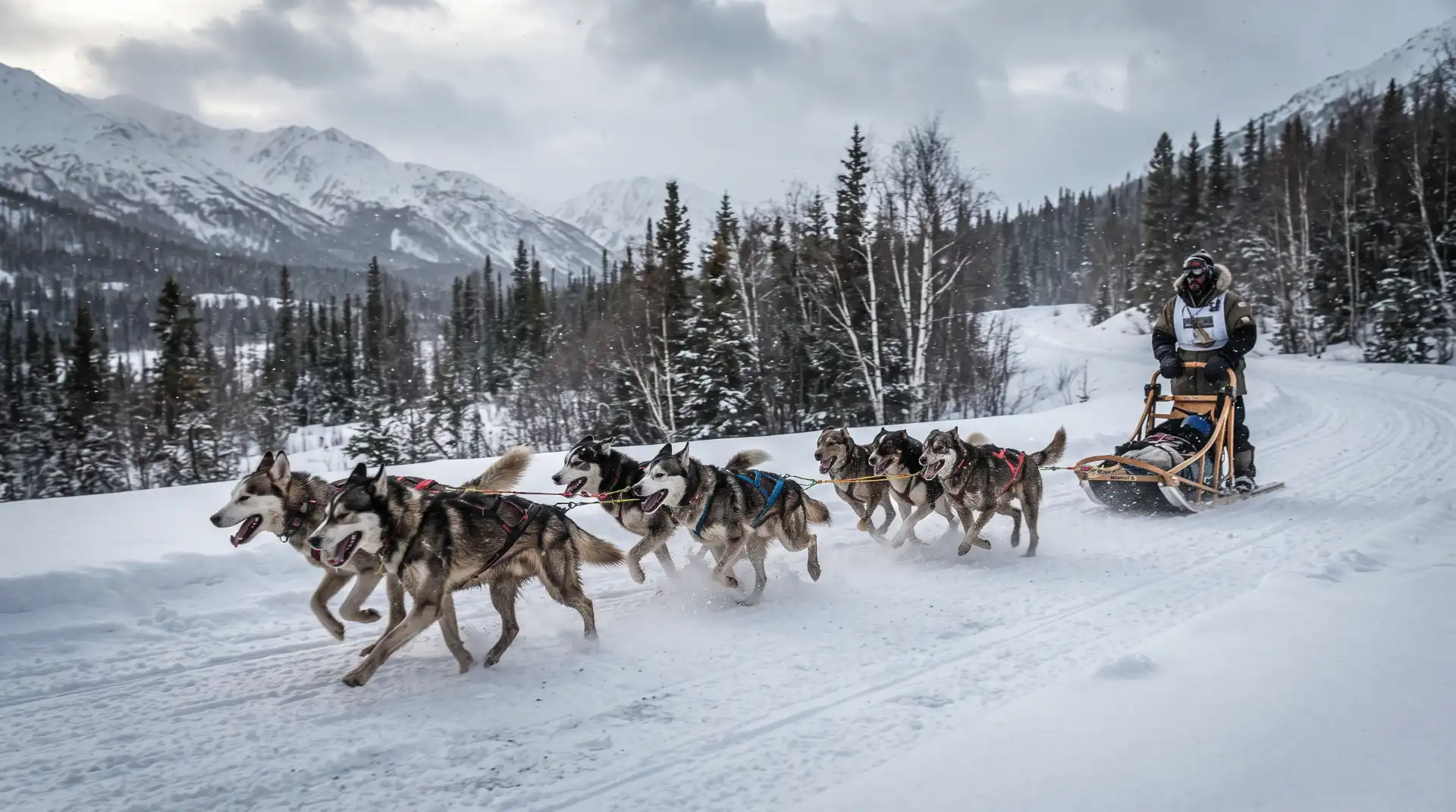
Siberian Huskies remain important in the mushing world despite the prominence of Alaskan Huskies in modern racing.
Their combination of endurance, athleticism, intelligence, and historical connection to sled work makes them well suited to a variety of pulling sports.
Siberians participate in recreational sledding, competitive events, skijoring, bikejoring, and dryland activities.
They are also attractive to people who appreciate the historical appearance and heritage of northern sled dogs.
However, prospective owners should remember that the Siberian Husky’s working background has not disappeared simply because the breed is popular as a companion.
The American Kennel Club’s guidance for prospective Siberian Husky owners emphasizes the breed’s high energy, intelligence, social nature, and strong desire to run.
That desire to run is especially important for American households.
A Siberian Husky that does not receive sufficient exercise and mental stimulation may become difficult to manage. Secure fencing and responsible supervision are particularly important because many Siberians have a strong instinct to explore and run.
Temperament and Teamwork
Physical ability is only one part of becoming a successful sled dog.
Temperament is equally important.
A sled dog works as part of a team, which means it needs to function around other dogs and people. A dog that is physically talented but unable to cooperate may not be suitable for a particular team role.
Siberian Huskies are generally known for their social nature.
Their historical development involved working in groups, and many Siberians enjoy the company of both dogs and humans.
Alaskan Huskies can also be highly social, especially when they are raised in working kennel environments where teamwork is part of daily life.
However, Alaskan Huskies can display greater individual variation because they do not belong to one tightly standardized breed population.
This is an important reason not to judge an individual dog solely by its label.
Every dog has its own personality.
Some are highly energetic and confident. Others may be quieter or more cautious. Some naturally enjoy leading, while others are more comfortable following.
Experienced mushers learn these differences and place dogs where their individual characteristics can contribute to the team’s success.
The Importance of the Lead Dog
Few positions on a sled team are as fascinating as the lead.
The lead dog is responsible for being at the front of the team and helping respond to the musher’s commands. A successful leader needs more than speed.
Intelligence, confidence, responsiveness, focus, and experience can all be important.
A lead dog may encounter situations where the trail is less obvious, visibility is poor, or conditions have changed. The dog needs to understand the musher’s commands and maintain appropriate direction.
This is why simply putting the fastest dog at the front is not necessarily the best strategy.
Leadership is a specialized skill.
Both Siberian Huskies and Alaskan Huskies can develop into capable lead dogs when they possess the appropriate temperament and receive suitable training.
The individual dog’s behavior often matters more than whether it belongs to one category or another.
Training Alaskan Huskies and Siberian Huskies
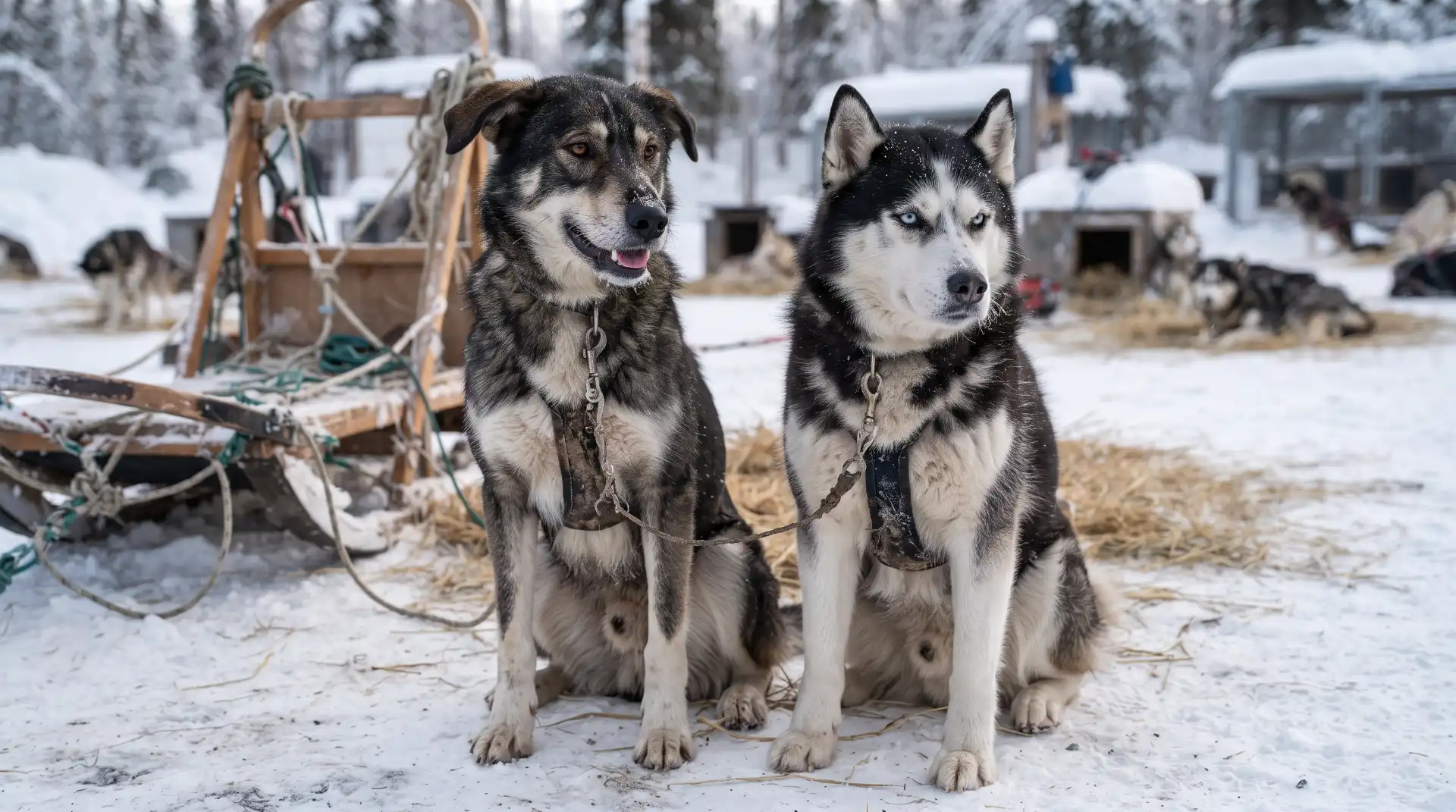
Training a sled dog requires patience and consistency.
Dogs must become comfortable wearing harnesses and working around other dogs. They also need to understand commands associated with starting, stopping, turning, slowing down, and changing direction.
Training does not happen overnight.
Young dogs need to develop physically before being expected to handle demanding workloads. Conditioning should progress gradually so that muscles, joints, cardiovascular fitness, and mental confidence can develop appropriately.
This is especially important when training dogs for longer distances.
A dog that appears enthusiastic during the first few runs may still need significant preparation before it can safely handle extended work.
Modern mushers also have to consider changing weather patterns and inconsistent snow conditions.
For readers interested in how this affects contemporary training, Outlaw Ridge’s article Dryland Training for Sled Dogs: How Warmer Winters Are Changing Mushing in 2026 provides a useful connection between traditional winter training and modern dryland conditioning.
Dryland activities can help maintain fitness when snow is unavailable, but they should be approached with the same attention to gradual conditioning and individual ability.
Nutrition for Working Sled Dogs
Nutrition is another major part of sled-dog management.
A working sled dog can have energy requirements that are dramatically different from those of a household dog that takes short daily walks.
Dogs performing sustained exercise need sufficient energy to support their workload, maintain body condition, recover properly, and remain healthy.
Cold temperatures can also affect energy requirements because the body may expend additional energy maintaining its temperature.
However, feeding a sled dog is not simply a matter of adding more food.
The dog’s workload, body condition, age, health, training schedule, and environmental conditions all need to be considered.
A dog that is training lightly will have different needs from a dog completing demanding endurance work.
Outlaw Ridge’s The Role of Nutrition in Sled Dog Performance is a natural internal link for readers who want to learn more about the relationship between diet, energy, and performance.
The most important principle is individualized care.
Two dogs of the same breed and similar size may require different feeding strategies because their workloads and metabolisms are not identical.
Paw Care and Trail Performance
A sled dog’s paws are among its most important pieces of natural equipment.
Every stride places pressure on the feet, and long-distance travel across snow and ice can create additional challenges.
Frozen surfaces, sharp ice, abrasive snow, hard-packed trails, and changes in terrain can all affect paw health.
Experienced mushers monitor paws closely.
A dog that begins moving differently, licking its feet excessively, slowing unexpectedly, or showing changes in gait may require attention.
Paw protection such as booties may sometimes be useful depending on trail conditions and individual dogs, but equipment should never replace regular observation.
Mushers need to know their dogs well enough to recognize subtle changes.
This is another area where the difference between Alaskan and Siberian Huskies becomes less important than the needs of the individual athlete.
Every dog has its own feet, movement pattern, tolerance, and history.
Are Alaskan Huskies Better Racing Dogs?
Alaskan Huskies are extremely prominent in modern competitive mushing because many have been specifically bred for performance.
That does not mean they are universally “better” dogs.
They have simply been developed around a particular purpose.
If a breeder or musher wants dogs capable of competing in a demanding racing environment, selecting from proven performance lines can be useful.
Siberian Huskies can also participate successfully in racing, but their breeding system places greater emphasis on maintaining a consistent breed type.
This difference becomes especially visible at high levels of competition.
When racing performance is the primary selection criterion, even relatively small advantages in efficiency, speed, endurance, or recovery can influence breeding decisions over multiple generations.
The result is a specialized working population.
That is why the modern racing sled dog may look very different from the Siberian Husky most Americans recognize.
Siberian Huskies as Family Dogs
The Siberian Husky is much more common as a companion dog in the United States.
Their striking appearance and friendly personalities have made them popular with active households.
But their popularity can sometimes cause people to underestimate the responsibilities associated with owning one.
A Siberian Husky is not simply a decorative northern breed.
It is an energetic working dog.
It needs appropriate physical exercise, mental stimulation, social interaction, and secure management. Owners should understand the breed’s tendency to explore and its strong running instinct.
A securely fenced yard is often an important part of responsible ownership.
Training should begin early and continue throughout the dog’s life. Positive reinforcement, consistency, and appropriate exercise can help channel the dog’s energy into productive activities.
Owners who want to provide more challenging activities can explore hiking, skijoring, canicross, bikejoring, obedience, scent work, or other appropriate canine sports.
The key is to match the activity to the dog’s age, health, and conditioning.
Can Alaskan Huskies Be Family Dogs?
The answer depends heavily on the individual dog and its background.
Some Alaskan Huskies can be affectionate, social, and comfortable around people outside a working environment.
However, many Alaskan Huskies are bred primarily for performance and may have very high exercise requirements.
Someone considering an Alaskan Husky as a companion should understand where the dog came from and what its parents were bred to do.
A dog coming from a high-performance racing kennel may have a very different lifestyle expectation from a dog that has been bred for recreational mushing.
Potential owners should never assume that all dogs labeled “Alaskan Husky” have identical personalities.
Because the term covers a working population rather than a tightly standardized breed, variation is expected.
Why Appearance Does Not Tell the Whole Story
One of the most important lessons from comparing these dogs is that appearance can be misleading.
A Siberian Husky with beautiful markings and bright blue eyes may not be an exceptional sled racer.
An Alaskan Husky with an unconventional appearance may be an extraordinary athlete.
Working performance depends on many characteristics that are difficult to see in a photograph.
Efficient movement, cardiovascular fitness, recovery, motivation, teamwork, trainability, and temperament all contribute to a dog’s value on the trail.
This is why experienced mushers often pay attention to things that casual observers overlook.
They watch how dogs move.
They observe how quickly they recover.
They notice which dogs respond to commands.
They watch interactions between teammates.
They learn which dogs enjoy particular positions and which dogs perform better in different conditions.
A sled dog team is therefore much more complicated than a collection of dogs running in harnesses.
It is a coordinated working system.
Genetics and the Modern Sled Dog
Selective breeding has played an enormous role in the development of sled dogs.
Breeders can influence future generations by choosing dogs that demonstrate desirable characteristics.
For Alaskan Huskies, these characteristics may include speed, endurance, efficient movement, working drive, social behavior, and the ability to recover after strenuous exercise.
For Siberian Huskies, selection takes place within a more defined breed framework.
The breed standard preserves a recognizable physical structure while maintaining the working characteristics associated with the breed.
Both approaches demonstrate how closely dogs and humans have worked together throughout history.
People did not simply train dogs that happened to be available.
Over generations, communities selected and bred dogs that could perform specific tasks.
In Arctic environments, those tasks included transportation and survival.
In modern America, the tasks may involve racing, recreation, tourism, wilderness travel, or competitive sports.
The dogs have changed alongside the jobs they perform.
Sled Dogs in the United States Today
Sled dogs remain an important part of American northern culture.
Alaska is naturally at the center of that tradition, but mushing also exists in other parts of the country where winter conditions support the sport.
Sled dogs participate in races, recreational tours, educational programs, expedition travel, skijoring, and other forms of winter activity.
Working sled dogs can also contribute to the preservation of historical traditions.
Denali National Park is one of the best-known examples. The park maintains a kennel of sled dogs that have become an important part of its identity and winter operations.
This demonstrates that sled dogs continue to have practical roles in modern American settings.
They are not merely historical symbols.
At the same time, modern sled-dog care benefits from advances in veterinary medicine, nutrition, conditioning, equipment, and monitoring.
The best modern practices combine traditional knowledge with contemporary understanding of canine health and athletic performance.
The Evolution of Mushing
Modern mushing combines old traditions with new technology.
GPS devices can help mushers monitor routes and location. Weather forecasting can help teams prepare for changing conditions. Improved harness designs can support efficient movement, while advances in veterinary care can help identify and manage health concerns earlier.
Training methods have also evolved.
Mushers can use structured conditioning programs, careful recovery periods, and increasingly sophisticated approaches to monitoring canine athletes.
Yet technology does not replace the relationship between musher and dog.
A GPS device cannot teach a lead dog how to navigate a challenging trail.
A modern harness cannot replace conditioning.
Advanced nutrition cannot compensate for poor training.
The human-animal relationship remains at the center of mushing.
Readers interested in this subject can continue with Outlaw Ridge’s The Evolution of Mushing: Modern Technology and Training Techniques Revolutionizing Dog Sledding.
Responsible Care Matters More Than Breed Labels
Whether a dog is an Alaskan Husky, Siberian Husky, or another working breed, responsible care should always be the priority.
Sled dogs are athletes, but they are also individual animals with individual needs.
They require appropriate veterinary care, nutrition, hydration, shelter, exercise, rest, social interaction, and careful monitoring.
The excitement of watching a sled team race across a snowy trail can make the sport look effortless.
Behind that moment is a significant amount of daily work.
Dogs need to be fed correctly, conditioned gradually, checked for injuries, monitored for changes in behavior, and given adequate recovery time.
The strongest teams are built around healthy dogs.
This principle also connects naturally with Outlaw Ridge’s own approach to sled-dog care and the importance of treating working dogs as members of the family and team.
The dogs are not simply equipment.
They are the heart of the sport.
Alaskan Huskies vs. Siberian Huskies for Recreational Mushing
For people interested in recreational mushing, both types can be fascinating choices.
Siberian Huskies are attractive to enthusiasts who want to experience mushing with a historically recognized sled-dog breed.
Alaskan Huskies may appeal to people interested in performance-oriented working dogs.
However, the right dog for a recreational activity depends on the individual dog, its training, its health, and the activity itself.
A short recreational run is different from a long-distance race.
A family skijoring outing is different from an expedition.
A dryland training session is different from a multi-day winter trip.
The dog should be conditioned for the specific activity rather than expected to perform simply because it belongs to a northern breed.
How Climate Affects Modern Sled Dogs
Climate is becoming an increasingly important consideration for mushing communities throughout the United States.
Traditional snow-based training depends on suitable winter conditions, but warmer or less predictable winters can create challenges for mushers.
When snow is limited, teams may turn to dryland training to maintain fitness.
This can include activities using specialized carts, scooters, bikes, or other equipment designed for appropriate canine conditioning.
However, warmer weather also requires careful management.
Northern breeds can be vulnerable to overheating, particularly during strenuous activity.
Training schedules may need to be adjusted according to temperature, humidity, trail conditions, and the individual dog’s tolerance.
This is another example of how modern mushing requires flexibility.
The traditions remain, but the way teams prepare for those traditions continues to evolve.
What Makes a Successful Sled Dog?
After comparing Alaskan and Siberian Huskies, one point becomes particularly clear: there is no single characteristic that creates a successful sled dog.
A successful working dog is the result of many qualities working together.
Physical fitness matters, but so does mental focus.
Speed matters, but so does endurance.
Strength matters, but efficiency is equally important.
A dog may have exceptional athletic ability but struggle in a team environment.
Another may not be the fastest dog on the team but could be an outstanding leader because it responds extremely well to commands.
A third dog may excel as a dependable team member that maintains a steady pace for long periods.
Every position has value.
That is one of the most fascinating aspects of mushing.
The goal is not simply to find one extraordinary dog.
The goal is to create a team in which individual strengths complement one another.
The Future of Alaskan and Siberian Huskies
Both Alaskan and Siberian Huskies are likely to remain important parts of the sled-dog world.
Siberian Huskies will continue to represent one of the world’s most recognizable traditional sled-dog breeds. Their historical significance, distinctive appearance, and athletic nature will keep them popular among both working-dog enthusiasts and companion-dog owners.
Alaskan Huskies will likely continue to play an important role in performance-oriented mushing.
As racing and training methods evolve, breeders will continue to pay attention to characteristics that help dogs work efficiently and safely.
At the same time, responsible breeding and welfare will remain important.
Modern mushing increasingly recognizes that athletic performance and animal welfare should not be treated as competing goals. Healthy dogs are essential to sustainable working teams.
The future of the sport therefore depends not only on producing fast dogs but also on understanding their physical and behavioral needs.
Alaskan Huskies and Siberian Huskies Share a Remarkable Heritage
Although their modern roles may differ, Alaskan Huskies and Siberian Huskies share a deep connection with human history.
For generations, people in northern environments depended on dogs capable of traveling across snow and ice.
Those dogs provided transportation, carried supplies, and helped communities survive in places where conditions could be extraordinarily difficult.
The Siberian Husky represents one clearly defined branch of that history.
The Alaskan Husky represents a more performance-oriented evolution shaped by generations of working selection.
Both demonstrate what can happen when humans and dogs develop a partnership around a demanding environment.
That partnership continues today.
A modern sled team racing across Alaska may use advanced equipment and benefit from contemporary veterinary knowledge, but the fundamental relationship remains recognizable.
A musher depends on the dogs.
The dogs depend on the musher.
And the team depends on every individual member doing its job.
Final Thoughts on Alaskan Huskies vs. Siberian Huskies
The comparison between Alaskan Huskies and Siberian Huskies is not simply a comparison between two types of dogs that happen to pull sleds.
It is a story about two different approaches to working-dog development.
The Siberian Husky is a recognized purebred breed with a defined standard and a long history connected to Arctic transportation. Its balanced structure, endurance, double coat, and recognizable appearance continue to make it one of America’s most famous sled dogs.
The Alaskan Husky is different.
Rather than being defined primarily by appearance, it has been shaped by generations of performance-oriented breeding. Alaskan Huskies can look dramatically different from one another because their development has focused heavily on what they can do rather than how they should look.
That distinction explains why modern racing teams can contain dogs that look nothing like the stereotypical Siberian Husky.
It also explains why appearances can be deceptive.
A dog’s value on the trail is determined by much more than coat color or eye color. Endurance, movement, recovery, temperament, trainability, teamwork, and health all contribute to working ability.
For people in the United States who are becoming interested in mushing, understanding this difference makes the sport even more fascinating.
The next time you see a sled dog team racing through the snow, look beyond the obvious.
Notice the differences in body structure.
Watch how the dogs work together.
Pay attention to the lead dog.
Consider the conditioning, nutrition, equipment, and care required to prepare the team.
And remember that every dog represents a long history of cooperation between people and working animals.
Whether the dog is a recognizable Siberian Husky or a performance-bred Alaskan Husky, the most important characteristic remains the same: the ability to form a strong partnership with its human team and fellow dogs.
That partnership is what has kept sled dogs relevant from the earliest days of northern transportation to the modern American mushing community.
The dogs may look different from generation to generation, and the equipment may continue to improve, but the heart of mushing remains remarkably unchanged.
It is still about dogs, people, teamwork, endurance, and the trail.