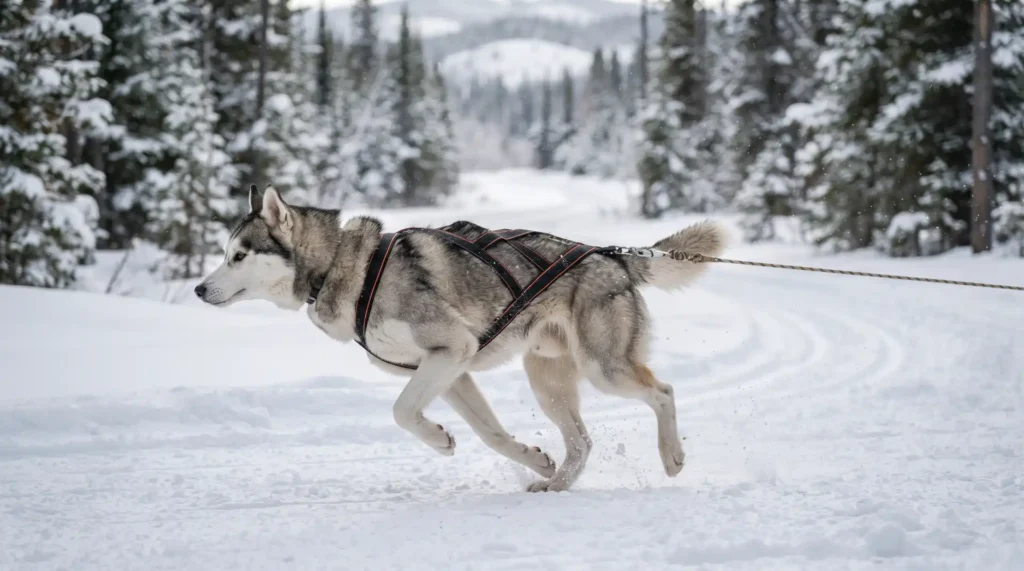
A sled dog team can look almost effortless when everything is working correctly. The dogs move forward together, the gangline stays organized, the sled follows smoothly, and the musher appears to make only small adjustments from behind the team. What is easy to miss is the complex system of force and movement connecting every dog to the sled.
One of the most important parts of that system is tugline tension.
The tugline is more than a simple piece of equipment connecting a dog to the team. It forms part of the mechanical connection through which a sled dog’s effort is transferred into forward movement. As individual dogs accelerate, settle into a pace, climb, turn, slow down, or encounter changing trail resistance, the tension in the lines can change as well.
Understanding this relationship gives mushers another way to think about team performance. Instead of viewing pulling as a simple question of strength, it becomes easier to recognize the importance of coordination, timing, gait, equipment fit, trail conditions, and individual dog behavior.
Modern research is beginning to examine these relationships more closely. Recent biomechanical work involving sled dogs has specifically considered how sustained external load and tugline forces can influence movement and gait. Researchers have noted that pulling a load introduces mechanical demands that are different from those involved in running without an external connection.
For U.S. mushers, this subject has practical value whether the team is preparing for competition, conditioning during the winter, participating in recreational mushing, or using dryland equipment when snow conditions are unreliable.
Tugline tension should never be considered in isolation. It is one part of a larger system involving the dogs, harnesses, gangline, sled, musher, terrain, and training program.
What Is Tugline Tension?
Tugline tension is the pulling force transmitted through the line connecting an individual sled dog to the team’s central gangline. When a dog moves forward against resistance, tension develops in the connection between the dog and the load.
In a traditional sled dog team, each dog wears a pulling harness designed to distribute the load across the body. A short tugline connects the harness to the gangline, while the overall gangline connects the team to the sled.
This arrangement allows individual dogs to contribute to a shared forward-moving system.
The tension is not necessarily constant.
A dog accelerating from a standing start can create a different force pattern from a dog maintaining a steady running pace. Likewise, a team climbing a hill experiences different resistance than the same team traveling over a firm, level trail.
Snow conditions can also make a major difference. Deep or soft snow can increase resistance, while a firm trail may allow the sled and team to move more efficiently. Downhill sections can reduce the resistance the dogs need to overcome, although they introduce their own demands because the musher may need to manage speed and sled control.
This is why experienced mushers pay attention to how a team feels and moves rather than focusing on a single theoretical measurement.
The line itself becomes a visual and physical indicator of team organization.
When dogs maintain forward effort, the tuglines and gangline generally remain organized and stretched. When individual dogs stop pulling, slow down, move sideways, or become distracted, the geometry of the lines can change.
That change can tell an experienced musher something about what is happening within the team.
Force in a Sled Dog Team Is a Teamwide System
It can be tempting to imagine that every sled dog contributes an identical amount of force.
Real teams are more complicated.
Dogs differ in size, body structure, fitness, motivation, experience, running style, and position within the team. Their contributions may change during a run depending on terrain and fatigue.
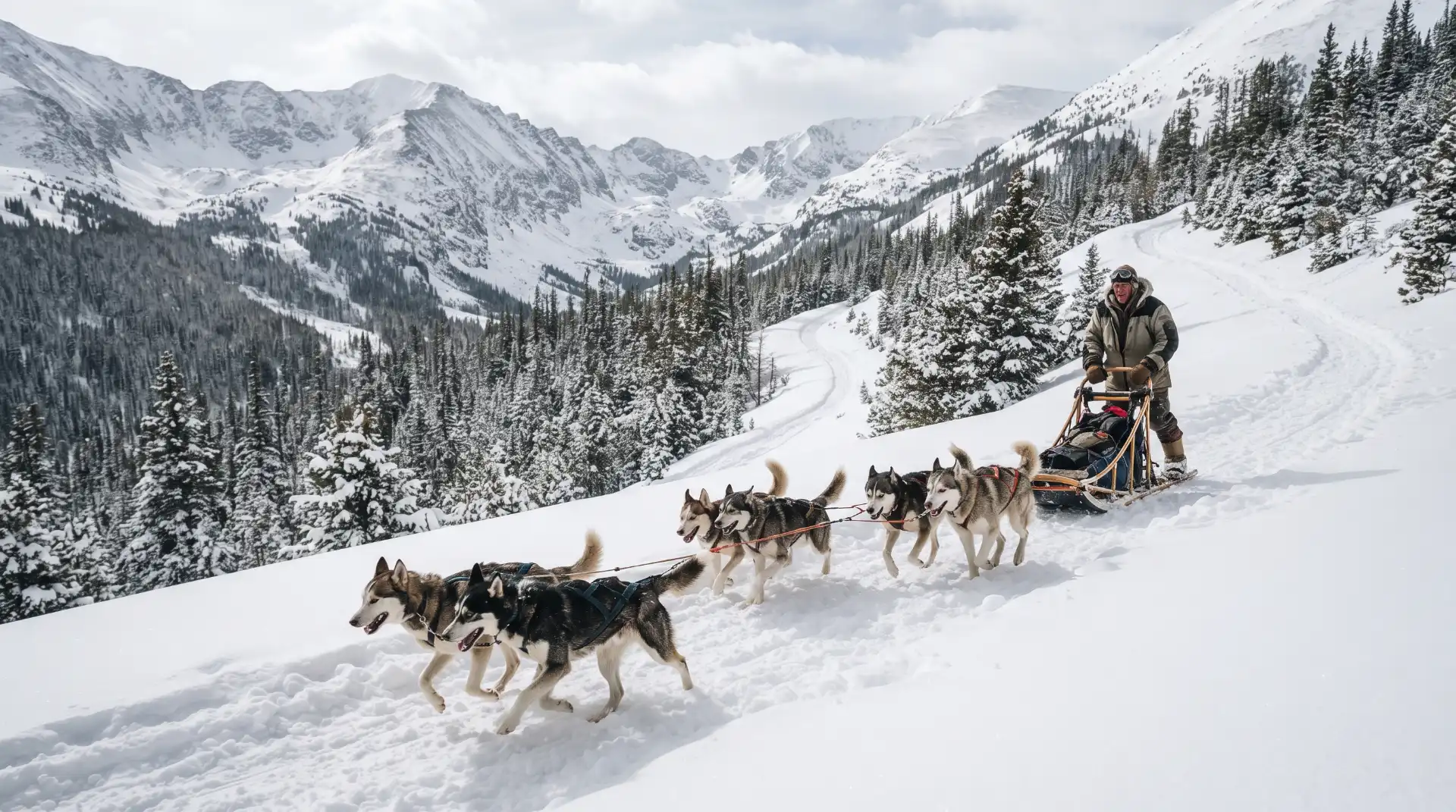
A dog that appears to be the strongest puller may not necessarily be the most valuable contributor in every position. A leader, for example, has responsibilities that extend beyond simply generating force. The lead dog helps respond to commands, maintain direction, establish forward movement, and influence the behavior of dogs farther back in the team.
Similarly, dogs closer to the sled have different mechanical responsibilities from dogs at the front.
The result is a coordinated system rather than a collection of identical pulling units.
This is one reason team organization matters so much. Outlaw Ridge’s discussion of running order explains that mushers consider factors such as strength, speed, endurance, confidence, temperament, experience, and relationships between dogs when deciding where individual dogs should run.
The position of a dog can influence how its abilities contribute to the overall team.
A successful team therefore does not necessarily maximize the pulling power of every individual dog independently. Instead, it creates a combination in which individual abilities complement one another.
How Tension Develops During Acceleration
Starting a sled is one of the clearest examples of changing tugline tension.
When a stationary sled begins moving, the dogs must overcome inertia and the resistance created by the sled, runners, snow, equipment, and any additional load.
The first moments of movement can therefore feel very different from steady travel.
If every dog starts together, the team can create a coordinated surge. If one dog hesitates while another accelerates quickly, tension can change unevenly throughout the system.
This is where timing becomes important.
A dog that suddenly accelerates can momentarily increase tension in its own tugline. If another dog is slow to respond, the line system may briefly become less uniform. Experienced teams learn to start together through consistent commands and repeated practice.
The objective is not simply to produce the hardest possible initial pull.
A controlled start can be more useful than a chaotic burst of power because excessive surging can disrupt the team’s rhythm and make the sled harder to manage.
Research into sled towing has also demonstrated that harness attachment configuration can affect force and movement patterns during pulling. A study indexed by PubMed found measurable differences in kinetic and kinematic variables depending on where a towing harness was attached, illustrating how the connection between an animal and a load can influence movement.
That research was not specifically a study of every modern sled-dog harness configuration, so its findings should not be treated as a universal formula for mushing. It does, however, reinforce an important biomechanical principle: where and how force is transferred can influence movement.
Steady Tension Versus Sudden Surges
Steady forward tension is generally easier for a musher to manage than repeated sudden surges.
Imagine a team traveling along a level winter trail. The dogs are running at a sustainable pace, the gangline is extended, and the sled is following smoothly.
Now imagine that one dog suddenly accelerates after seeing another team farther ahead.
That acceleration can affect the dog’s own line and the movement of the dogs behind it. If several dogs respond at once, the entire team can increase speed.
The musher may welcome acceleration at the right moment, but uncontrolled surging can interfere with pacing.
This distinction becomes particularly important during longer runs. A dog that repeatedly accelerates and slows may expend energy differently from a dog that maintains a consistent working rhythm.
The goal of efficient mushing is therefore not necessarily maximum tension at every moment.
Instead, good team movement usually depends on appropriate force applied at the appropriate time.
That principle applies to many forms of working-dog activity. Strength is valuable, but coordination determines how effectively that strength can be converted into useful movement.
Why a Tight Gangline Does Not Automatically Mean Better Performance
A stretched line is often associated with a productive sled dog team, and maintaining forward line tension is an important training objective.
However, it would be a mistake to assume that the tighter the line, the better the team.
Line tension needs to be interpreted in context.
A team running efficiently at a sustainable pace may maintain a consistent connection without extreme pulling forces. A team climbing a steep hill may produce greater force while traveling much more slowly. A team descending a slope may have lower pulling resistance while still requiring careful control.
Likewise, a dog that pulls excessively hard does not automatically improve the performance of the team.
If that dog repeatedly surges ahead, disrupts pacing, or causes other dogs to accelerate beyond their intended workload, its extra effort may create inefficiency elsewhere.
Good mushing is therefore about balance.
The musher has to consider the relationship between speed, resistance, workload, terrain, temperature, fitness, and team behavior.
How Terrain Changes Tugline Force
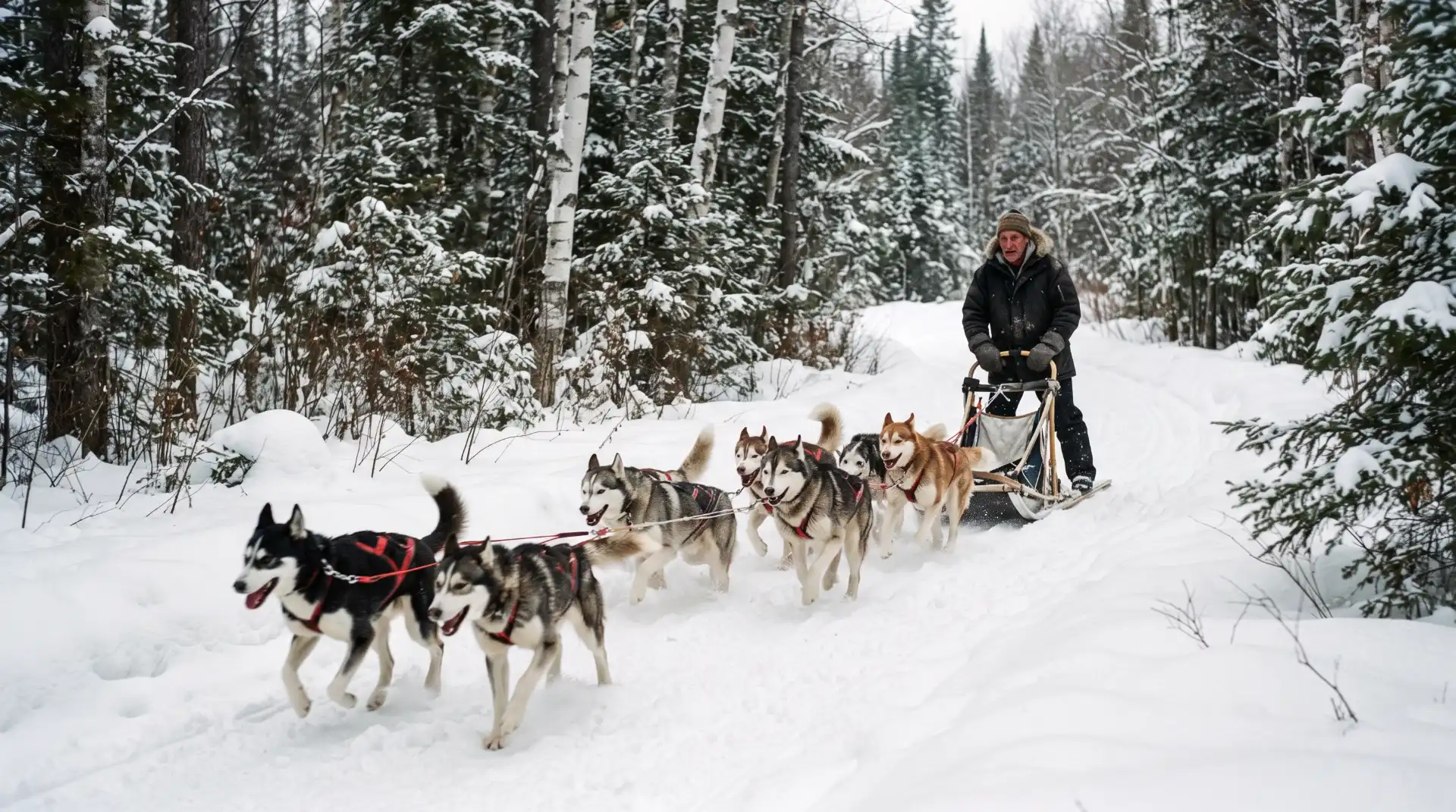
The trail is one of the biggest variables affecting the mechanical demands placed on a sled dog team.
A firm, well-packed trail can allow the runners to glide efficiently. The same sled traveling through soft snow may encounter substantially more resistance.
Climbing introduces another challenge because the team must overcome the component of gravity acting against forward movement.
A hill does not simply make the dogs work harder in an abstract sense. It changes the relationship between force and movement.
The team may need to produce more forward force while maintaining a slower pace.
This is one reason mushers should not judge a dog’s effort solely by speed.
A dog traveling slowly uphill may be working extremely hard. Conversely, a team moving quickly downhill may not be producing the same type of pulling effort, even though the dogs appear to be moving faster.
Terrain also changes how the sled behaves.
On a technical trail, the musher may need to brake, shift weight, or steer around obstacles. The dogs then experience a moving load that is influenced not only by their own forward effort but also by the musher’s actions.
Snow Conditions and the Resistance of the Sled
Snow is not a single surface.
Temperature, moisture, grooming, recent snowfall, wind, ice, and traffic can all change the characteristics of a trail.
Fresh snow can create additional resistance. Hard-packed snow may allow easier movement. Icy conditions can reduce resistance in some situations but introduce handling and traction concerns.
For a sled dog team, these differences can change the amount of effort needed to maintain a particular speed.
This is one reason experienced mushers evaluate trail conditions before deciding how hard or how far a team should work.
A distance that seems modest under one set of conditions may represent a much more demanding workload under another.
The same principle applies to dryland training.
Outlaw Ridge’s article on training during late-snow seasons explains how wheeled rigs, scooters, bikejoring, and canicross can help teams continue developing movement and pulling skills when traditional snow training is not yet possible.
Read Outlaw Ridge’s guide to late-snow sled dog training
The equipment and surface are different from snow mushing, so the mechanical environment is not identical. Nevertheless, the same broad concept applies: the resistance created by the equipment and surface influences how the dog moves and how much force is required.
Harness Fit Determines How Force Is Distributed
Tugline tension cannot be separated from harness design.
A pulling harness is intended to transfer force from the dog’s body into the line while allowing the dog to move naturally.
A poorly fitted harness can interfere with that objective.
If the harness shifts, rubs, restricts movement, or concentrates pressure in an inappropriate area, the dog may change its gait or posture to compensate.
That can alter the way force travels through the body.
Modern sled-dog equipment has developed considerably, and the importance of proper harness design is recognized throughout the mushing community. Outlaw Ridge’s beginner guide also emphasizes the importance of properly fitted pulling harnesses and explains the role of tow lines and shock-absorbing components in sled-dog equipment.
Research into canine harness biomechanics provides another reason to take equipment fit seriously. Studies have found that harness configuration can affect canine movement, although the effects depend on the design and the activity being performed.
Mushers should therefore avoid assuming that one harness design will be equally suitable for every dog.
Individual anatomy matters.
So does the activity.
A harness appropriate for a particular pulling discipline should be evaluated in the context of how the dog actually moves while working.
How Gait and Tugline Tension Are Connected
A dog does not simply generate forward force with its legs and ignore everything else.
Running involves a coordinated sequence of limb movements, trunk motion, balance, and energy transfer.
When a dog pulls against an external load, that load becomes part of the movement system.
Recent research published in the Journal of the Royal Society Interface examined gait transitions in load-pulling quadrupeds, using sled dogs as an important example. The researchers noted that sled dogs sustain high-speed movement while generating forward force through a tugline, creating biomechanical constraints that are different from unloaded running.
This is an important area of research because gait is closely connected to efficiency.
A dog may change gait as speed, load, terrain, or fatigue changes.
For mushers, this means observing movement can provide useful information.
A smooth, coordinated gait may indicate that a dog is working comfortably within the current conditions. Changes in stride, unusual movement, hesitation, or declining coordination can indicate that something deserves attention.
A musher should never diagnose an injury simply by looking at gait, but changes in movement can be a reason to reduce workload and seek appropriate veterinary or professional evaluation.
The Role of the Lead Dogs in Managing Team Movement
Lead dogs are particularly important because they influence how the rest of the team moves.
They respond to the musher’s commands and establish direction and pace at the front.
When the lead dogs maintain forward movement, the rest of the team has a clear physical reference.
Outlaw Ridge’s article on training beside an experienced leader explains how younger dogs can learn to maintain the gangline and develop confidence by working beside experienced teammates. The article also emphasizes that line tension is part of the behavior a developing sled dog learns through repeated team experience.
Learn more about training beside an experienced sled dog leader
This relationship illustrates an important point about tugline tension: it is partly mechanical and partly behavioral.
The line responds to physical forces, but those forces are generated by animals making decisions and responding to training.
A confident lead dog can help establish consistent forward movement. A distracted or hesitant lead dog may cause the team to slow, stop, or become less organized.
The musher must therefore consider both biomechanics and behavior.
Why Individual Dogs Do Not Pull Identically
Every sled dog is an individual.
Even dogs that are similar in size can have very different running styles.
One dog may naturally maintain a steady pace. Another may be more explosive during acceleration. Another may show excellent endurance but prefer a moderate speed.
Experience also matters.
A veteran dog may understand how to settle into a sustainable pace, while a young dog may initially be eager to accelerate whenever the team starts moving.
This is why team building cannot be reduced to simply putting the strongest dogs together.
A musher has to consider compatibility.
The goal is to create a team in which the dogs can work together rather than constantly competing against one another.
This is especially important because force is transmitted through a shared system. When one dog changes speed, position, or direction, its actions can influence the rest of the team.
Tugline Tension and the Different Team Positions
The position of a dog can influence its mechanical and behavioral responsibilities.
Lead dogs guide the team and respond directly to commands.
Swing dogs work behind the leaders and help carry directional changes through the team.
Team dogs provide much of the central pulling effort and contribute to maintaining a consistent working rhythm.
Wheel dogs run closest to the sled and can experience unique demands associated with the movement of the sled itself.
These positions are not interchangeable in terms of responsibility.
Outlaw Ridge’s discussion of experienced leaders notes that dogs do not all need to become lead dogs and that individual strengths can make a dog particularly valuable in another position.
That is an important principle when considering force.
The strongest dog is not automatically the best leader, just as the fastest dog is not automatically the best choice for every team position.
A successful musher looks at the whole system.
How Fatigue Can Change Tugline Behavior
Fatigue changes movement.
As a dog becomes tired, its pace may decrease, its stride may change, and its ability to respond quickly to commands can be affected.
The dog may also become less consistent in maintaining forward line tension.
This is one reason experienced mushers observe their dogs throughout a run rather than evaluating them only at the beginning.
A team that looks excellent during the first few miles may move differently later.
That change is not automatically a sign of poor conditioning. It can simply reflect the physical workload of the session.
However, sudden or unusual changes should never be ignored.
A dog that begins moving abnormally, stops pulling unexpectedly, repeatedly changes gait, appears distressed, or shows other concerning signs should receive appropriate attention.
The musher’s responsibility is not to maximize tension.
It is to manage the workload so that the dogs can perform safely and recover appropriately.
Using Tugline Tension as a Training Observation
Mushers do not need laboratory equipment to learn from line tension.
Visual observation can reveal a surprising amount.
During a training run, a musher can notice whether the team starts together, whether the lines remain organized, whether certain dogs consistently surge, and whether particular dogs lose forward engagement under specific conditions.
These observations can be recorded after training.
Over time, patterns can emerge.
For example, a team might maintain excellent line tension on firm snow but struggle after heavy snowfall. A young dog might perform well at moderate speed but become distracted during acceleration. Another dog might maintain excellent rhythm during long steady runs but struggle on steep climbs.
These observations can help shape future training.
The objective is not to create a rigid numerical target for tension.
Instead, the musher can use the line as one piece of information about how the team is functioning.
Can Technology Measure Sled Dog Force?
Technology is making it increasingly possible to study animal movement in greater detail.
GPS systems can record distance and speed. Wearable devices can provide information about activity and movement. Research environments can use force-measuring equipment and motion analysis to study how animals interact with external loads.
For competitive and research-oriented mushing, this creates exciting possibilities.
A future training system could potentially combine speed, distance, terrain, movement patterns, and force measurements to help mushers understand how a team performs under different conditions.
However, data should not replace observation.
A numerical measurement can tell a musher something about force or speed, but it may not explain why a dog produced that result.
The dog’s behavior, posture, gait, appetite, enthusiasm, recovery, and overall condition still matter.
Technology works best as an additional tool rather than as a replacement for knowledgeable handling.
What Tugline Tension Teaches Us About Efficient Mushing
The deeper lesson behind tugline tension is that efficient mushing is a coordination problem.
A sled dog team must synchronize multiple animals with different strengths, personalities, and movement patterns.
The musher adds another layer by managing commands, sled control, trail conditions, pacing, and safety.
The sled itself becomes part of the mechanical system.
When all of those pieces work together, the team can travel smoothly.
Efficiency does not necessarily mean every dog pulls as hard as possible.
It means the dogs generate useful forward movement without unnecessary wasted effort.
That distinction is important for both racing and recreational mushing.
A team that constantly surges, fights for position, or loses line organization may waste energy even if individual dogs are extremely powerful.
A coordinated team can often use its available energy more effectively.
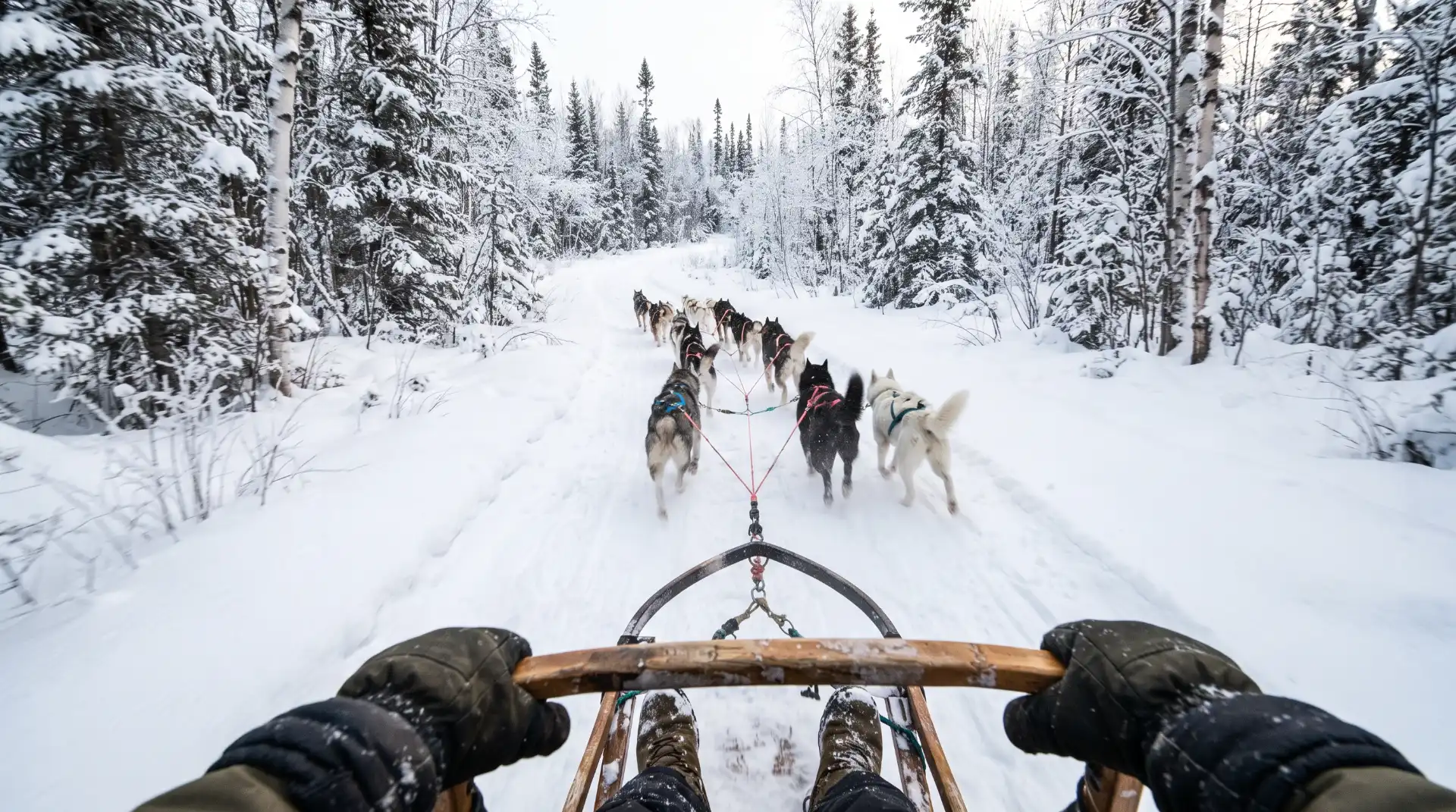
Tugline Tension During Long-Distance Versus Sprint Mushing
The importance of tension also varies depending on the discipline.
Sprint mushing emphasizes speed and rapid acceleration. Teams may encounter intense periods of force production where efficient starts and high-speed coordination are particularly important.
Distance mushing requires a different approach.
The team must maintain useful movement over a much longer period. Energy conservation, pacing, recovery, nutrition, and consistency become increasingly important.
This does not mean distance teams simply pull less.
Instead, they need to manage effort differently.
A dog that spends excessive energy during the first portion of a long run may have less capacity later.
The same principle applies to the overall team.
Successful distance mushing depends on finding a sustainable working rhythm that can be maintained as trail conditions and fatigue change.
How Mushers Can Improve Team Coordination
Improving team coordination starts with fundamentals.
Dogs need to understand the team’s commands and learn that forward movement is a cooperative activity. Training should build gradually, allowing individual dogs to develop confidence without being pushed beyond an appropriate workload.
Consistent starts are particularly useful.
When the team learns to respond to the same starting cue, the musher can reduce chaotic surges and establish a more predictable movement pattern.
Training beside experienced dogs can also help developing dogs learn how a working team behaves.
Outlaw Ridge’s experienced-leader guide describes how younger dogs can learn line maintenance, pace, commands, and distraction management through repeated work beside reliable veterans.
The musher should also pay attention to pairings.
Two dogs that constantly compete may create more instability than two dogs with complementary temperaments.
Good team management is therefore partly science and partly careful observation.
Checking Equipment Before a Run
Because tugline tension transfers force through the equipment, pre-run inspection is important.
The musher should examine harnesses, tuglines, neckline connections, gangline components, snaps, shock-absorbing sections, and sled connections.
Wear can become especially important when equipment is used repeatedly in cold, wet, icy, or abrasive conditions.
A damaged line may fail under load.
A poorly fitted harness may move during running.
A connection that looks acceptable while standing still should still be checked during actual movement.
This is particularly relevant because the forces experienced during acceleration can be different from those experienced while standing.
Equipment inspection should therefore be part of every training and adventure routine rather than an occasional task.
A Practical U.S. Approach to Training With Line Awareness
For U.S. mushers, training conditions can vary dramatically.
Alaska and northern states may provide long periods of snow, while mushers in other regions may have shorter winter windows.
Some teams may transition between snow, packed trails, dryland rigs, scooters, and other training systems throughout the year.
The exact surface and equipment should always be considered when comparing sessions.
A practical approach is to establish consistent observations for each run.
The musher can record the distance, approximate conditions, temperature, trail surface, team composition, general pace, and any notable changes in line behavior.
Over time, those records can help reveal patterns.
For example, if a team consistently loses line tension after a particular distance, the musher may investigate conditioning, pacing, hydration, weather, equipment, or individual dog workload.
If the issue occurs only on a particular trail surface, resistance may be an important variable.
If one dog repeatedly behaves differently from the rest of the team, that individual may need closer observation.
This approach turns training into a process of learning rather than simply accumulating miles.
Tugline Tension and Dog Welfare
The science of pulling should ultimately support the welfare of the dogs.
Performance is important in competitive mushing, but a healthy working relationship requires more than speed.
Dogs should have properly fitted equipment, appropriate conditioning, adequate rest, suitable nutrition, and veterinary care when needed.
Mushers should recognize that dogs cannot explain discomfort in words.
Changes in movement or line behavior can sometimes be early clues that something is different.
A dog that suddenly stops maintaining tension should not automatically be labeled lazy or unmotivated.
There may be a physical, environmental, behavioral, or training-related explanation.
Likewise, a dog that continues pulling enthusiastically is not necessarily incapable of becoming fatigued.
Strong work ethic makes observation more important, not less.
The Future of Sled Dog Biomechanics
Sled dog mushing provides a fascinating environment for studying animal locomotion because the dogs are not simply running.
They are running while connected to a moving external load.
That creates a unique combination of biological and mechanical factors.
Recent research into gait transitions in load-pulling quadrupeds shows how scientists are beginning to examine these relationships in greater detail. Sled dogs are especially valuable subjects because they routinely perform sustained locomotion while generating forward force through a tugline.
Future research may provide better information about how harness design, load, speed, terrain, fatigue, and gait interact.
That knowledge could eventually influence training practices, equipment design, veterinary rehabilitation, and the broader understanding of working-dog biomechanics.
For mushers, the most useful outcome may be a better understanding of how to recognize efficient movement before problems develop.
Final Thoughts: The Line Connects More Than Dogs to a Sled
Tugline tension may appear to be a simple mechanical concept, but it represents something much larger within a sled dog team.
It connects the physical effort of individual dogs to the movement of the entire team.
It reflects acceleration, resistance, terrain, pacing, equipment, gait, behavior, and coordination.
A good musher learns to see the line as part of the team’s communication system.
When the dogs move together, the line helps transfer their combined effort efficiently. When one dog hesitates, accelerates, becomes distracted, or changes its gait, the line can reflect that change.
Understanding this relationship does not mean mushers need to turn every training run into a laboratory experiment.
Instead, it provides a useful framework for observation.
The strongest team is not necessarily the one producing the greatest force at every instant. It is the team that can coordinate its strength, maintain an appropriate pace, respond to the musher, adapt to the trail, and continue working comfortably within the demands of the activity.
That is the real science behind tugline tension.
It is not simply about pulling harder.
It is about how force becomes movement when a group of working dogs learns to move as one.
Frequently Asked Questions About Sled Dog Tugline Tension
What is tugline tension in sled dog mushing?
Tugline tension is the pulling force transmitted through the connection between a sled dog’s harness and the team’s gangline. It changes according to the dog’s movement, the team’s speed, the resistance of the sled, terrain, snow conditions, and other factors.
Should a sled dog always keep the tugline tight?
Maintaining forward line tension is generally an important part of organized team movement, but a constantly tight line should not be treated as an automatic measure of performance. The appropriate amount of effort depends on the terrain, speed, training objective, and condition of the dog.
Does a stronger dog always create better tugline performance?
Not necessarily. A successful sled dog team depends on coordination, pacing, temperament, position, endurance, and responsiveness as well as strength. A very powerful dog may be extremely valuable, but the best team uses individual abilities in complementary ways.
Can tugline tension affect a dog’s gait?
External pulling loads can influence the biomechanics of locomotion. Recent research into load-pulling sled dogs has specifically examined how external force and tugline connection relate to gait and movement.
Why does snow condition matter?
Snow condition changes the resistance experienced by the sled. Fresh, soft, wet, icy, or heavily packed surfaces can produce different movement characteristics, meaning a team may need different levels of effort to maintain a similar pace.
Can dryland training teach dogs about line tension?
Yes. Dryland activities such as wheeled rigs, bikejoring, and canicross can provide opportunities to practice pulling, communication, pacing, and maintaining line organization. However, the equipment and surface differ from snow mushing, so training loads should not be assumed to be identical.
How can a musher tell if a dog is struggling?
Changes in gait, pace, posture, behavior, enthusiasm, or line engagement can all warrant attention. A sudden or persistent change should be taken seriously, and veterinary evaluation may be appropriate if discomfort, injury, or illness is suspected.
Where can I learn more about basic sled dog equipment?
Outlaw Ridge Sled Dogs’ beginner guide covers essential equipment such as sleds, harnesses, tow lines, booties, and snow hooks.
Read the Outlaw Ridge Sled Dog Equipment and Beginner Guide
Where can I find scientific research about sled dog movement?
The peer-reviewed literature includes research examining the biomechanics of dogs pulling loads and the relationship between external load and locomotion. A useful starting point is the PubMed-indexed study on harness attachment and sled towing kinetics and kinematics.
View the PubMed research on harness attachment and sled towing biomechanics
Conclusion
The tugline is one of the simplest-looking components of a sled dog team, yet it sits at the center of a remarkably complex system.
Every change in speed, terrain, resistance, gait, or team behavior can influence the forces moving through the lines. Understanding those forces gives mushers another way to evaluate performance while keeping the focus on coordination, efficiency, safety, and dog welfare.
For modern U.S. mushing, this perspective is particularly valuable. Whether a team is preparing for a race, training on snow, adapting to late winter conditions, or using dryland equipment, the basic relationship remains the same: dogs generate force, equipment transfers that force, and the team converts coordinated effort into forward movement.
The best results come when that process is controlled, efficient, and comfortable for the dogs.
Tugline tension is therefore more than a measurement of pulling power.
It is a window into how effectively an entire sled dog team is working together.